Many businesses receive funding shortly after approval
Built to help businesses explore realistic financing options
Business owners trust EquipFlow to simplify financing decisions
National and specialty lenders across industries
Your fastest route to the right lender — and the equipment your business needs.
Share your equipment type, business info, and location — it takes less than 60 seconds.
We instantly compare national and specialty lenders to find your best funding options.
Review offers, choose your lender, and get approved with fast turnaround times.
You're looking at a freightliner cascadia for sale, and the sticker shows $89,000. What it doesn't show is the hidden $35,000 you'll need before that truck earns its first dollar—between the down payment banks actually require, insurance deposits, DOT authority, ELD hardware, and the cash reserves you need to survive your first 90 days without freight.
Here's what most first-time buyers miss: paying cash feels safe, but you're bleeding 15-20% in opportunity cost while that capital sits in steel instead of generating revenue. Meanwhile, lease-purchase programs advertised by mega-carriers mark up trucks $30,000-$50,000 over fair value, lock you into below-market freight rates, and trap you in balloon buyouts that cost $101,000 more than fair financing.
The math that matters: financing a quality used Cascadia at 8-12% APR and reinvesting your cash in working capital, additional equipment, or high-ROI freight contracts typically generates 40% faster fleet growth than paying cash. Let me walk you through the real numbers so you can make the decision that builds wealth instead of just buying a truck.
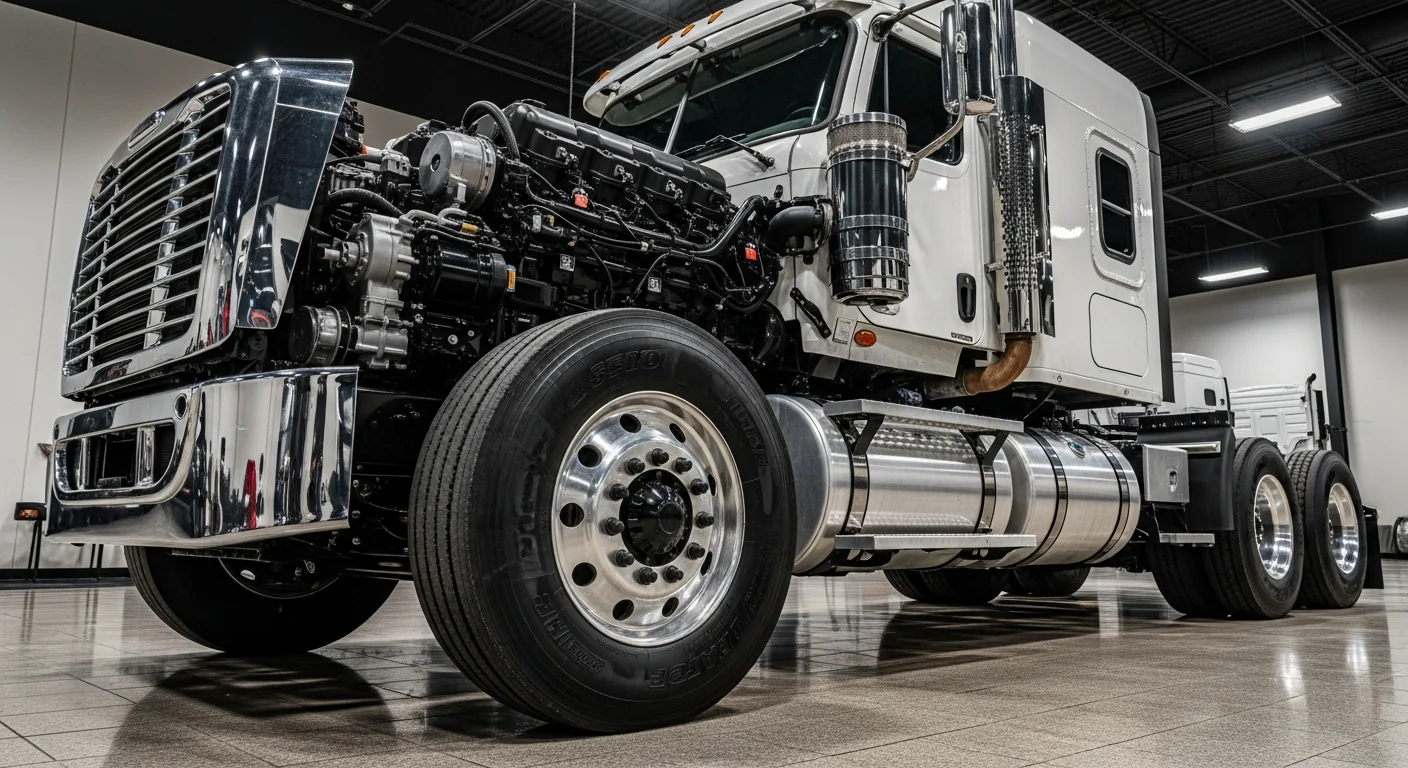
New 2026 Freightliner Cascadia 126 sleeper models range from $181,984 to $208,900 according to dealer pricing from Truck Center Companies, Fyda Freightliner, and Peach State Trucks. But here's the number that kills most buyers' budgets: federal excise tax adds 12% to every new heavy truck purchase. On a $190,000 Cascadia, that's an additional $22,800 in FET, pushing your real cost above $212,000.
Used Cascadias tell a different financial story. 2022-2024 models with under 300,000 miles typically run $85,000-$120,000 with zero federal excise tax—an immediate 12% savings over new. Quality 2019-2021 Cascadias with 300,000-500,000 miles range from $55,000-$85,000, and these trucks still deliver 500,000+ miles of productive life when properly maintained.
The depreciation math is brutal on new trucks: a $190,000 new Cascadia depreciates to roughly $120,000 in 3 years (a $70,000 loss), while a used 2022 at $90,000 drops to about $65,000 over the same period (only $25,000 lost). That's $45,000 in avoided depreciation—enough to buy a second truck or fund 18 months of operating capital.
Let me be direct about interest rates: your personal credit score alone won't get you prime rates on commercial truck financing. Lenders weight your commercial trucking experience equally or more heavily than personal FICO.
A-Tier borrowers (720+ credit with 2+ years OTR experience and existing commercial credit) typically see 6-10% APR. B-Tier buyers (650-719 credit or 1-2 years experience) face 10-14% APR. Startup and first-time buyers—regardless of personal credit—usually land in the 12-18% range because lenders view zero commercial trucking history as high-risk.
SBA 7(a) loans offer an alternative path with current rates of 7.25-9.75% APR according to SBA guidelines. These programs require 650+ credit and a viable business plan, but they'll work with as low as 10% down payment versus the 20-50% conventional lenders demand from first-time buyers.
Down payment reality by buyer profile: Established fleets with 3+ years of commercial credit get away with 10-15% down. Owner-operators with solid payment history need 15-20%. First-time buyers face 20-50% down requirements. On a $90,000 used Cascadia, that's the difference between $18,000 and $45,000 upfront—money that could fund operating capital instead.
The truck price is just the beginning. Here's the complete first-year cost stack most buyers don't budget for:
Insurance runs $12,000-$18,000 annually for new owner-operators—that's $1,000-$1,500 monthly before you turn a wheel. Financed trucks require comprehensive and collision coverage, adding 30-50% over liability-only policies. Established operators with clean records pay $7,000-$12,000 yearly, but new operators get hammered with high-risk pricing.
Compliance costs add another $8,000-$15,000 in startup expenses. DOT number and MC authority cost roughly $600 combined. ELD mandate compliance requires $300-$1,000 in hardware plus $20-$60 monthly service fees. IRP registration ranges from $1,500-$3,000 for the first year. Heavy Vehicle Use Tax (Form 2290) demands $550 annually for trucks over 55,000 lbs GVW—which covers all Class 8 Cascadias.
Cash reserves beyond your down payment and first month's truck payment: budget minimum $15,000-$25,000. This covers insurance deposits, first premium, initial fuel fill-ups, and 60-90 days of operating capital before steady revenue flow establishes. First-time operators who launch undercapitalized are the number one failure profile in trucking—not because they can't drive, but because one $4,000 repair or two weeks without freight collapses their cash flow.
According to IRS Publication 946, the Section 179 deduction limit for 2026 is $2,560,000, which covers the full purchase price of any Cascadia—new or used. This means immediate tax relief regardless of whether you pay cash or finance.
At a 25% tax bracket, Section 179 provides $30,975 in tax savings on a $123,900 Cascadia. At 32%, that's $39,648. At 35%, you're looking at $43,365 in immediate tax relief. The truck must be purchased AND placed in service before December 31, 2026 to claim these 2026 deductions.
Bonus depreciation adds another layer of savings at 20% for 2026, though this rate remains at 100% in 2027 under OBBB under current tax law. Based on EquipFlow's analysis of IRS data, Section 179 creates a 4.8x cash flow advantage over standard depreciation schedules. For a $165,000 Cascadia, Section 179 provides $34,650 in immediate tax savings at 21% corporate rate versus only $7,200 annually under standard depreciation.
Here's why this matters for financing decisions: you get the full Section 179 deduction whether you pay cash or finance. Paying cash depletes working capital that could generate 15-20% ROI elsewhere in your operation. Financing at 8% and reinvesting cash at 15% creates a 7-point spread in your favor—$7,000 annual profit on every $100,000 financed.
For a $90,000 used 2022 Cascadia financed at 10% APR over 60 months with 15% down: your down payment is $13,500, monthly payments hit $1,625, total paid reaches $110,993, and total interest costs $20,993. But you still qualify for full Section 179 deduction on the $90,000 purchase price.
Lease-purchase programs, particularly those from mega-carriers, frequently structure deals with $30,000-$50,000 markups over fair market value. A Cascadia worth $140,000 gets listed at $4,500 monthly for 48 months plus $25,000 buyout—totaling $241,000 for a $140,000 truck. That's a $101,000 premium for the convenience of low down payment.
Cash purchase eliminates interest costs but creates massive opportunity cost. Smart operators don't ask "can I afford to finance?" They ask "can I afford NOT to?" When your working capital generates 15-20% annual returns through additional equipment, better freight contracts, or business expansion, paying cash becomes the expensive option.Compared to rental costs, the math strongly favors ownership for extended use. At $170 daily rental rates ($5,093 monthly), financing at $3,253 monthly breaks even around month 28. Over 5 years, purchasing saves $131,000+ versus continuous rental with zero equity buildup.
Ava analyzes your specific situation—whether you're buying a $90,000 used 2022 model or a $200,000+ new 2026 Cascadia. She needs to know your credit profile, trucking experience, and business structure because these factors determine which lenders will compete for your deal. A 780 personal credit score with zero commercial history gets treated like a startup (12-18% APR), while a 650-score owner-operator with 3 years of truck payments gets A-tier rates (6-10% APR).
Ava connects you with 3-4 lenders who specialize in Class 8 truck financing and understand Freightliner's depreciation curves. This matters because banks reject 67% of truck loans over 7 years old—but specialty commercial lenders work with older equipment at reasonable terms. When lenders compete for the same deal, rates typically drop 0.5-2 percentage points.
See exactly how each offer affects your monthly cash flow. A $90,000 Cascadia financed at 8% for 60 months costs $1,825/month versus $2,050/month at 12% APR—that's $2,700 more per year for the life of the loan. Ava shows you the total cost math so you can pick the deal that maximizes your ROI.
You control the process. No pressure, no obligation, no commitment until you decide which offer works best for your operation. Most contractors get multiple offers within 24-48 hours and close within 5-7 business days.
Ava analyzes your specific situation—whether you're buying a $90,000 used 2022 model or a $200,000+ new 2026 Cascadia. She needs to know your credit profile, trucking experience, and business structure because these factors determine which lenders will compete for your deal. A 780 personal credit score with zero commercial history gets treated like a startup (12-18% APR), while a 650-score owner-operator with 3 years of truck payments gets A-tier rates (6-10% APR).
Ava connects you with 3-4 lenders who specialize in Class 8 truck financing and understand Freightliner's depreciation curves. This matters because banks reject 67% of truck loans over 7 years old—but specialty commercial lenders work with older equipment at reasonable terms. When lenders compete for the same deal, rates typically drop 0.5-2 percentage points.
See exactly how each offer affects your monthly cash flow. A $90,000 Cascadia financed at 8% for 60 months costs $1,825/month versus $2,050/month at 12% APR—that's $2,700 more per year for the life of the loan. Ava shows you the total cost math so you can pick the deal that maximizes your ROI.
You control the process. No pressure, no obligation, no commitment until you decide which offer works best for your operation. Most contractors get multiple offers within 24-48 hours and close within 5-7 business days.
Ava analyzes your specific situation—whether you're buying a $90,000 used 2022 model or a $200,000+ new 2026 Cascadia. She needs to know your credit profile, trucking experience, and business structure because these factors determine which lenders will compete for your deal. A 780 personal credit score with zero commercial history gets treated like a startup (12-18% APR), while a 650-score owner-operator with 3 years of truck payments gets A-tier rates (6-10% APR).
Ava connects you with 3-4 lenders who specialize in Class 8 truck financing and understand Freightliner's depreciation curves. This matters because banks reject 67% of truck loans over 7 years old—but specialty commercial lenders work with older equipment at reasonable terms. When lenders compete for the same deal, rates typically drop 0.5-2 percentage points.
See exactly how each offer affects your monthly cash flow. A $90,000 Cascadia financed at 8% for 60 months costs $1,825/month versus $2,050/month at 12% APR—that's $2,700 more per year for the life of the loan. Ava shows you the total cost math so you can pick the deal that maximizes your ROI.
You control the process. No pressure, no obligation, no commitment until you decide which offer works best for your operation. Most contractors get multiple offers within 24-48 hours and close within 5-7 business days.
When 3-4 lenders compete for the same Cascadia deal, rates typically drop 0.5-2 percentage points versus single-lender shopping. That translates to $150-$400 monthly savings on a typical $90,000 truck loan. Over 60 months, you're looking at $9,000-$24,000 in total interest savings just from competitive bidding.
Most banks reject truck loans over 7 years old, but Ava connects you with specialty lenders who understand Freightliner depreciation curves and work with older equipment at reasonable terms. She also identifies SBA 7(a) opportunities that cut down payments from 25-50% to as low as 10% for qualified buyers.
Every day without your Cascadia is lost revenue. Established operators typically generate $400-$600 daily gross with a Class 8 sleeper. Ava gets you multiple competing offers within 24-48 hours so you can close fast and get back to moving freight instead of waiting weeks for bank committees.
Compare offers with zero commitment until you find the deal that maximizes your ROI. No credit impact for initial matching, no pressure to accept any offer, and complete control over your financing decision.
When 3-4 lenders compete for the same Cascadia deal, rates typically drop 0.5-2 percentage points versus single-lender shopping. That translates to $150-$400 monthly savings on a typical $90,000 truck loan. Over 60 months, you're looking at $9,000-$24,000 in total interest savings just from competitive bidding.
Most banks reject truck loans over 7 years old, but Ava connects you with specialty lenders who understand Freightliner depreciation curves and work with older equipment at reasonable terms. She also identifies SBA 7(a) opportunities that cut down payments from 25-50% to as low as 10% for qualified buyers.
Every day without your Cascadia is lost revenue. Established operators typically generate $400-$600 daily gross with a Class 8 sleeper. Ava gets you multiple competing offers within 24-48 hours so you can close fast and get back to moving freight instead of waiting weeks for bank committees.
Compare offers with zero commitment until you find the deal that maximizes your ROI. No credit impact for initial matching, no pressure to accept any offer, and complete control over your financing decision.
When 3-4 lenders compete for the same Cascadia deal, rates typically drop 0.5-2 percentage points versus single-lender shopping. That translates to $150-$400 monthly savings on a typical $90,000 truck loan. Over 60 months, you're looking at $9,000-$24,000 in total interest savings just from competitive bidding.
Most banks reject truck loans over 7 years old, but Ava connects you with specialty lenders who understand Freightliner depreciation curves and work with older equipment at reasonable terms. She also identifies SBA 7(a) opportunities that cut down payments from 25-50% to as low as 10% for qualified buyers.
Every day without your Cascadia is lost revenue. Established operators typically generate $400-$600 daily gross with a Class 8 sleeper. Ava gets you multiple competing offers within 24-48 hours so you can close fast and get back to moving freight instead of waiting weeks for bank committees.
Compare offers with zero commitment until you find the deal that maximizes your ROI. No credit impact for initial matching, no pressure to accept any offer, and complete control over your financing decision.
When 3-4 lenders compete for the same Cascadia deal, rates typically drop 0.5-2 percentage points versus single-lender shopping. That translates to $150-$400 monthly savings on a typical $90,000 truck loan. Over 60 months, you're looking at $9,000-$24,000 in total interest savings just from competitive bidding.
Most banks reject truck loans over 7 years old, but Ava connects you with specialty lenders who understand Freightliner depreciation curves and work with older equipment at reasonable terms. She also identifies SBA 7(a) opportunities that cut down payments from 25-50% to as low as 10% for qualified buyers.
Every day without your Cascadia is lost revenue. Established operators typically generate $400-$600 daily gross with a Class 8 sleeper. Ava gets you multiple competing offers within 24-48 hours so you can close fast and get back to moving freight instead of waiting weeks for bank committees.
Compare offers with zero commitment until you find the deal that maximizes your ROI. No credit impact for initial matching, no pressure to accept any offer, and complete control over your financing decision.
.png)