Many businesses receive funding shortly after approval
Built to help businesses explore realistic financing options
Business owners trust EquipFlow to simplify financing decisions
National and specialty lenders across industries
Your fastest route to the right lender — and the equipment your business needs.
Share your equipment type, business info, and location — it takes less than 60 seconds.
We instantly compare national and specialty lenders to find your best funding options.
Review offers, choose your lender, and get approved with fast turnaround times.
Mini excavator rental rates jumped 23% in the last 18 months, which means contractors paying Sunbelt's current rate of $2,223 per month for an 11,000-pound class machine are bleeding $26,676 annually with zero equity to show for it. Meanwhile, that same contractor could finance a comparable $50,000 mini excavator at current 0% APR promotions from Bobcat, John Deere, Yanmar, and CASE for just $833 per month—saving $16,680 annually while building ownership equity.
Here's what most contractors miss: the math isn't just about monthly payments. According to IRS Publication 946, the 2026 Section 179 deduction limit of $2,560,000 means you can deduct the full purchase price in year one. On an $18,500 mini excavator, that generates $4,625 in tax savings at the 25% bracket, $5,920 at 32%, or $6,475 at 35%—effectively slashing your net cost by 25-35%. When you combine manufacturer cash rebates with tax benefits, some contractors recover up to 73% of their purchase price in the first year.
The challenge? Most banks reject 67% of equipment loans on machines over 7 years old, and startup contractors get quoted 15-18% APR while established operators with strong credit secure 6.5-9.5% rates on identical equipment. This is exactly why lender competition matters—when 3-4 lenders compete for your deal, rates typically drop 0.5-2 percentage points, potentially saving thousands over the loan term.
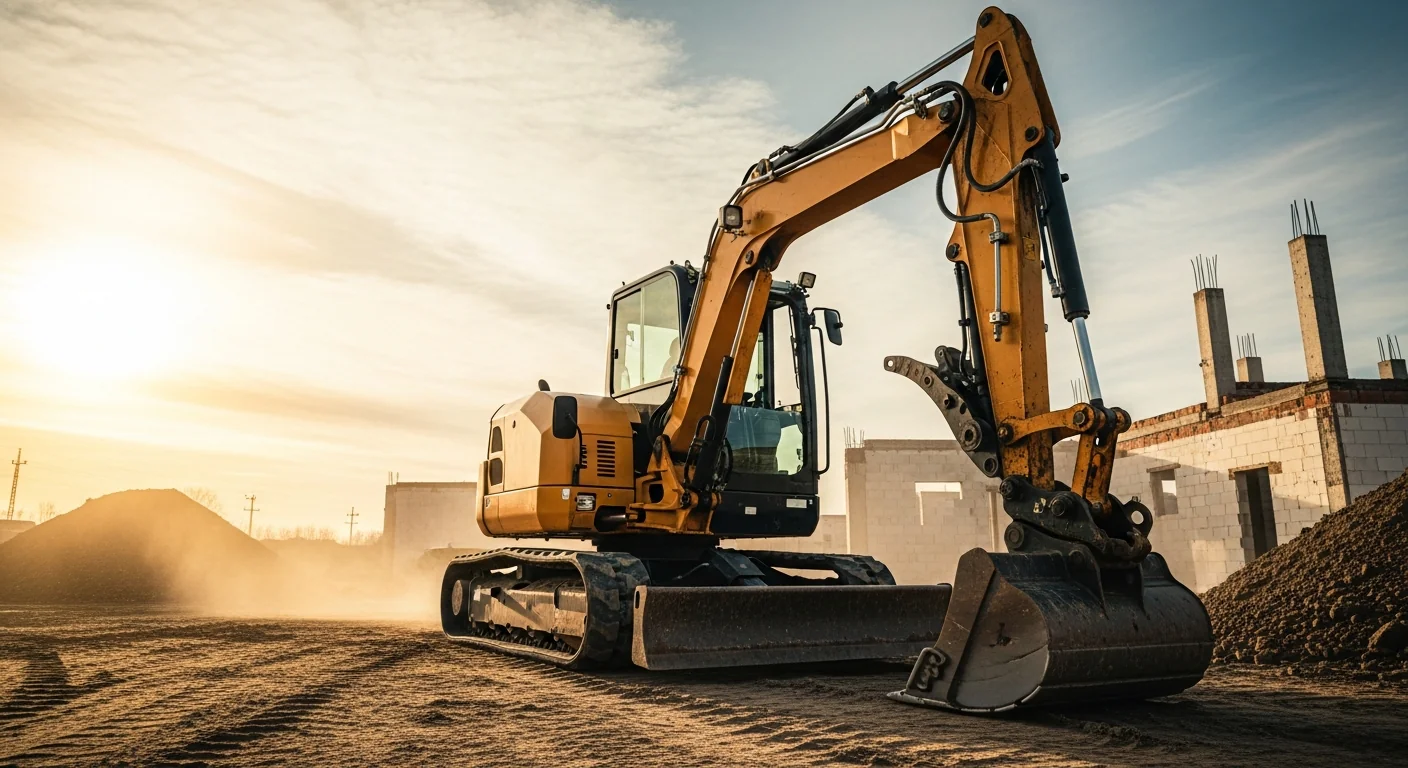
Most equipment dealers quote "starting at" rates that apply to maybe 12% of applicants. Here's what you'll actually pay based on real lender requirements from our network.
Top-tier borrowers with 720+ credit scores, 2+ years in business, and strong revenue typically qualify for the best rates. Ameris Bank, for example, requires a minimum 620 FICO score, $100,000+ annual revenue, and one year in business—but their best rates go to borrowers well above these minimums. At 6.5% APR, a $40,000 mini excavator financed for 60 months costs $783 monthly with zero or minimal down payment required.
Mid-tier borrowers face rates 2-4 percentage points higher and typically need 10-15% down. That same $40,000 excavator at 12% APR costs $890 monthly—$107 more per month or $6,420 additional over the loan term. However, these borrowers still qualify for mainstream lenders and standard terms.
Contractors with challenged credit or limited business history face the steepest rates and often need 20-30% down payments. At 16% APR, monthly payments jump to $983—but here's the critical insight: for startups under one year in business, the SBA Microloan program offers up to $50,000 with no minimum time requirement at rates typically 2-4 points below specialty lenders.
Manufacturer promotions currently available from Bobcat, John Deere, Yanmar, and CASE offer 0% APR financing through early 2026. Based on EquipFlow's analysis combining current rental rates with promotional financing, the numbers are stark:
Rental Cost (Sunbelt Rentals 11,000 lb class): $2,223 monthly, $26,676 annually
Purchase with 0% APR: $50,000 machine = $833 monthly, $9,996 annually
Annual savings by owning: $16,680—plus you build equity instead of enriching the rental company.
Even at standard financing rates, ownership typically beats rental once you exceed 600 hours of annual use. The breakeven threshold: approximately 18-22 months of steady use at 9.5% financing versus rental rates.
Most contractors discover these limitations after wasting a credit pull. Here's what lenders won't finance—and the workarounds:
Tier 1 brands (Caterpillar, Kubota, Bobcat, John Deere, Komatsu) get the best terms: 0-10% down for qualified buyers, access to captive financing programs, and the strongest resale values (55-65% retention at 5 years). Import brands from Chinese manufacturers often require 25-40% down because lenders factor in weak resale values—making the "cheaper" machine actually more expensive upfront.
Most mainstream lenders cap used equipment at 7-10 years from manufacture date and 3,000-5,000 operating hours. A clean-looking 9-year-old excavator with 5,200 hours gets declined automatically, forcing you toward specialty lenders at 14-18% rates or cash purchase. Know these limits before you shop.
Most equipment lenders require $15,000-$25,000 minimum financed amounts. That $12,000 used mini excavator may be too small for conventional financing—making the SBA Microloan program (up to $50,000) a crucial backup option for smaller purchases.
According to IRS Publication 946, businesses can deduct up to $2,560,000 in equipment purchases under Section 179 in 2026—meaning the full purchase price of qualifying mini excavators gets deducted in year one, not depreciated over five years.
Based on EquipFlow's analysis of IRS data, here's what an $18,500 mini excavator saves in actual taxes:
25% tax bracket: $4,625 savings
32% tax bracket: $5,920 savings
35% tax bracket: $6,475 savings
Bonus depreciation adds another 20% first-year deduction in 2026—down from 100% in 2022 and continuing to phase out. This shrinking window makes 2026 potentially the last year for maximum combined tax benefits.
When you combine Section 179 savings with manufacturer cash rebates, some mini excavator purchases create what we call a liquidity multiplier. A contractor buying an $18,500 machine with a $7,000 manufacturer rebate recovers $11,625-$13,475 in the first year between tax savings and rebates—reducing the effective net cost to just $5,025-$6,875. That's a 4.35x to 2.86x return on actual cash invested.
The decision comes down to utilization and cash flow priorities:
Own if: You'll use 600+ hours annually. Rental costs $26,676 yearly versus $14,000 total ownership cost (payments + insurance + maintenance) at 0% APR.
Rent if: Under 200 hours annually or highly variable seasonal use. The flexibility premium justifies higher per-hour costs. You can rent a mini excavator for your project without long-term commitment.
Lease if: 200-600 hours annually. Fair market value leases offer lower monthly payments than financing ($850-$950 vs. $1,002 on a $50K machine) but you don't build equity. Good for businesses prioritizing cash flow over ownership.
Operating leases provide full tax deductibility of monthly payments as business expenses, while financed equipment requires Section 179 or MACRS depreciation—both achieve similar tax benefits through different mechanisms. If you're ready to buy, finance a mini excavator with flexible options that fit your budget.
Instead of calling banks one by one—and potentially damaging your credit with multiple pulls—EquipFlow's AI advisor Ava matches you with mini excavator lenders who compete for your business.
Ava analyzes your specific needs: equipment type, purchase price, credit profile, time in business, and cash flow requirements. This isn't a generic application—she's diagnosing which lenders will actually approve your deal and at what terms. For example, if you're eyeing a 9-year-old Kubota with 4,800 hours, Ava knows which lenders in our network specialize in older equipment versus those who'll decline automatically.
Here's where the magic happens: instead of you chasing lenders, they compete for your business. Ava connects you with specialized equipment lenders who understand mini excavator depreciation curves, seasonal cash flow in construction, and the specific financing challenges of your equipment class. When lenders know they're competing, rates drop 0.5-2 percentage points on average.
You'll see exactly how each offer affects your cash flow: monthly payments, down payment requirements, total interest cost, and any hidden fees. A $40,000 mini excavator at 6.5% for 60 months costs $783 monthly versus $838 at 9.5%—that's $3,300 in additional interest over the loan term.
You control the decision. No pressure, no obligation, no surprises. Once you select your preferred offer, the lender handles the closing process while you focus on running your business.
Instead of calling banks one by one—and potentially damaging your credit with multiple pulls—EquipFlow's AI advisor Ava matches you with mini excavator lenders who compete for your business.
Ava analyzes your specific needs: equipment type, purchase price, credit profile, time in business, and cash flow requirements. This isn't a generic application—she's diagnosing which lenders will actually approve your deal and at what terms. For example, if you're eyeing a 9-year-old Kubota with 4,800 hours, Ava knows which lenders in our network specialize in older equipment versus those who'll decline automatically.
Here's where the magic happens: instead of you chasing lenders, they compete for your business. Ava connects you with specialized equipment lenders who understand mini excavator depreciation curves, seasonal cash flow in construction, and the specific financing challenges of your equipment class. When lenders know they're competing, rates drop 0.5-2 percentage points on average.
You'll see exactly how each offer affects your cash flow: monthly payments, down payment requirements, total interest cost, and any hidden fees. A $40,000 mini excavator at 6.5% for 60 months costs $783 monthly versus $838 at 9.5%—that's $3,300 in additional interest over the loan term.
You control the decision. No pressure, no obligation, no surprises. Once you select your preferred offer, the lender handles the closing process while you focus on running your business.
Instead of calling banks one by one—and potentially damaging your credit with multiple pulls—EquipFlow's AI advisor Ava matches you with mini excavator lenders who compete for your business.
Ava analyzes your specific needs: equipment type, purchase price, credit profile, time in business, and cash flow requirements. This isn't a generic application—she's diagnosing which lenders will actually approve your deal and at what terms. For example, if you're eyeing a 9-year-old Kubota with 4,800 hours, Ava knows which lenders in our network specialize in older equipment versus those who'll decline automatically.
Here's where the magic happens: instead of you chasing lenders, they compete for your business. Ava connects you with specialized equipment lenders who understand mini excavator depreciation curves, seasonal cash flow in construction, and the specific financing challenges of your equipment class. When lenders know they're competing, rates drop 0.5-2 percentage points on average.
You'll see exactly how each offer affects your cash flow: monthly payments, down payment requirements, total interest cost, and any hidden fees. A $40,000 mini excavator at 6.5% for 60 months costs $783 monthly versus $838 at 9.5%—that's $3,300 in additional interest over the loan term.
You control the decision. No pressure, no obligation, no surprises. Once you select your preferred offer, the lender handles the closing process while you focus on running your business.
EquipFlow specializes in one thing: matching equipment buyers with lenders who compete for their business. Here's why this approach saves money and time:
When lenders know they're competing for the same deal, rates typically drop 0.5-2 percentage points. Our contractors report average savings of 1.2% compared to their first quote—which translates to $2,400-$4,800 in interest savings on a typical $50,000 mini excavator loan. Single-lender shopping leaves money on the table.
Ava, our AI matching advisor, understands the specific challenges of mini excavator financing: which lenders accept older equipment, who specializes in startup contractors, and how different brands affect approval odds. She's analyzed thousands of equipment deals and knows, for instance, that Bank A declines anything over 7 years old while Bank B finances up to 10 years at competitive rates.
Every day without equipment costs money. A contractor earning $300-500 daily with a mini excavator can't afford weeks of back-and-forth with banks. Ava delivers 3-4 competing offers within 24-48 hours, letting you make informed decisions quickly while job opportunities are still available.
You see multiple offers with no commitment required. Compare terms, rates, and down payment requirements without pressure tactics from dealers or lenders who've already invested time in your application. Choose the best deal—or walk away if none meet your needs.
EquipFlow specializes in one thing: matching equipment buyers with lenders who compete for their business. Here's why this approach saves money and time:
When lenders know they're competing for the same deal, rates typically drop 0.5-2 percentage points. Our contractors report average savings of 1.2% compared to their first quote—which translates to $2,400-$4,800 in interest savings on a typical $50,000 mini excavator loan. Single-lender shopping leaves money on the table.
Ava, our AI matching advisor, understands the specific challenges of mini excavator financing: which lenders accept older equipment, who specializes in startup contractors, and how different brands affect approval odds. She's analyzed thousands of equipment deals and knows, for instance, that Bank A declines anything over 7 years old while Bank B finances up to 10 years at competitive rates.
Every day without equipment costs money. A contractor earning $300-500 daily with a mini excavator can't afford weeks of back-and-forth with banks. Ava delivers 3-4 competing offers within 24-48 hours, letting you make informed decisions quickly while job opportunities are still available.
You see multiple offers with no commitment required. Compare terms, rates, and down payment requirements without pressure tactics from dealers or lenders who've already invested time in your application. Choose the best deal—or walk away if none meet your needs.
EquipFlow specializes in one thing: matching equipment buyers with lenders who compete for their business. Here's why this approach saves money and time:
When lenders know they're competing for the same deal, rates typically drop 0.5-2 percentage points. Our contractors report average savings of 1.2% compared to their first quote—which translates to $2,400-$4,800 in interest savings on a typical $50,000 mini excavator loan. Single-lender shopping leaves money on the table.
Ava, our AI matching advisor, understands the specific challenges of mini excavator financing: which lenders accept older equipment, who specializes in startup contractors, and how different brands affect approval odds. She's analyzed thousands of equipment deals and knows, for instance, that Bank A declines anything over 7 years old while Bank B finances up to 10 years at competitive rates.
Every day without equipment costs money. A contractor earning $300-500 daily with a mini excavator can't afford weeks of back-and-forth with banks. Ava delivers 3-4 competing offers within 24-48 hours, letting you make informed decisions quickly while job opportunities are still available.
You see multiple offers with no commitment required. Compare terms, rates, and down payment requirements without pressure tactics from dealers or lenders who've already invested time in your application. Choose the best deal—or walk away if none meet your needs.
EquipFlow specializes in one thing: matching equipment buyers with lenders who compete for their business. Here's why this approach saves money and time:
When lenders know they're competing for the same deal, rates typically drop 0.5-2 percentage points. Our contractors report average savings of 1.2% compared to their first quote—which translates to $2,400-$4,800 in interest savings on a typical $50,000 mini excavator loan. Single-lender shopping leaves money on the table.
Ava, our AI matching advisor, understands the specific challenges of mini excavator financing: which lenders accept older equipment, who specializes in startup contractors, and how different brands affect approval odds. She's analyzed thousands of equipment deals and knows, for instance, that Bank A declines anything over 7 years old while Bank B finances up to 10 years at competitive rates.
Every day without equipment costs money. A contractor earning $300-500 daily with a mini excavator can't afford weeks of back-and-forth with banks. Ava delivers 3-4 competing offers within 24-48 hours, letting you make informed decisions quickly while job opportunities are still available.
You see multiple offers with no commitment required. Compare terms, rates, and down payment requirements without pressure tactics from dealers or lenders who've already invested time in your application. Choose the best deal—or walk away if none meet your needs.
.png)