Many businesses receive funding shortly after approval
Built to help businesses explore realistic financing options
Business owners trust EquipFlow to simplify financing decisions
National and specialty lenders across industries
Your fastest route to the right lender — and the equipment your business needs.
Share your equipment type, business info, and location — it takes less than 60 seconds.
We instantly compare national and specialty lenders to find your best funding options.
Review offers, choose your lender, and get approved with fast turnaround times.
Wheel loader rental rates jumped 23% in the last 18 months—which means contractors paying $8,400/month are bleeding cash with zero equity to show for it. Meanwhile, that same mid-size loader can be financed for approximately $3,460/month, building ownership instead of just covering rental company profits.
Here's what most contractors miss: paying cash for a $185,000 CAT 926M feels 'safe,' but you're paying an invisible 15-20% opportunity cost on working capital that could generate returns elsewhere. The math is simple—at 7.5% financing cost versus 20% opportunity cost of tied-up cash, financing actually saves you money. Add in the Section 179 deduction that can put $38,850 back in your pocket in Year 1, and financing becomes the only logical choice.
But here's the problem: most contractors get stuck with whatever rate their dealer offers, or waste weeks calling banks individually. When lenders compete for your business, rates typically drop 0.5-2 percentage points. That's why smart operators use EquipFlow to get 3-4 competing offers in 24 hours, with zero obligation and no credit impact.
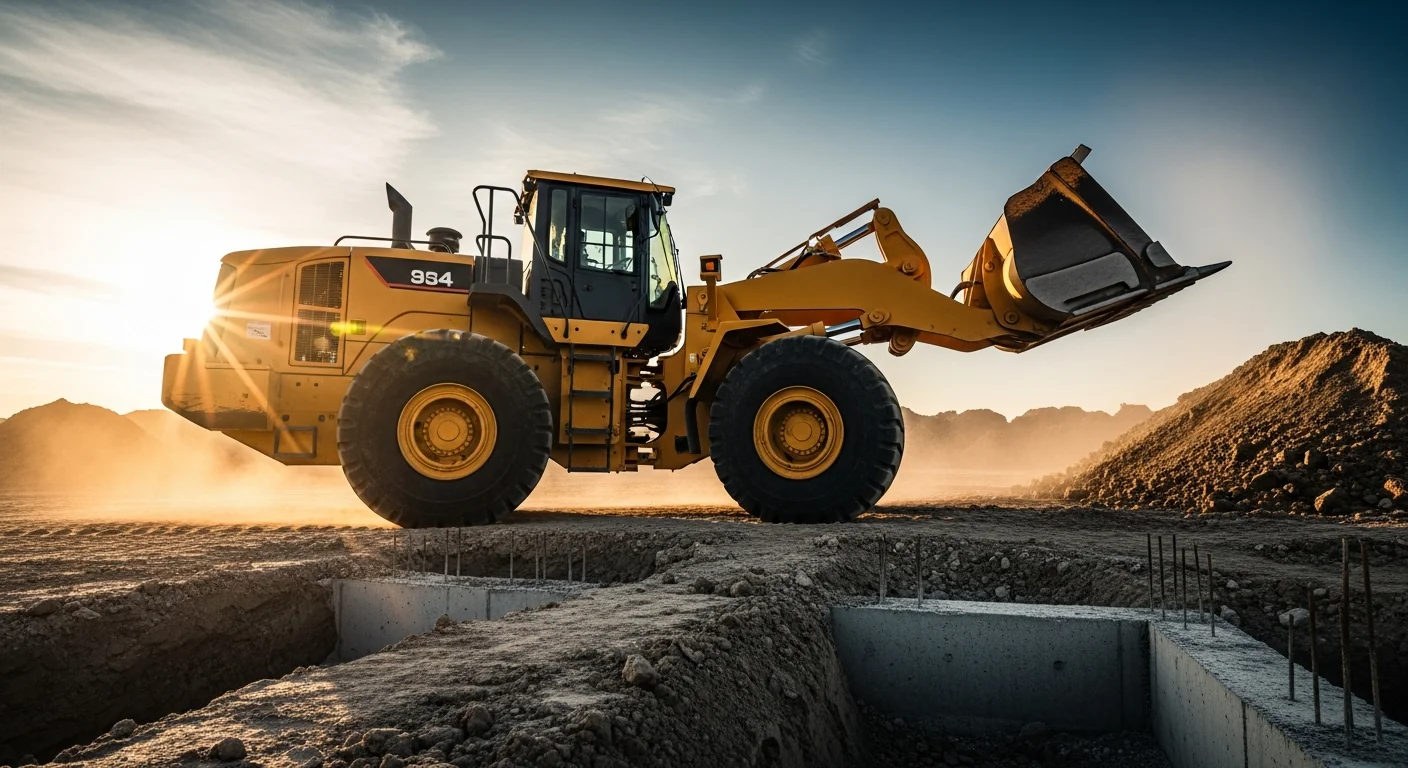
That promotional 0% APR offer looks irresistible—until you learn it requires 30% down, applies only to two models nobody wants, and expires before you can get approved. Meanwhile, the dealer just marked up the machine $15,000 to compensate for the subsidized rate.
Here's what wheel loader financing actually costs when the promotional smoke clears:
A-Tier Borrowers (700+ credit, 2+ years in business): 6.5% to 9.5% APR with 10-15% down payment requirements. These borrowers often qualify for zero-down options on new equipment and get the longest available terms (up to 84 months).
B-Tier Borrowers (600-699 credit, 1-2 years in business): 9.5% to 14% APR with 15-20% down payment expectations. Terms typically max out at 72 months, and lenders may require stronger business financials or personal guarantees.
Startup/Challenged Credit (under 600 or less than 1 year in business): 12% to 18% APR with 20-30% down payments and shorter terms (36-60 months). According to the SBA, programs like SBA 7(a) loans up to $5,000,000 and SBA Microloans up to $50,000 can provide more favorable terms for qualifying small businesses.
Promotional 0% rates are limited to select new models and require A-tier credit. This table shows what 85% of borrowers actually pay.
Contractors think in monthly cash outflow, not total price. Here's what wheel loader financing actually costs per month:
Compact Loaders ($60,000-$120,000): Monthly payments range from $1,175 to $2,350 at 60 months with 7.5% APR and 10% down. Think Kubota R630 or similar—perfect for landscaping and light construction.
Small Loaders ($120,000-$180,000): Monthly payments from $2,350 to $3,525 under the same terms. This covers most John Deere 544 series machines—workhorses for general construction.
Medium Loaders ($180,000-$350,000): Monthly payments from $3,525 to $6,855. Here's where you find the CAT 926M that most contractors consider the sweet spot—enough power for serious work, not overkill for daily operations. A $185,000 CAT 926M financed at 4.54% over 60 months equals approximately $3,460 per month.
Large Loaders ($350,000-$700,000+): Monthly payments from $6,855 to $13,710 or more. These are the CAT 966 and John Deere 724 machines that handle quarry and heavy infrastructure work.
Every legitimate lender charges documentation fees ($150-$500)—that's standard business. But watch for red flags: excessive "processing" fees over 2% of loan amount, mandatory insurance products that benefit the lender, or prepayment penalties beyond 24 months. Origination fees of 0.5-2% are often negotiable, especially for A-tier borrowers.
The #1 question on contractor forums: "Is it better to buy or lease a wheel loader?" Here's the math no competitor provides.
Consider that $185,000 CAT 926M again. Cash purchase costs $185,000 upfront. Financed at 7.5% over 60 months, you'll pay approximately $3,710 monthly for a total of $222,600—that's $37,600 in interest.
But here's what cash buyers miss: $185,000 invested conservatively at 7% annual return generates approximately $74,400 over five years. When you factor in opportunity cost, financing actually costs less than paying cash.
According to IRS Publication 946, the Section 179 deduction lets you deduct the full $185,000 in Year 1. At the 21% corporate tax rate, that's $38,850 in immediate tax savings—enough to cover over 12 months of equipment payments.
Operating leases typically run $2,400 to $2,800 monthly on that same $185,000 machine. Lower monthly outlay, but you're building zero equity. At lease end, you can return the equipment, purchase at fair market value (typically $50,000-$65,000), or extend the lease.
The critical difference: $1 buyout leases versus fair market value (FMV) leases. FMV leases offer lower monthly payments but leave you with a substantial buyout payment if you want to own the equipment.
Warning about evergreen clauses: Some leases auto-renew month-to-month at the same rate after the term ends. You must provide written notice 60-90 days before term end, or you're locked into additional payments at the full lease rate.
Mid-size wheel loader rentals average approximately $8,400 monthly versus $3,460 monthly to finance the same machine. The breakeven point hits around month 53-55, making financing advantageous for any project exceeding 4.5 years.
Rule of thumb: If you'll use the machine more than 500 hours annually for over 18 months, financing beats rental. Renting wins for single projects under six months, testing new markets, or avoiding transport costs to remote job sites.
This is the largest content gap in the equipment financing market. No competitor quantifies tax savings with real dollar amounts.
According to IRS Publication 946, the Section 179 deduction limit for 2026 is $2,560,000. Wheel loaders qualify as Section 179-eligible property when used for business purposes more than 50% of the time.
Worked example: That $185,000 CAT 926M generates a full $185,000 deduction. At the 21% corporate tax rate, you save $38,850 in Year 1 taxes. This tax savings alone covers over 12 months of equipment payments at $3,200 monthly, creating a liquidity multiplier that essentially provides free financing for the first year.
Critical timing: Equipment must be purchased AND placed in service by December 31, 2026.
The 2026 bonus depreciation rate is 20% for first-year deduction on qualifying property—both new and used equipment qualify. This rate has declined annually under the Tax Cuts and Jobs Act: 100% in 2022, 80% in 2023, 60% in 2024, 40% in 2025, and 20% in 2026.2027 drops to 0% unless Congress acts, making 2026 potentially the last year for any bonus depreciation. For most single wheel loader purchases under $2.56 million, Section 179 alone covers the full equipment cost, making bonus depreciation secondary but still valuable for larger fleet purchases.
Can you finance a used wheel loader? Yes, but lenders have strict eligibility tiers:
Like-New Used (0-3 years, under 2,000 hours): Rates typically 0.5-1% higher than new, maximum 72-month terms, 10-15% down payment.
Standard Used (3-7 years, 2,000-5,000 hours): Rates 1-2% higher than new, maximum 60-month terms, 15-20% down payment.
Older Used (7-10 years, 5,000-7,000 hours): Rates 2-3% higher than new, maximum 48-month terms, 20-25% down payment.
Aged Equipment (10-15 years, 7,000-12,000 hours): Specialty lenders only, 36-month terms, 25-30% down payment.
Legacy Equipment (15+ years, 12,000+ hours): Cash purchase typically required.
The cost-per-hour analysis: A new CAT 926M at $185,000 with 10,000-hour useful life costs $18.50 per hour. A three-year-old model at $120,000 with 8,000 hours remaining costs $15.00 per hour—$3.50 per hour savings. At 2,000 hours annually, that's $7,000 yearly savings. Factor in higher maintenance costs on used equipment ($2-$5 per hour more) and shorter financing terms, and used often makes sense for operators running 1,000-1,500 hours annually.
We don't lend money ourselves—we're the matchmaking service that gets lenders competing for your wheel loader financing deal. Here's how we solve the rate shopping problem:
Our AI advisor analyzes your specific needs—equipment type, price range, credit profile, and business financials. Instead of generic loan shopping, Ava identifies which lenders actually specialize in wheel loader financing and match your qualification profile.
This is where the magic happens. When lenders compete, rates drop 0.5-2 points below what you'd get calling them individually. Ava presents your deal to multiple lenders simultaneously, creating a competitive environment that works in your favor.
See exactly how each offer affects your monthly cash flow. Compare not just rates, but terms, down payment requirements, and total cost. No hidden fees, no surprises—just transparent math so you can make the right decision for your business.
You're in control. Pick the offer that works best for your situation, or walk away with no obligation. Most contractors close within 48-72 hours of selecting their preferred lender.
We don't lend money ourselves—we're the matchmaking service that gets lenders competing for your wheel loader financing deal. Here's how we solve the rate shopping problem:
Our AI advisor analyzes your specific needs—equipment type, price range, credit profile, and business financials. Instead of generic loan shopping, Ava identifies which lenders actually specialize in wheel loader financing and match your qualification profile.
This is where the magic happens. When lenders compete, rates drop 0.5-2 points below what you'd get calling them individually. Ava presents your deal to multiple lenders simultaneously, creating a competitive environment that works in your favor.
See exactly how each offer affects your monthly cash flow. Compare not just rates, but terms, down payment requirements, and total cost. No hidden fees, no surprises—just transparent math so you can make the right decision for your business.
You're in control. Pick the offer that works best for your situation, or walk away with no obligation. Most contractors close within 48-72 hours of selecting their preferred lender.
We don't lend money ourselves—we're the matchmaking service that gets lenders competing for your wheel loader financing deal. Here's how we solve the rate shopping problem:
Our AI advisor analyzes your specific needs—equipment type, price range, credit profile, and business financials. Instead of generic loan shopping, Ava identifies which lenders actually specialize in wheel loader financing and match your qualification profile.
This is where the magic happens. When lenders compete, rates drop 0.5-2 points below what you'd get calling them individually. Ava presents your deal to multiple lenders simultaneously, creating a competitive environment that works in your favor.
See exactly how each offer affects your monthly cash flow. Compare not just rates, but terms, down payment requirements, and total cost. No hidden fees, no surprises—just transparent math so you can make the right decision for your business.
You're in control. Pick the offer that works best for your situation, or walk away with no obligation. Most contractors close within 48-72 hours of selecting their preferred lender.
When lenders compete for the same deal, rates typically drop 0.5-2 percentage points below what you'd get calling them individually. We present your financing request to multiple specialized lenders simultaneously, creating a competitive environment that works in your favor. No more accepting the first offer or spending weeks shopping rates yourself.
Our AI advisor understands that banks reject 67% of wheel loader loans on equipment over 10 years old—but specialty lenders don't. Ava matches you with lenders who actually understand wheel loader depreciation curves, seasonal cash flow patterns, and the specific risks of your business type. This isn't generic loan shopping; it's precision matching.
Every day without equipment costs you money. Most contractors get 3-4 competing offers within 24 hours of submitting their information. Compare that to the 2-4 weeks most banks require just for initial underwriting. When you find the right deal at the right rate, you can move fast.
See what rates you qualify for with zero commitment and no hard credit pull during the matching process. Review all offers, negotiate if needed, then choose the lender that works best for your situation—or walk away entirely. The power stays in your hands throughout the entire process.
When lenders compete for the same deal, rates typically drop 0.5-2 percentage points below what you'd get calling them individually. We present your financing request to multiple specialized lenders simultaneously, creating a competitive environment that works in your favor. No more accepting the first offer or spending weeks shopping rates yourself.
Our AI advisor understands that banks reject 67% of wheel loader loans on equipment over 10 years old—but specialty lenders don't. Ava matches you with lenders who actually understand wheel loader depreciation curves, seasonal cash flow patterns, and the specific risks of your business type. This isn't generic loan shopping; it's precision matching.
Every day without equipment costs you money. Most contractors get 3-4 competing offers within 24 hours of submitting their information. Compare that to the 2-4 weeks most banks require just for initial underwriting. When you find the right deal at the right rate, you can move fast.
See what rates you qualify for with zero commitment and no hard credit pull during the matching process. Review all offers, negotiate if needed, then choose the lender that works best for your situation—or walk away entirely. The power stays in your hands throughout the entire process.
When lenders compete for the same deal, rates typically drop 0.5-2 percentage points below what you'd get calling them individually. We present your financing request to multiple specialized lenders simultaneously, creating a competitive environment that works in your favor. No more accepting the first offer or spending weeks shopping rates yourself.
Our AI advisor understands that banks reject 67% of wheel loader loans on equipment over 10 years old—but specialty lenders don't. Ava matches you with lenders who actually understand wheel loader depreciation curves, seasonal cash flow patterns, and the specific risks of your business type. This isn't generic loan shopping; it's precision matching.
Every day without equipment costs you money. Most contractors get 3-4 competing offers within 24 hours of submitting their information. Compare that to the 2-4 weeks most banks require just for initial underwriting. When you find the right deal at the right rate, you can move fast.
See what rates you qualify for with zero commitment and no hard credit pull during the matching process. Review all offers, negotiate if needed, then choose the lender that works best for your situation—or walk away entirely. The power stays in your hands throughout the entire process.
When lenders compete for the same deal, rates typically drop 0.5-2 percentage points below what you'd get calling them individually. We present your financing request to multiple specialized lenders simultaneously, creating a competitive environment that works in your favor. No more accepting the first offer or spending weeks shopping rates yourself.
Our AI advisor understands that banks reject 67% of wheel loader loans on equipment over 10 years old—but specialty lenders don't. Ava matches you with lenders who actually understand wheel loader depreciation curves, seasonal cash flow patterns, and the specific risks of your business type. This isn't generic loan shopping; it's precision matching.
Every day without equipment costs you money. Most contractors get 3-4 competing offers within 24 hours of submitting their information. Compare that to the 2-4 weeks most banks require just for initial underwriting. When you find the right deal at the right rate, you can move fast.
See what rates you qualify for with zero commitment and no hard credit pull during the matching process. Review all offers, negotiate if needed, then choose the lender that works best for your situation—or walk away entirely. The power stays in your hands throughout the entire process.
.png)