Many businesses receive funding shortly after approval
Built to help businesses explore realistic financing options
Business owners trust EquipFlow to simplify financing decisions
National and specialty lenders across industries
Your fastest route to the right lender — and the equipment your business needs.
Share your equipment type, business info, and location — it takes less than 60 seconds.
We instantly compare national and specialty lenders to find your best funding options.
Review offers, choose your lender, and get approved with fast turnaround times.
Air compressor comparison searches typically return vague promises about 'competitive rates'—but nobody tells you that a 650 FICO score means you're looking at 14% APR, not the 6% rate advertised for A-tier credit. Here's what 15 years of closing equipment deals has taught me: the difference between smart financing and expensive financing isn't the lender—it's understanding exactly where you fit in the credit tier system and what that means for your actual monthly payment.
Even more frustrating? Your accountant probably told you to 'pay cash and avoid interest.' That advice is mathematically wrong for 2026. With the Section 179 deduction limit at $2,560,000 and 100% bonus depreciation still in effect, financing a $30,000 rotary screw compressor and deducting the full purchase price in Year 1 often beats writing a check—even after paying 5 years of interest. According to IRS Publication 946, a business in the 35% tax bracket captures $10,500 in immediate tax savings on that $30K purchase, which more than offsets the total financing cost at rates under 10%.
Here's the real air compressor financing landscape in 2026: A-tier borrowers (680+ FICO) typically see 6-10% APR, B-tier credit (620-679) ranges from 10-14%, and startup or challenged credit sits at 12-18%. The difference between the top and bottom of that range? About $200-400 per month on a $30,000 purchase. That's why understanding your exact positioning—and which lenders compete for your specific profile—matters more than finding the 'best' lender.
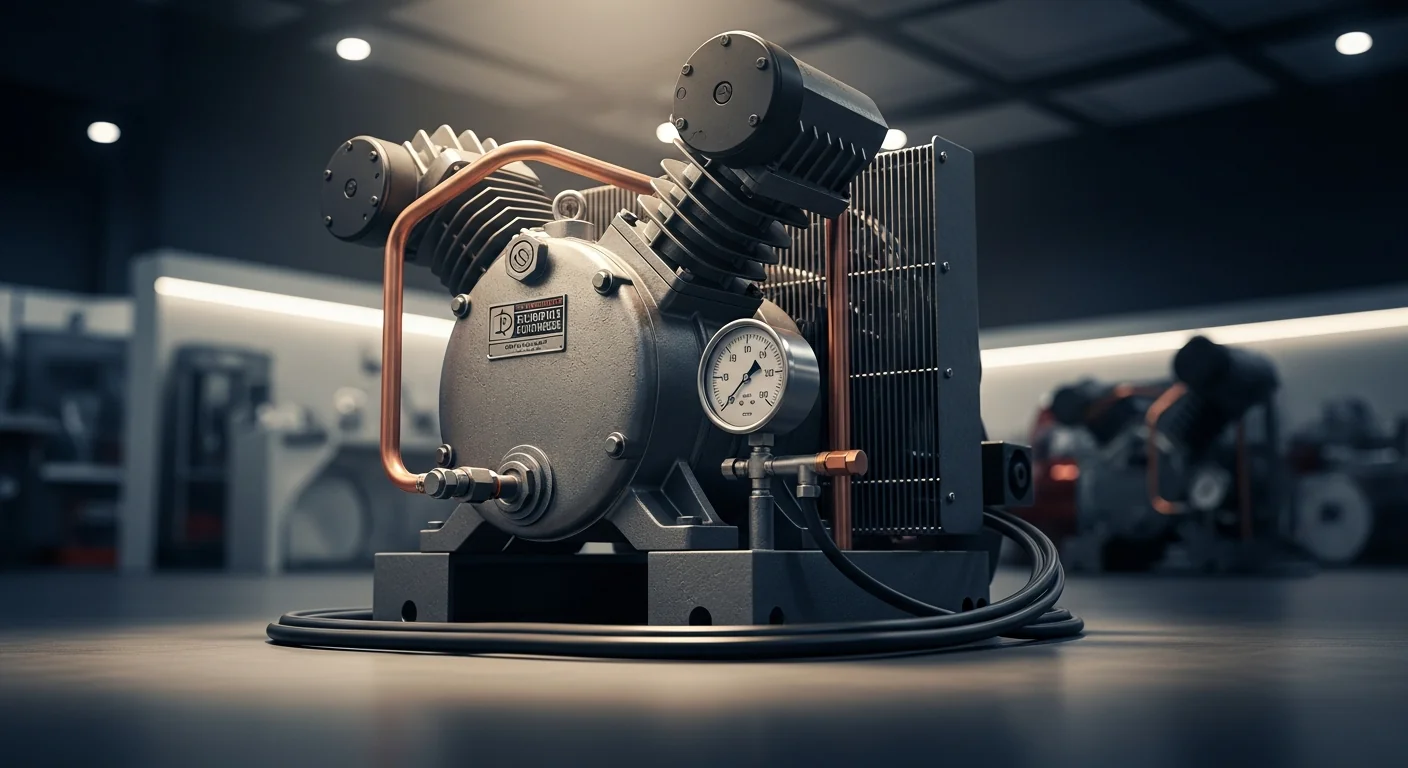
Let me be direct: if you're searching for air compressor financing without knowing your credit tier, you're shopping blind. The difference between A-tier and startup pricing isn't marginal—it's the difference between building equity and bleeding cash.
A-tier borrowers get the best treatment because they represent the lowest default risk. Equipment finance companies typically offer 6-8% APR for new compressors, 7-10% for used units under 5 years old. Most importantly, $0 down payment is standard for amounts under $75,000. On a $30,000 rotary screw compressor at 8% over 60 months, you're looking at $608 monthly payments with total interest of $6,461.
B-tier credit means higher rates and down payment requirements. That same $30,000 compressor jumps to 12% APR with a $3,000 down payment. Monthly payment: $667. Total interest: $10,000. The extra $3,500 in total cost over A-tier financing is why improving your credit score before applying can save thousands.
Businesses under 2 years or with sub-620 credit face the toughest terms. Even with strong revenue, expect 15-18% APR and significant down payments. On that $30K compressor: 16% APR, $6,000 down, $584 monthly payment on the remaining $24,000, but total interest of $11,040. The math gets ugly fast.
Every lender charges documentation fees ($150-500), UCC-1 filing fees ($50-150), and requires equipment insurance. According to OSHA standards, pressure vessel inspections add ongoing compliance costs. Factor an extra $1,000-2,000 annually in insurance and compliance for industrial units.
Here's where most contractors make expensive mistakes. They focus on monthly payments instead of total economic impact. Let me break down the real math on a $30,000 rotary screw compressor (185 CFM, typical for auto shops and small manufacturing).
Equipment Finance Agreement (8% APR, 60 months): $36,461 total cost, but you own the asset. With Section 179 tax savings of $10,500 (35% bracket), net cost drops to $25,961.
Cash Purchase: $30,000 upfront, but you lose 15-20% annual ROI on that working capital. Over 5 years, opportunity cost ranges from $22,500 to $30,000. Even with the same $10,500 tax savings, your total economic cost is $42,000-49,500.
Rental ($900/month for comparable unit): $54,000 over 5 years with zero ownership. Tax-deductible as operating expense, saving $18,900 in taxes, but net cost is still $35,100 with nothing to show for it. If short-term needs apply, you can rent an air compressor for your project instead of committing to ownership.
$1 Buyout Lease: Similar total cost to financing but different tax treatment. Lease payments are fully deductible ($30,000 in payments × 35% = $10,500 tax savings), making net cost $25,961—essentially identical to financing.
Cash makes sense only if: you're pre-revenue (no tax benefits), have no other use for capital (unlikely for growing businesses), or face credit issues that push financing above 20% APR. For profitable businesses with growth opportunities, financing wins mathematically.
Industrial air compressor ownership breaks even within 6-18 months versus rental costs. At $900/month rental versus $608 financing payment, you're building $292/month in equity instead of burning cash. After 18 months, you've paid $10,944 in financing toward ownership versus $16,200 in rental fees for zero equity.
Not all financing is created equal. Each structure serves different business situations, and choosing wrong can cost thousands. Before you commit, review the typical air compressor cost to expect across unit types and sizes.
EFAs dominate the air compressor market because they're simple: you own the equipment, make monthly payments, and can prepay without penalty. Most lenders use simple interest, so early payoff saves money. Terms range from 24-84 months, with amounts from $5,000 to $500,000+.
SBA programs offer lower rates but longer approval times. According to SBA.gov, SBA 7(a) loans cap at $5,000,000 with competitive rates for established businesses. SBA 504 loans cap at $5,500,000 but require owner-occupied real estate or job creation. SBA Microloans cap at $50,000—perfect for smaller portable compressors but useless for industrial systems.
Manufacturer financing often advertises 0% promotional rates, but they inflate equipment prices to compensate. Always compare the total deal: a $35,000 compressor at 0% versus the same unit at $32,000 cash price financed at 8% elsewhere. Do the math—sometimes 'free' money costs more.
Operating leases treat payments as expenses (fully tax-deductible). Capital leases and $1 buyouts require depreciating the asset while deducting interest. For cash-flow-tight businesses, operating leases provide better monthly tax relief.
This is where outdated competitor information costs money. Most sites still cite 2024's Section 179 limit of $1.16 million. The 2026 limit is $2,560,000—meaning most businesses can deduct their entire air compressor purchase immediately.
According to IRS Publication 946, the 2026 Section 179 deduction allows businesses to deduct the full purchase price of qualifying equipment in the year placed in service. This creates immediate cash flow benefits that often exceed financing options for your air compressor purchase.
Bonus depreciation remains at 100% for 2026, covering both new and used air compressors. This stacks with Section 179 for purchases exceeding the limit, though most compressor buyers won't approach $2.56 million annually.
Air compressors qualify for 5-year MACRS depreciation if you don't elect Section 179. Year 1 deduction is 20%, then 32%, 19.2%, 11.52%, 11.52%, and 5.76%. For most businesses, immediate Section 179 deduction provides better cash flow.
Stop guessing about monthly payments. Here's what real compressor financing looks like across the three most common purchase ranges.
A-tier (8% APR): 36 months = $313/month, 60 months = $203/month
B-tier (12% APR): 36 months = $332/month, 60 months = $222/month
Startup (16% APR): 36 months = $352/month, 60 months = $243/month
Section 179 savings at 25% bracket: $2,500 (effectively reducing net cost to $7,500)
A-tier financing (8% APR, 60 months): $608/month, $6,461 total interest
After Section 179 tax savings: $10,500 immediate deduction (35% bracket)
Net economic cost: $25,961 versus $30,000 cash
SBA 504 (6.5% APR, 120 months): $731/month, requires owner-occupied property
Equipment Finance (9% APR, 84 months): $1,247/month, faster approval
Total cost difference: $43,320 in SBA's favor, but 60-90 day approval versus 2-3 weeks
This is where lease versus loan structures matter most. Get this wrong, and you'll pay thousands more than necessary.
Equipment Finance Agreements use simple interest—pay early, save money. Most bank term loans work the same way. Capital leases and $1 buyout leases often require paying all remaining scheduled payments regardless of early payoff. On a $30,000 lease, early payoff could cost an extra $3,000-8,000.
A-tier credit typically requires $0 down on amounts under $75,000. B-tier sees 5-10% down requirements. Startup credit faces 10-20% down. Used equipment over 7 years old often requires larger down payments regardless of credit.
Fair Market Value leases let you buy equipment at its depreciated value (typically 10-25% of original cost). $1 buyouts guarantee ownership for $1. Purchase option (PUT) leases set a fixed percentage—usually 10%—regardless of actual market value.
Financing approval isn't just about creditworthiness. Lenders require specific insurance and compliance measures that add to total ownership cost.
According to OSHA standards, pressure vessels require regular inspection. Recent regulatory updates show OSHA repeat violations carry penalties up to $165,514, with serious violations ranging from $1,190 to $16,550. Lenders often require documented compliance programs.
Most equipment lenders require general liability coverage starting at $1 million, plus physical damage coverage on the equipment itself. Budget $1,500-3,000 annually for adequate coverage.
Most lenders won't finance air compressors over 10 years old or with 15,000+ operating hours. This creates a secondary market financing gap—equipment too old for traditional lenders but still operationally viable.
The biggest mistake contractors make is walking into their bank and accepting whatever rate they're offered. Banks don't specialize in air compressor financing—they're generalists trying to fit your equipment deal into their standard commercial loan box. When lenders compete for the same deal, rates typically drop 0.5-2 percentage points. Here's how we create that competition:
Ava, our AI advisor, needs to understand your specific financing needs: the compressor type (reciprocating, rotary screw, centrifugal), CFM requirements, new vs. used, and your credit profile. This isn't just data collection—Ava is diagnosing which lenders will actually compete for your deal. A startup with 620 FICO looking at a 10-year-old compressor faces different lending options than an established manufacturer buying new equipment.
Ava matches you with 3-4 lenders from our network who specialize in your equipment type and credit tier. This isn't random—banks reject 67% of used equipment loans over 7 years old, but equipment finance companies understand depreciation curves and will finance older units. The key is finding lenders who see your deal as attractive, not risky.
You'll receive actual rate quotes, not estimates. Each offer shows the monthly payment, total cost, down payment requirements, and prepayment terms. Here's where the math matters: see exactly how a 60-month term at 8% APR ($608/month) compares to 36 months at 9% APR ($954/month) for that $30K compressor.
You control the decision. No pressure, no obligation to accept any offer. Most deals close within 7-14 days once you select a lender, compared to 30-45 days for traditional bank applications.
The biggest mistake contractors make is walking into their bank and accepting whatever rate they're offered. Banks don't specialize in air compressor financing—they're generalists trying to fit your equipment deal into their standard commercial loan box. When lenders compete for the same deal, rates typically drop 0.5-2 percentage points. Here's how we create that competition:
Ava, our AI advisor, needs to understand your specific financing needs: the compressor type (reciprocating, rotary screw, centrifugal), CFM requirements, new vs. used, and your credit profile. This isn't just data collection—Ava is diagnosing which lenders will actually compete for your deal. A startup with 620 FICO looking at a 10-year-old compressor faces different lending options than an established manufacturer buying new equipment.
Ava matches you with 3-4 lenders from our network who specialize in your equipment type and credit tier. This isn't random—banks reject 67% of used equipment loans over 7 years old, but equipment finance companies understand depreciation curves and will finance older units. The key is finding lenders who see your deal as attractive, not risky.
You'll receive actual rate quotes, not estimates. Each offer shows the monthly payment, total cost, down payment requirements, and prepayment terms. Here's where the math matters: see exactly how a 60-month term at 8% APR ($608/month) compares to 36 months at 9% APR ($954/month) for that $30K compressor.
You control the decision. No pressure, no obligation to accept any offer. Most deals close within 7-14 days once you select a lender, compared to 30-45 days for traditional bank applications.
The biggest mistake contractors make is walking into their bank and accepting whatever rate they're offered. Banks don't specialize in air compressor financing—they're generalists trying to fit your equipment deal into their standard commercial loan box. When lenders compete for the same deal, rates typically drop 0.5-2 percentage points. Here's how we create that competition:
Ava, our AI advisor, needs to understand your specific financing needs: the compressor type (reciprocating, rotary screw, centrifugal), CFM requirements, new vs. used, and your credit profile. This isn't just data collection—Ava is diagnosing which lenders will actually compete for your deal. A startup with 620 FICO looking at a 10-year-old compressor faces different lending options than an established manufacturer buying new equipment.
Ava matches you with 3-4 lenders from our network who specialize in your equipment type and credit tier. This isn't random—banks reject 67% of used equipment loans over 7 years old, but equipment finance companies understand depreciation curves and will finance older units. The key is finding lenders who see your deal as attractive, not risky.
You'll receive actual rate quotes, not estimates. Each offer shows the monthly payment, total cost, down payment requirements, and prepayment terms. Here's where the math matters: see exactly how a 60-month term at 8% APR ($608/month) compares to 36 months at 9% APR ($954/month) for that $30K compressor.
You control the decision. No pressure, no obligation to accept any offer. Most deals close within 7-14 days once you select a lender, compared to 30-45 days for traditional bank applications.
After closing 500+ equipment deals, I've learned that the lender marketplace has changed dramatically. Banks used to dominate equipment financing—now specialized lenders offer better rates, faster approvals, and more flexible terms. The challenge is finding the right lender for your specific situation.
When multiple lenders compete for the same deal, rates typically drop 0.5-2 percentage points. We've seen contractors save $50-150/month on payments just by having lenders bid against each other. On a $30,000 air compressor, that's $3,000-9,000 in total savings over the loan term.
Ava specializes in understanding which lenders prefer specific equipment types and credit profiles. Banks reject 67% of used equipment loans over 7 years old, but Ava knows which equipment finance companies understand air compressor depreciation curves and will finance older units at competitive rates.
Every day without equipment costs money. A manufacturer waiting for air compressor cost approval might shut down production lines, costing thousands daily. Our lender network provides preliminary approvals within 24-48 hours versus the 30-45 day bank timeline.
You're not committed to any offer. Compare multiple lenders, see the real terms, then decide. Most contractors are surprised by the rate differences—sometimes 3-4 percentage points between the highest and lowest offers for the identical deal.
After closing 500+ equipment deals, I've learned that the lender marketplace has changed dramatically. Banks used to dominate equipment financing—now specialized lenders offer better rates, faster approvals, and more flexible terms. The challenge is finding the right lender for your specific situation.
When multiple lenders compete for the same deal, rates typically drop 0.5-2 percentage points. We've seen contractors save $50-150/month on payments just by having lenders bid against each other. On a $30,000 air compressor, that's $3,000-9,000 in total savings over the loan term.
Ava specializes in understanding which lenders prefer specific equipment types and credit profiles. Banks reject 67% of used equipment loans over 7 years old, but Ava knows which equipment finance companies understand air compressor depreciation curves and will finance older units at competitive rates.
Every day without equipment costs money. A manufacturer waiting for air compressor cost approval might shut down production lines, costing thousands daily. Our lender network provides preliminary approvals within 24-48 hours versus the 30-45 day bank timeline.
You're not committed to any offer. Compare multiple lenders, see the real terms, then decide. Most contractors are surprised by the rate differences—sometimes 3-4 percentage points between the highest and lowest offers for the identical deal.
After closing 500+ equipment deals, I've learned that the lender marketplace has changed dramatically. Banks used to dominate equipment financing—now specialized lenders offer better rates, faster approvals, and more flexible terms. The challenge is finding the right lender for your specific situation.
When multiple lenders compete for the same deal, rates typically drop 0.5-2 percentage points. We've seen contractors save $50-150/month on payments just by having lenders bid against each other. On a $30,000 air compressor, that's $3,000-9,000 in total savings over the loan term.
Ava specializes in understanding which lenders prefer specific equipment types and credit profiles. Banks reject 67% of used equipment loans over 7 years old, but Ava knows which equipment finance companies understand air compressor depreciation curves and will finance older units at competitive rates.
Every day without equipment costs money. A manufacturer waiting for air compressor cost approval might shut down production lines, costing thousands daily. Our lender network provides preliminary approvals within 24-48 hours versus the 30-45 day bank timeline.
You're not committed to any offer. Compare multiple lenders, see the real terms, then decide. Most contractors are surprised by the rate differences—sometimes 3-4 percentage points between the highest and lowest offers for the identical deal.
After closing 500+ equipment deals, I've learned that the lender marketplace has changed dramatically. Banks used to dominate equipment financing—now specialized lenders offer better rates, faster approvals, and more flexible terms. The challenge is finding the right lender for your specific situation.
When multiple lenders compete for the same deal, rates typically drop 0.5-2 percentage points. We've seen contractors save $50-150/month on payments just by having lenders bid against each other. On a $30,000 air compressor, that's $3,000-9,000 in total savings over the loan term.
Ava specializes in understanding which lenders prefer specific equipment types and credit profiles. Banks reject 67% of used equipment loans over 7 years old, but Ava knows which equipment finance companies understand air compressor depreciation curves and will finance older units at competitive rates.
Every day without equipment costs money. A manufacturer waiting for air compressor cost approval might shut down production lines, costing thousands daily. Our lender network provides preliminary approvals within 24-48 hours versus the 30-45 day bank timeline.
You're not committed to any offer. Compare multiple lenders, see the real terms, then decide. Most contractors are surprised by the rate differences—sometimes 3-4 percentage points between the highest and lowest offers for the identical deal.
.png)