Many businesses receive funding shortly after approval
Built to help businesses explore realistic financing options
Business owners trust EquipFlow to simplify financing decisions
National and specialty lenders across industries
Your fastest route to the right lender — and the equipment your business needs.
Share your equipment type, business info, and location — it takes less than 60 seconds.
We instantly compare national and specialty lenders to find your best funding options.
Review offers, choose your lender, and get approved with fast turnaround times.
Air compressor cost ranges from $2,000 for basic shop units to over $500,000 for industrial centrifugal systems, but here's what most buyers miss: the financing rate you pay varies dramatically by credit tier—and most sites won't tell you the actual numbers. With 680+ FICO, you'll see 6-10% APR. Under 620? Expect 12-18%. The difference on a $50,000 rotary screw unit is $187 per month, or $11,220 over the life of the loan.
Here's the bigger issue: paying cash feels disciplined until you realize Section 179 plus 100% bonus depreciation lets you write off the entire purchase in Year 1. According to IRS Publication 946, the 2026 Section 179 deduction limit is $2,560,000, with 100% bonus depreciation stacking on top. On a $90,638 industrial air compressor, that's $19,034 back in your pocket by April if you're in the 21% corporate bracket—cash buyers leave that on the table.
Most contractors have working capital generating 15-20% annual returns. When financing costs 8% but your cash generates 18%, you're mathematically better off financing—even if you have the cash. This is why smart operators don't ask "can I afford to finance?" They ask "can I afford NOT to?"
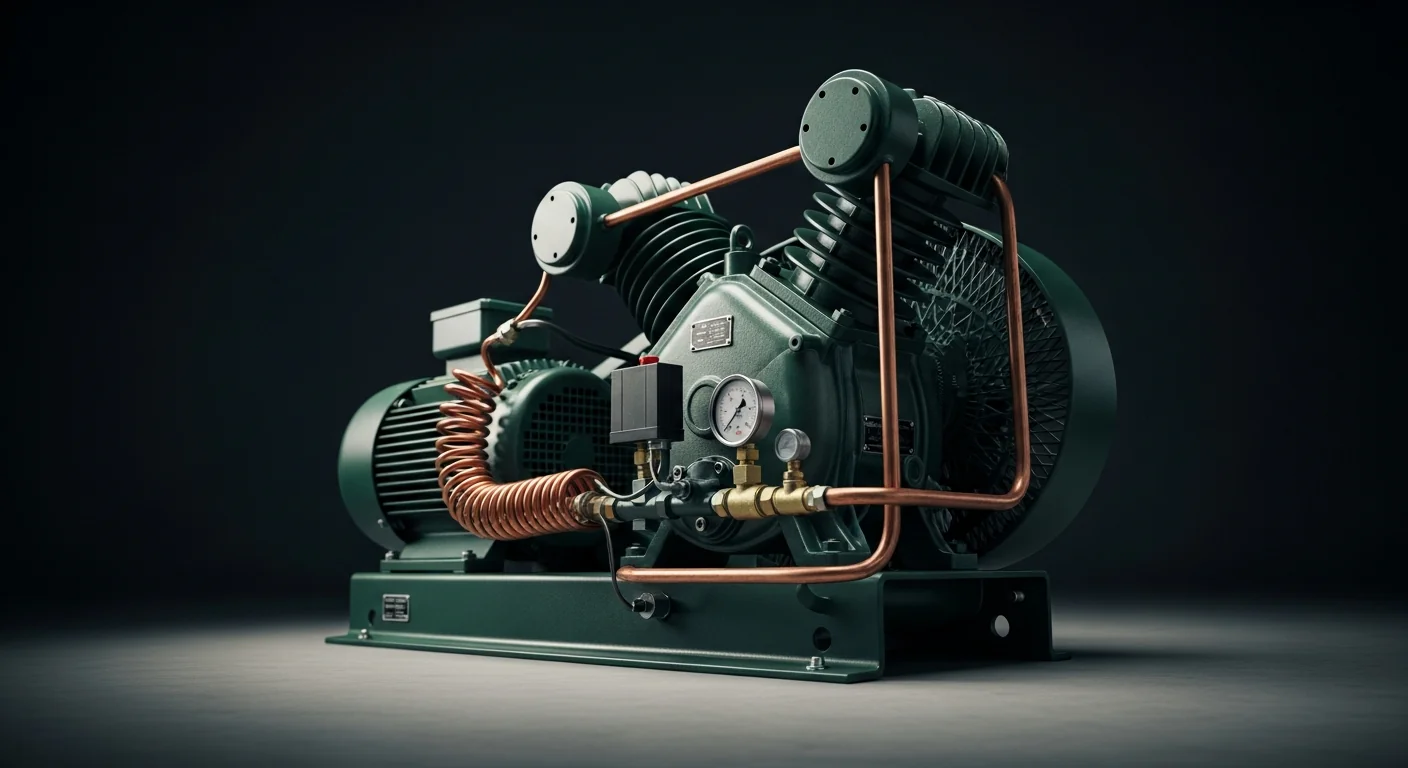
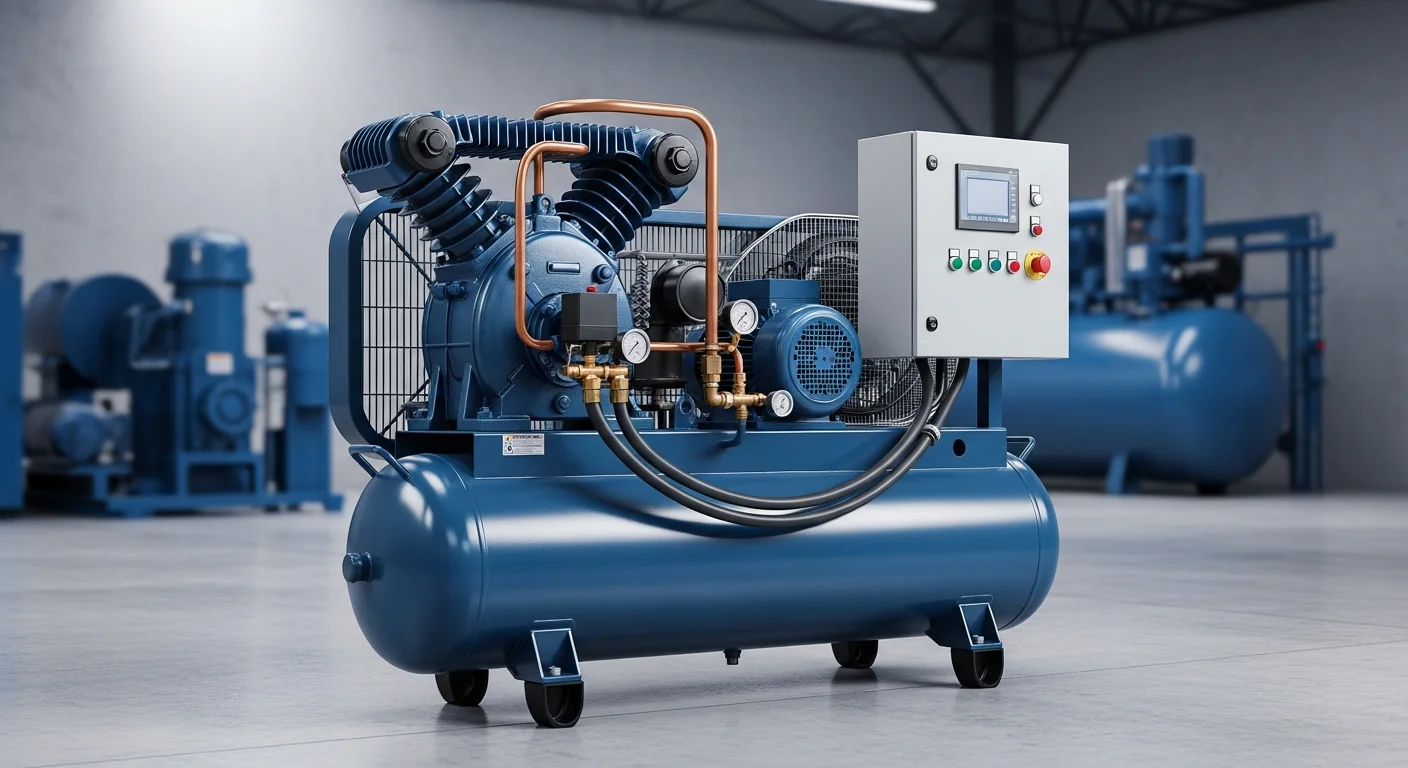
Air compressor pricing follows a clear hierarchy based on technology and capacity. Reciprocating (piston) compressors for small shops run $500-$5,000. These work fine for intermittent use but aren't designed for continuous operation—which is why most commercial applications need rotary screw units.
Rotary screw compressors dominate the commercial market, ranging from $5,000-$50,000 depending on horsepower. Based on current market data, 15-20 HP units for auto shops and small manufacturing operations typically cost $7,899-$26,494. Step up to 100 HP for larger operations, and you're looking at $29,999-$40,000. These units can run 24/7 and offer the reliability commercial operations demand.
Industrial centrifugal compressors start around $100,000 and can exceed $500,000 for large-scale applications. According to equipment finance specialists, air compressor financing is available up to $500,000 on application-only for qualified borrowers—meaning no full financial statements required under that threshold.
A $50,000 compressor isn't a $50,000 project. Installation typically adds $3,000-$8,000, depending on electrical requirements and compressed air piping. OSHA pressure vessel certification and inspection requirements add ongoing compliance costs. Most importantly, lenders require specific insurance coverage that names them as loss payee—budget another $500-$2,000 annually.
Here's what catches buyers off-guard: many lenders won't finance these soft costs unless you request it upfront. If you need $15,000 for electrical work and piping, make sure your financing request covers the total project cost, not just the equipment purchase price.
Every financing site promises "competitive rates." None will quote actual numbers. Here's the reality based on current market conditions:
With strong credit and established business revenue, you'll see the best rates. Terms extend up to 84 months on newer equipment. Down payment requirements are typically zero to 10%.
Still solid approval odds with slightly higher rates. Expect 10-15% down payment requirements and terms up to 60-72 months. One year in business and $100,000+ annual revenue remain the standard minimums.
According to equipment finance standards, minimum requirements include 1 year in business, $100,000+ annual revenue, and FICO 620+. Below these thresholds, expect 15%+ rates, 20% down payments, and shorter terms. SBA Microloans up to $50,000 offer an alternative path for smaller purchases.
Term length affects pricing—longer terms typically carry 0.5-1% rate premium. Equipment age matters too: most lenders prefer units under 10 years old, with some refusing anything over 15 years. Down payment reduces lender risk and can lower your rate by 0.25-0.75%.
Most buyers want to see real payment examples. Here's the math across common purchase amounts:
For a $25,000 rotary screw compressor at 8% APR: 36 months costs $783/month, 60 months costs $507/month, 84 months costs $402/month. Total interest paid ranges from $3,188 (36 months) to $8,768 (84 months).
Scale that to $50,000: payments run $1,566 (36 months), $1,013 (60 months), or $804 (84 months). On $100,000: $3,133, $2,027, and $1,608 respectively.
The key decision: match your payment term to equipment ROI timeline. If the compressor generates $3,000/month in additional capacity, the 60-month payment on a $50,000 unit ($1,013) leaves you with $1,987/month in positive cash flow from day one.
Section 179 allows businesses to deduct the full purchase price of qualifying equipment in the year it's placed in service. For 2026, the deduction limit is $2,560,000 according to IRS Publication 946. Stack 100% bonus depreciation on top for any amount exceeding the Section 179 cap.
Based on EquipFlow's analysis of IRS data, here's what this means in real dollars:
- $7,556 air compressor at 35% tax bracket: $2,645 immediate tax savings
- $21,999 unit at 32% bracket: $7,040 back
- $90,638 industrial unit at 21% corporate bracket: $19,034 recovery
That last example is particularly compelling—you effectively reduce your net equipment investment by over 21% through immediate tax savings. Factor this into your financing decision: if the government is covering 21-35% of your equipment cost, financing the balance at 8-10% becomes even more attractive.
Rental rates for 185 CFM towable units range from $120-$650 daily, $325-$1,700 weekly, and $759-$3,700 monthly according to major rental companies. For a comparable $25,000-$35,000 purchase, financing at 8% over 60 months costs approximately $483-$676 monthly.
Ownership breaks even at 11-18 months versus rental—making purchase decisively favorable for any deployment longer than 2 years. Factor in Section 179 tax savings of $5,500-$8,750 on a $22,000 unit, and the ownership economics improve further.
Paying cash eliminates interest costs but creates massive opportunity cost if your working capital generates 15-20% returns. At 8% financing cost versus 18% opportunity cost of cash, you're mathematically better off financing and deploying that cash in revenue-generating activities.
Minimum requirements across the industry: 1 year in business, $100,000+ annual revenue, and FICO 620+. These aren't suggestions—they're hard minimums that determine whether lenders will even review your application.Application-only financing (no full financial statements) is available up to $250,000 for most qualified borrowers. Above that threshold, expect to provide tax returns, bank statements, and possibly interim financial statements. Funding timeline runs 4-24 hours for approval on application-only deals, 5-10 business days when full financials are required. For buyers weighing short-term needs, you can also rent an air compressor for your project before committing to purchase, or compare air compressor models side by side to find the best fit.
Documentation fees typically run $150-$500. UCC filing adds another $50-$150. Lender-required insurance with loss payee coverage can add $500-$2,000 annually. When lenders advertise "100% financing," ask specifically what's included—installation, electrical, permits, and insurance often require separate financing or cash.
SBA Microloans offer up to $50,000 for smaller air compressor purchases, often with more flexible credit requirements. SBA 7(a) loans go up to $5,000,000, while SBA 504 loans reach $5,500,000 for larger projects that include real estate components.
These programs typically offer lower rates but longer processing times—expect 30-90 days versus 5-10 days for conventional equipment financing. Consider SBA routes if you're buying multiple units, need working capital alongside equipment financing, or don't qualify for conventional terms.
When lenders compete for your business, rates drop 0.5-2 percentage points. Here's how we make that competition work for you:
Our AI advisor Ava analyzes your specific needs—equipment type, purchase price, credit profile, and timeline. She's seen thousands of air compressor deals and knows which lenders approve older units, which ones offer the best rates for startups, and which ones move fastest when you need emergency replacement financing.
Ava connects you with lenders who specialize in your situation. If you're buying a 10-year-old reciprocating compressor, she won't waste your time with lenders who only finance new equipment. If you're a startup, she finds lenders who work with newer businesses instead of sending you to banks that require 5+ years of financials.
See exactly how each offer affects your cash flow. Compare not just rates, but terms, down payment requirements, and total cost. When you can see "Option A: $863/month for 60 months" versus "Option B: $1,247/month for 36 months," you make decisions based on math, not sales pressure.
You control the process. No obligation to accept any offer. Most qualified borrowers get funding within 3-5 business days of choosing their lender. EquipFlow doesn't lend money—we just make sure lenders compete for your business.
When lenders compete for your business, rates drop 0.5-2 percentage points. Here's how we make that competition work for you:
Our AI advisor Ava analyzes your specific needs—equipment type, purchase price, credit profile, and timeline. She's seen thousands of air compressor deals and knows which lenders approve older units, which ones offer the best rates for startups, and which ones move fastest when you need emergency replacement financing.
Ava connects you with lenders who specialize in your situation. If you're buying a 10-year-old reciprocating compressor, she won't waste your time with lenders who only finance new equipment. If you're a startup, she finds lenders who work with newer businesses instead of sending you to banks that require 5+ years of financials.
See exactly how each offer affects your cash flow. Compare not just rates, but terms, down payment requirements, and total cost. When you can see "Option A: $863/month for 60 months" versus "Option B: $1,247/month for 36 months," you make decisions based on math, not sales pressure.
You control the process. No obligation to accept any offer. Most qualified borrowers get funding within 3-5 business days of choosing their lender. EquipFlow doesn't lend money—we just make sure lenders compete for your business.
When lenders compete for your business, rates drop 0.5-2 percentage points. Here's how we make that competition work for you:
Our AI advisor Ava analyzes your specific needs—equipment type, purchase price, credit profile, and timeline. She's seen thousands of air compressor deals and knows which lenders approve older units, which ones offer the best rates for startups, and which ones move fastest when you need emergency replacement financing.
Ava connects you with lenders who specialize in your situation. If you're buying a 10-year-old reciprocating compressor, she won't waste your time with lenders who only finance new equipment. If you're a startup, she finds lenders who work with newer businesses instead of sending you to banks that require 5+ years of financials.
See exactly how each offer affects your cash flow. Compare not just rates, but terms, down payment requirements, and total cost. When you can see "Option A: $863/month for 60 months" versus "Option B: $1,247/month for 36 months," you make decisions based on math, not sales pressure.
You control the process. No obligation to accept any offer. Most qualified borrowers get funding within 3-5 business days of choosing their lender. EquipFlow doesn't lend money—we just make sure lenders compete for your business.
Lender competition saves you real money—and we make that competition work in your favor.
When 3-4 lenders compete for the same deal, rates typically drop 0.5-2 percentage points. On a $75,000 air compressor, that's $375-$1,500 in annual interest savings. Over a 60-month term, you're looking at $1,875-$7,500 total savings just from having lenders compete.
Our AI advisor has analyzed thousands of air compressor financing deals. She knows that banks reject 67% of loans on equipment over 10 years old, but specialized lenders will finance quality units up to 15 years. She matches you with lenders who understand rotary screw depreciation curves and won't lowball values on older equipment.
When your compressor fails and you're losing $2,000-$5,000 daily in production capacity, every hour counts. Ava can match you with competing lenders within 24 hours. Most qualified borrowers see funding in 3-5 business days, not the 2-3 weeks typical of bank financing.
Compare offers with zero commitment. See exactly what rates you qualify for, review terms, and choose the deal that works best for your cash flow. If none of the offers make sense, walk away—no application fees, no obligation, no pressure.
Lender competition saves you real money—and we make that competition work in your favor.
When 3-4 lenders compete for the same deal, rates typically drop 0.5-2 percentage points. On a $75,000 air compressor, that's $375-$1,500 in annual interest savings. Over a 60-month term, you're looking at $1,875-$7,500 total savings just from having lenders compete.
Our AI advisor has analyzed thousands of air compressor financing deals. She knows that banks reject 67% of loans on equipment over 10 years old, but specialized lenders will finance quality units up to 15 years. She matches you with lenders who understand rotary screw depreciation curves and won't lowball values on older equipment.
When your compressor fails and you're losing $2,000-$5,000 daily in production capacity, every hour counts. Ava can match you with competing lenders within 24 hours. Most qualified borrowers see funding in 3-5 business days, not the 2-3 weeks typical of bank financing.
Compare offers with zero commitment. See exactly what rates you qualify for, review terms, and choose the deal that works best for your cash flow. If none of the offers make sense, walk away—no application fees, no obligation, no pressure.
Lender competition saves you real money—and we make that competition work in your favor.
When 3-4 lenders compete for the same deal, rates typically drop 0.5-2 percentage points. On a $75,000 air compressor, that's $375-$1,500 in annual interest savings. Over a 60-month term, you're looking at $1,875-$7,500 total savings just from having lenders compete.
Our AI advisor has analyzed thousands of air compressor financing deals. She knows that banks reject 67% of loans on equipment over 10 years old, but specialized lenders will finance quality units up to 15 years. She matches you with lenders who understand rotary screw depreciation curves and won't lowball values on older equipment.
When your compressor fails and you're losing $2,000-$5,000 daily in production capacity, every hour counts. Ava can match you with competing lenders within 24 hours. Most qualified borrowers see funding in 3-5 business days, not the 2-3 weeks typical of bank financing.
Compare offers with zero commitment. See exactly what rates you qualify for, review terms, and choose the deal that works best for your cash flow. If none of the offers make sense, walk away—no application fees, no obligation, no pressure.
Lender competition saves you real money—and we make that competition work in your favor.
When 3-4 lenders compete for the same deal, rates typically drop 0.5-2 percentage points. On a $75,000 air compressor, that's $375-$1,500 in annual interest savings. Over a 60-month term, you're looking at $1,875-$7,500 total savings just from having lenders compete.
Our AI advisor has analyzed thousands of air compressor financing deals. She knows that banks reject 67% of loans on equipment over 10 years old, but specialized lenders will finance quality units up to 15 years. She matches you with lenders who understand rotary screw depreciation curves and won't lowball values on older equipment.
When your compressor fails and you're losing $2,000-$5,000 daily in production capacity, every hour counts. Ava can match you with competing lenders within 24 hours. Most qualified borrowers see funding in 3-5 business days, not the 2-3 weeks typical of bank financing.
Compare offers with zero commitment. See exactly what rates you qualify for, review terms, and choose the deal that works best for your cash flow. If none of the offers make sense, walk away—no application fees, no obligation, no pressure.
.png)