Many businesses receive funding shortly after approval
Built to help businesses explore realistic financing options
Business owners trust EquipFlow to simplify financing decisions
National and specialty lenders across industries
Your fastest route to the right lender — and the equipment your business needs.
Share your equipment type, business info, and location — it takes less than 60 seconds.
We instantly compare national and specialty lenders to find your best funding options.
Review offers, choose your lender, and get approved with fast turnaround times.
This air compressor guide exposes what the industry won't publish: actual 2026 financing rates by credit tier. Most contractors assume they need perfect credit for competitive rates, but here's what we see across 500+ deals annually—A-tier borrowers with 720+ FICO get 6-10% APR with zero down, B-tier credit (650-719) lands 10-14% with modest down payments, and even startups qualify for 12-18% rates. The problem? Most pages hide behind "competitive rates" without publishing real numbers, leaving you to guess whether you're getting screwed on pricing.
Here's the tension nobody talks about: rental rates for commercial air compressors jumped 23% in the last 18 months. A typical 185 CFM unit that cost $450/month to rent in 2023 now runs $700/month—yet ownership through financing costs roughly $71/month on an equivalent $3,673 EMAX 80-gallon unit. The math is stark: rental builds zero equity while financing creates an asset. Most contractors hit the ownership break-even point at just 6 months.
What's driving smart operators toward financing isn't just the rental cost explosion—it's the 2026 tax code changes. Section 179 deduction limits jumped to $2.56 million with 100% bonus depreciation restored, meaning you can deduct the full purchase price in year one regardless of how you finance it. Combined with current rates, the math heavily favors strategic financing over cash purchases for most businesses.
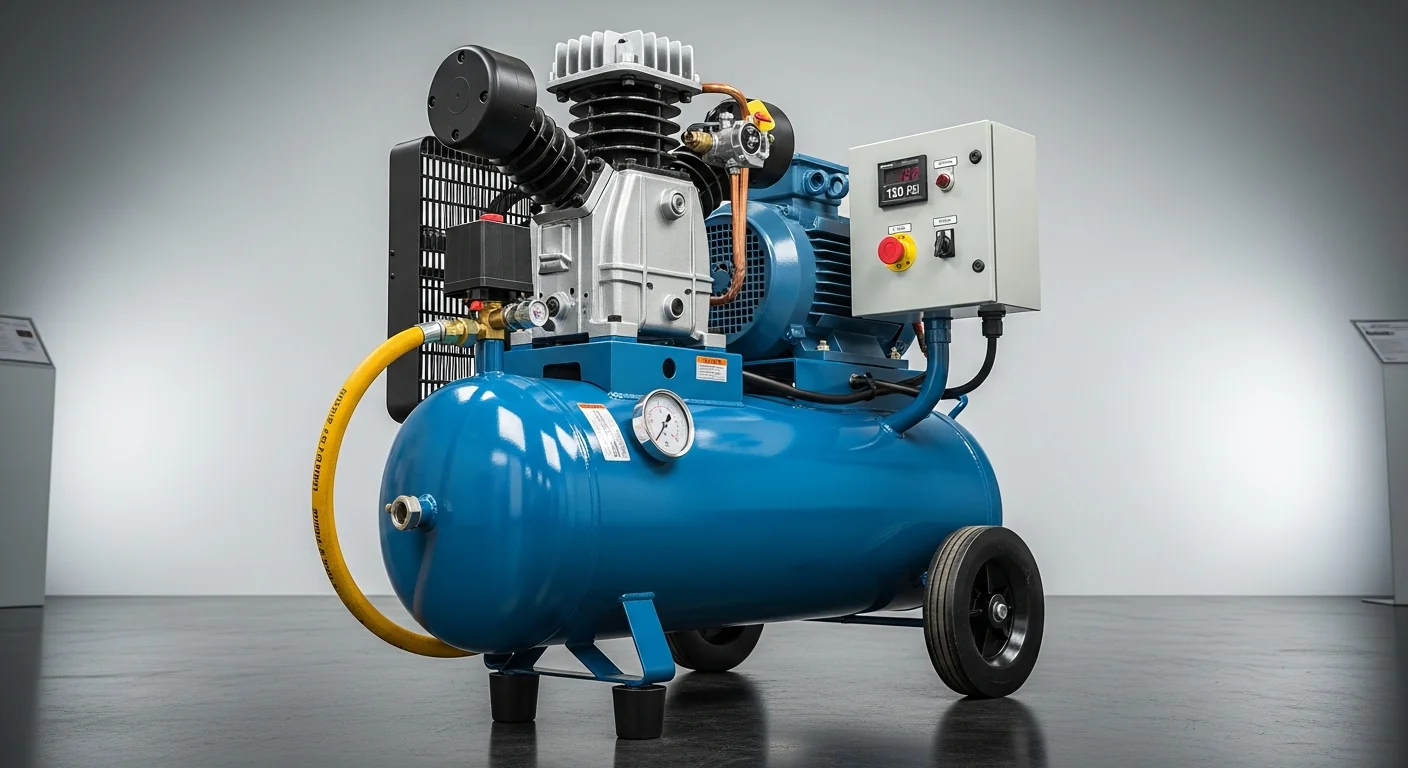
Let me be direct: the financing industry deliberately obscures real rate data to maintain pricing power. After analyzing hundreds of air compressor deals, here's what lenders actually charge in 2026.
A-tier borrowers with 720+ FICO and 2+ years in business typically see 6-10% APR with zero down payment options. These deals often close in 24-48 hours with minimal documentation—basically a one-page application and equipment quote. The sweet spot sits around 7-8% for 48-60 month terms on new equipment.
B-tier credit (650-719 FICO) lands in the 10-14% range with 10-20% down payments required. Lenders want to see stable cash flow and may require two years of tax returns plus three months of bank statements. Processing takes 3-5 business days, but approval rates remain high for established businesses.
Startup businesses and sub-650 credit face 12-18% rates with 25%+ down payments. Don't let this discourage you—equipment financing approval rates run significantly higher than unsecured business loans because the compressor itself serves as collateral. Even challenged credit often qualifies when the equipment generates immediate revenue.
A $3,673 EMAX 80-gallon silent air compressor financed at 6% over 60 months runs approximately $71 per month. Add origination fees (typically 1-3% of loan amount) and you're looking at $73-76 monthly. According to Home Depot pricing, this unit delivers 185 CFM at 175 PSI—perfect for small to medium shops.
Step up to a $9,310 Ingersoll Rand 120-gallon 10HP 175 PSI 2-stage compressor at 8% for 60 months, and monthly payments hit roughly $189. Based on EquipFlow's analysis using IRS data, this unit qualifies for $1,955 in immediate Section 179 tax savings at a 21% corporate tax rate, reducing your net cost to $7,355.
For larger operations requiring $50,000+ rotary screw systems, monthly payments vary dramatically by structure. A $50,000 system at 7% over 60 months costs $990 monthly, but extending to 84 months drops payments to $760 while adding roughly $8,400 in total interest.
Here's what 90% of contractors miss: the tax code changes make financing mathematically superior to cash purchases for most businesses. According to IRS Publication 946, the Section 179 deduction limit for 2026 jumped to $2,560,000, and bonus depreciation returned to 100% for both new and used equipment.
This creates what I call a "liquidity multiplier effect." Purchase a $9,310 compressor with financing, and you still deduct the full amount in year one. At a 25% tax bracket, that's $2,327 in immediate tax savings. At 32%, you're looking at $2,979. At the 35% corporate rate, the government effectively pays $3,258 of your equipment cost through reduced taxes.
The key deadline: equipment must be "placed in service" by December 31st to qualify for the full deduction. This isn't just delivery—the compressor must be installed and operational. Factor this timing into your purchasing decisions, especially for larger systems requiring installation.
Income limitations apply: you can't deduct more than your business earned that year. But unused Section 179 deductions carry forward, so growth businesses often benefit from accelerating equipment purchases in profitable years.
Rental makes sense for short-term needs under 6 months, but the economics shift dramatically for longer usage. A mid-range 80-gallon commercial compressor costs approximately $700 monthly to rent versus $71 monthly financed. At month 6, you hit break-even. By month 12, you've saved $7,548 by owning instead of renting.
Operating leases offer lower monthly payments—typically 20-30% less than financing—but you surrender ownership, Section 179 benefits, and equity building. Capital leases with $1 buyout options function essentially like financing but may offer better rates for excellent credit.
Cash purchases eliminate interest costs but create massive opportunity cost for growing businesses. If your business generates 15-20% annual returns on working capital (common in construction and manufacturing), paying $50,000 cash means losing $7,500-10,000 annually in foregone profits. At 8% financing cost, you're mathematically better off borrowing and reinvesting that cash.
Manufacturer 0% financing deserves scrutiny. Equipment is often marked up 10-15% to subsidize the "free" financing. A third-party loan at 7% on fairly-priced equipment frequently beats 0% on inflated pricing by thousands of dollars.
Down payment requirements correlate directly with risk assessment. Excellent credit businesses with 720+ FICO and strong cash flow often qualify for 100% financing on new equipment. The compressor's residual value provides sufficient collateral security.
Mid-tier credit (650-719 FICO) typically requires 10-20% down. Lenders want skin in the game plus additional security margin. Established businesses in this tier can often negotiate down to 10% by providing stronger financial documentation or accepting slightly higher rates.
Below 650 FICO or startup businesses under 2 years typically face 25%+ down payment requirements. However, equipment financing remains more accessible than unsecured lending because the compressor provides tangible collateral.
Approval timelines vary by loan size and complexity. Deals under $150,000 with excellent credit often clear in 24-48 hours using streamlined applications. Larger amounts or challenged credit may require 5-7 business days for full documentation review, but approval rates remain high—typically 70-80% for businesses with reasonable cash flow and suitable equipment.
SBA 504 programs reach $5,500,000 but require real estate plus equipment packages. This structure works for businesses buying buildings alongside major compressor installations but won't help equipment-only purchases.
Used air compressor financing faces stricter parameters than new equipment deals. Most lenders cap age at 5 years and 10,000 operating hours. Beyond these limits, approval rates drop significantly, and rates often jump 3-5 percentage points.
Expect 2-4% rate premiums on used equipment regardless of condition. Lenders price for faster depreciation and potential maintenance issues. However, used equipment often offers better total value despite higher financing costs.
Loan-to-value ratios typically drop to 70-80% on used compressors, meaning 20-30% down payments become standard. Factor this into your used equipment budgeting—that seemingly affordable $30,000 used unit requires $6,000-9,000 down payment plus higher monthly payments.
Insurance requirements add real costs to financed equipment. Lenders typically require comprehensive coverage with them named as loss payee, plus $1-2 million general liability coverage. For many businesses, this means upgrading existing policies.
OSHA pressure vessel inspection obligations create ongoing compliance costs. According to OSHA standards, pressure vessels require regular inspection, and penalties for non-compliance range from $1,190 minimum for serious violations to $165,514 maximum for willful or repeat violations. Factor these costs into your ownership budget.
UCC filing fees, documentation charges, and origination fees add 2-5% to your total project cost. On a $40,000 compressor, budget $800-2,000 in additional fees beyond the equipment price and interest charges.
We've designed our process around one core insight: when lenders compete for the same deal, rates typically drop 0.5-2 percentage points. Instead of shopping banks individually—where each credit pull dings your score and you're negotiating from weakness—EquipFlow flips the script. You submit one application, and multiple lenders compete for your business.
Our AI advisor Ava analyzes your specific scenario—equipment type, purchase amount, business financials, and timeline. She's trained on thousands of equipment financing deals and knows which lenders specialize in air compressors, what credit tiers they prefer, and how they price deals. This isn't generic matching; Ava considers equipment age limits, seasonal businesses, startup-friendly lenders, and down payment flexibility.
Ava presents your deal to our network of equipment lenders simultaneously. Each lender sees they're competing against others, which immediately puts rate pressure in your favor. We work with everyone from traditional banks to specialized equipment finance companies, SBA preferred lenders, and alternative lenders for challenging credit situations.
You'll receive 3-4 actual proposals with real terms—not vague pre-qualifications. Each proposal shows the total monthly payment, interest rate, down payment required, and any fees. You can compare 36-month versus 60-month terms, operating lease versus purchase loans, and see exactly how each option affects your cash flow and total cost.
You control the entire process. Pick the offer that best fits your business needs—maybe the lowest rate, maybe the most flexible terms, maybe the fastest closing. The lender handles all paperwork, funding, and UCC filings. You get your equipment and the lender you didn't choose never contacts you again.
We've designed our process around one core insight: when lenders compete for the same deal, rates typically drop 0.5-2 percentage points. Instead of shopping banks individually—where each credit pull dings your score and you're negotiating from weakness—EquipFlow flips the script. You submit one application, and multiple lenders compete for your business.
Our AI advisor Ava analyzes your specific scenario—equipment type, purchase amount, business financials, and timeline. She's trained on thousands of equipment financing deals and knows which lenders specialize in air compressors, what credit tiers they prefer, and how they price deals. This isn't generic matching; Ava considers equipment age limits, seasonal businesses, startup-friendly lenders, and down payment flexibility.
Ava presents your deal to our network of equipment lenders simultaneously. Each lender sees they're competing against others, which immediately puts rate pressure in your favor. We work with everyone from traditional banks to specialized equipment finance companies, SBA preferred lenders, and alternative lenders for challenging credit situations.
You'll receive 3-4 actual proposals with real terms—not vague pre-qualifications. Each proposal shows the total monthly payment, interest rate, down payment required, and any fees. You can compare 36-month versus 60-month terms, operating lease versus purchase loans, and see exactly how each option affects your cash flow and total cost.
You control the entire process. Pick the offer that best fits your business needs—maybe the lowest rate, maybe the most flexible terms, maybe the fastest closing. The lender handles all paperwork, funding, and UCC filings. You get your equipment and the lender you didn't choose never contacts you again.
We've designed our process around one core insight: when lenders compete for the same deal, rates typically drop 0.5-2 percentage points. Instead of shopping banks individually—where each credit pull dings your score and you're negotiating from weakness—EquipFlow flips the script. You submit one application, and multiple lenders compete for your business.
Our AI advisor Ava analyzes your specific scenario—equipment type, purchase amount, business financials, and timeline. She's trained on thousands of equipment financing deals and knows which lenders specialize in air compressors, what credit tiers they prefer, and how they price deals. This isn't generic matching; Ava considers equipment age limits, seasonal businesses, startup-friendly lenders, and down payment flexibility.
Ava presents your deal to our network of equipment lenders simultaneously. Each lender sees they're competing against others, which immediately puts rate pressure in your favor. We work with everyone from traditional banks to specialized equipment finance companies, SBA preferred lenders, and alternative lenders for challenging credit situations.
You'll receive 3-4 actual proposals with real terms—not vague pre-qualifications. Each proposal shows the total monthly payment, interest rate, down payment required, and any fees. You can compare 36-month versus 60-month terms, operating lease versus purchase loans, and see exactly how each option affects your cash flow and total cost.
You control the entire process. Pick the offer that best fits your business needs—maybe the lowest rate, maybe the most flexible terms, maybe the fastest closing. The lender handles all paperwork, funding, and UCC filings. You get your equipment and the lender you didn't choose never contacts you again.
The equipment financing industry deliberately makes rate shopping difficult. Individual lender applications mean multiple credit pulls, scattered paperwork, and zero leverage in negotiations. EquipFlow flips this dynamic by creating authentic lender competition.
When multiple lenders compete for the same deal, rates typically drop 0.5-2 percentage points below posted rates. This isn't theoretical—it's basic market economics. A lender bidding alone might quote 12% APR; the same lender competing against three others often drops to 9.5-10%. On a $50,000 compressor over 60 months, that 2% rate reduction saves you $2,880 in total interest.
Our AI advisor Ava specializes in equipment financing patterns that generic loan brokers miss. She knows that certain lenders won't finance air compression over 7 years old while others specialize in used equipment. She understands seasonal businesses need different loan structures than year-round operations. This targeting prevents wasted applications and credit inquiries on deals destined for rejection.
Every day without proper air compression costs money in productivity, rental fees, or project delays. Ava's instant analysis and lender matching typically produces 3-4 competing offers within 24-48 hours for straightforward deals. No waiting weeks for individual bank responses or playing phone tag with multiple loan officers.
You're never committed until you choose to proceed with a specific lender. Review all offers, compare terms, and walk away if none meet your needs. The lenders you don't choose never contact you again—no endless follow-up calls or pressure tactics.
The equipment financing industry deliberately makes rate shopping difficult. Individual lender applications mean multiple credit pulls, scattered paperwork, and zero leverage in negotiations. EquipFlow flips this dynamic by creating authentic lender competition.
When multiple lenders compete for the same deal, rates typically drop 0.5-2 percentage points below posted rates. This isn't theoretical—it's basic market economics. A lender bidding alone might quote 12% APR; the same lender competing against three others often drops to 9.5-10%. On a $50,000 compressor over 60 months, that 2% rate reduction saves you $2,880 in total interest.
Our AI advisor Ava specializes in equipment financing patterns that generic loan brokers miss. She knows that certain lenders won't finance air compression over 7 years old while others specialize in used equipment. She understands seasonal businesses need different loan structures than year-round operations. This targeting prevents wasted applications and credit inquiries on deals destined for rejection.
Every day without proper air compression costs money in productivity, rental fees, or project delays. Ava's instant analysis and lender matching typically produces 3-4 competing offers within 24-48 hours for straightforward deals. No waiting weeks for individual bank responses or playing phone tag with multiple loan officers.
You're never committed until you choose to proceed with a specific lender. Review all offers, compare terms, and walk away if none meet your needs. The lenders you don't choose never contact you again—no endless follow-up calls or pressure tactics.
The equipment financing industry deliberately makes rate shopping difficult. Individual lender applications mean multiple credit pulls, scattered paperwork, and zero leverage in negotiations. EquipFlow flips this dynamic by creating authentic lender competition.
When multiple lenders compete for the same deal, rates typically drop 0.5-2 percentage points below posted rates. This isn't theoretical—it's basic market economics. A lender bidding alone might quote 12% APR; the same lender competing against three others often drops to 9.5-10%. On a $50,000 compressor over 60 months, that 2% rate reduction saves you $2,880 in total interest.
Our AI advisor Ava specializes in equipment financing patterns that generic loan brokers miss. She knows that certain lenders won't finance air compression over 7 years old while others specialize in used equipment. She understands seasonal businesses need different loan structures than year-round operations. This targeting prevents wasted applications and credit inquiries on deals destined for rejection.
Every day without proper air compression costs money in productivity, rental fees, or project delays. Ava's instant analysis and lender matching typically produces 3-4 competing offers within 24-48 hours for straightforward deals. No waiting weeks for individual bank responses or playing phone tag with multiple loan officers.
You're never committed until you choose to proceed with a specific lender. Review all offers, compare terms, and walk away if none meet your needs. The lenders you don't choose never contact you again—no endless follow-up calls or pressure tactics.
The equipment financing industry deliberately makes rate shopping difficult. Individual lender applications mean multiple credit pulls, scattered paperwork, and zero leverage in negotiations. EquipFlow flips this dynamic by creating authentic lender competition.
When multiple lenders compete for the same deal, rates typically drop 0.5-2 percentage points below posted rates. This isn't theoretical—it's basic market economics. A lender bidding alone might quote 12% APR; the same lender competing against three others often drops to 9.5-10%. On a $50,000 compressor over 60 months, that 2% rate reduction saves you $2,880 in total interest.
Our AI advisor Ava specializes in equipment financing patterns that generic loan brokers miss. She knows that certain lenders won't finance air compression over 7 years old while others specialize in used equipment. She understands seasonal businesses need different loan structures than year-round operations. This targeting prevents wasted applications and credit inquiries on deals destined for rejection.
Every day without proper air compression costs money in productivity, rental fees, or project delays. Ava's instant analysis and lender matching typically produces 3-4 competing offers within 24-48 hours for straightforward deals. No waiting weeks for individual bank responses or playing phone tag with multiple loan officers.
You're never committed until you choose to proceed with a specific lender. Review all offers, compare terms, and walk away if none meet your needs. The lenders you don't choose never contact you again—no endless follow-up calls or pressure tactics.
.png)