Many businesses receive funding shortly after approval
Built to help businesses explore realistic financing options
Business owners trust EquipFlow to simplify financing decisions
National and specialty lenders across industries
Your fastest route to the right lender — and the equipment your business needs.
Share your equipment type, business info, and location — it takes less than 60 seconds.
We instantly compare national and specialty lenders to find your best funding options.
Review offers, choose your lender, and get approved with fast turnaround times.
Bulldozer rental rates can shock contractors who haven't done their homework. While base rates range from approximately $650 per day for small dozers to $6,900+ for large units, the all-in cost typically runs 25-40% higher once you factor in delivery fees, damage waivers, deposits, attachment rentals, and state sales tax. What's worse? Contractors who rent the same bulldozer for more than 11 consecutive months spend more than what a financed purchase would cost—and walk away with zero equity, zero tax deductions, and zero resale value.
Here's what most rental companies won't tell you upfront: that $2,000 per day quote becomes $2,600-$2,800 once you add mandatory damage protection ($150-$500/day), delivery charges ($500-$2,500), attachment rentals ($200-$500/day for rippers or 6-way blades), and state rental tax averaging 6-8% in most markets. Meanwhile, OSHA can fine your company up to $165,514 for operating rented equipment without proper training, daily inspections, and verified ROPS compliance—and the rental company won't be paying that fine.
Smart operators don't just compare daily rates—they run the math on total project cost versus financing a purchase. For projects requiring bulldozers more than 150 days per year (roughly 60-70% utilization), financing typically wins by a wide margin, especially when you factor in Section 179 tax deductions up to $2,560,000 and 100% bonus depreciation on qualifying equipment.
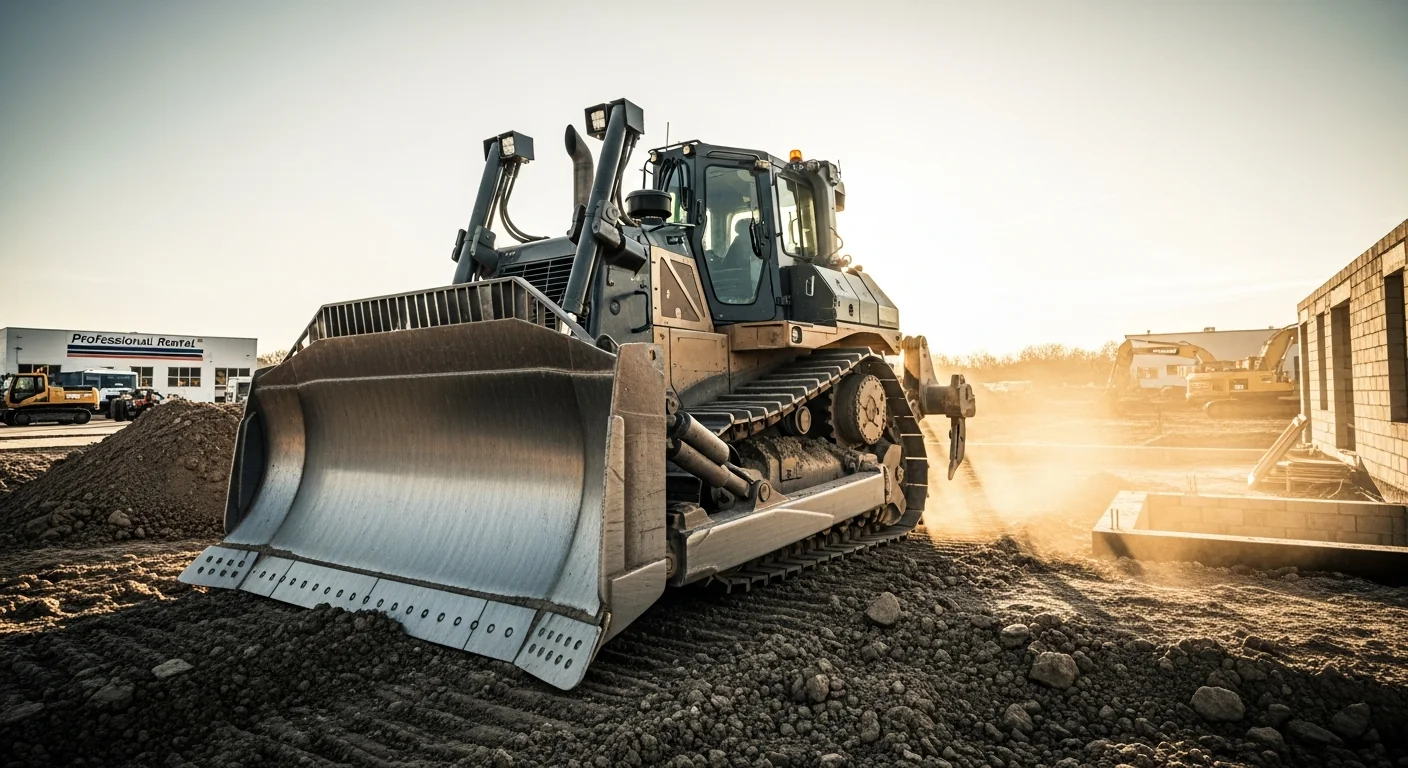
Most rental companies advertise base rates, but the real cost runs significantly higher. Here's the complete breakdown contractors need before signing any rental agreement.
National rental rates vary significantly by equipment class and market demand. Small bulldozers (D1-D3 class) typically rent for $650-$1,500 per day, with weekly rates offering 15-30% savings and monthly rates reducing the effective daily cost by 40-60%. Mid-size units (D4-D6 class) range from $1,500-$3,500 daily, while large dozers (D7-D9 class) command $3,500-$6,900+ per day.
According to MachineryTrader.com data, monthly rental costs average $54,570 for mid-size bulldozers, with weekly rates around $19,890. The math generally works out to five daily rentals equaling one weekly rate, while three weekly rentals approximate one monthly rate—but these break-even points vary by region and seasonal demand.
Delivery and pickup fees represent the largest hidden cost, ranging from $500-$2,500+ depending on distance from the rental depot. Damage waiver or Equipment Protection Plans add $150-$500 per day for large dozers—and these are typically mandatory, not optional. Deposits range from $2,000-$10,000+ and tie up working capital for the rental duration.
Attachment rentals create another surprise expense. A ripper attachment costs $200-$500 per day, while 6-way blades and GPS grade control systems add similar premiums. State rental sales tax, averaging 6-8% in most jurisdictions, applies to the total rental amount including attachments and fees.
Rental rates spike 30-50% during peak construction season (April through September) in most U.S. markets. Urban markets typically offer next-day delivery, while rural areas may require 5-7 day lead times plus delivery surcharges exceeding $2,000. Contractors with flexible timelines can save 20-35% by scheduling earthwork during shoulder seasons (October and March).
The math on bulldozer acquisition becomes clear when you run real numbers instead of relying on rule-of-thumb estimates.
For a $530,500 mid-size bulldozer over 12 months, rental costs reach approximately $654,840 at current market rates ($54,570/month). Financing the same equipment at 12% APR over 60 months results in monthly payments of $11,882, or $142,584 over 12 months. The contractor financing walks away owning an asset worth approximately $450,000 after one year of depreciation.
According to IRS Publication 946, Section 179 deduction limits for 2026 allow up to $2,560,000 in immediate tax deductions on qualifying equipment. For our $530,500 bulldozer, a contractor in the 32% tax bracket saves $169,760 in Year 1 taxes—creating a 32% immediate cash flow recovery. Rental payments offer no comparable tax advantage beyond standard operating expense deductions.
Most contractors can determine their optimal acquisition strategy using the 60-70% utilization threshold. If you need a bulldozer more than 150-180 working days per year (roughly 60-70% annual utilization), financing almost always costs less than renting. Below 50 working days annually, rental makes sense. Between 50-150 days requires project-specific analysis.
Bonus depreciation for 2026 allows a 20% first-year deduction on qualifying new and used equipment, continuing the annual phase-down under the Tax Cuts and Jobs Act. Combined with Section 179, contractors can recover significant cash in Year 1 through accelerated depreciation that rental simply cannot provide.
State rental sales tax adds 6-8% to rental costs in many jurisdictions—a hidden expense that doesn't apply to equipment purchases in most states. Over a 12-month rental period, this tax burden can reach $40,000-$50,000 on a mid-size bulldozer.
Rental contracts contain terms that can significantly impact your total project cost if you don't understand the fine print.
Most national rental companies require valid government ID (21+ years), proof of general liability insurance with $1-2 million minimum coverage ($5 million+ for large equipment), and deposits ranging from $2,000-$10,000+ depending on equipment value. Credit checks or established corporate accounts are standard.
For contractors without sufficient insurance coverage, separate equipment riders typically cost $2,000-$5,000 and must be secured before rental commencement. This insurance requirement alone can add significant upfront costs that many contractors don't anticipate.
Most rental agreements include "short-rental" penalties if you return equipment before the selected rate period expires. Returning a monthly rental after two weeks typically reverts pricing to the higher weekly rate, not prorated monthly pricing. Some contracts include minimum rental periods ranging from three days to one week, regardless of actual usage.
Not one major rental company website adequately explains the renter's OSHA compliance obligations—yet violations can cost your company tens of thousands in penalties.
Under 29 CFR 1926.602, OSHA requires that all bulldozer operators receive proper training before operating material handling equipment. While formal certification isn't mandated, employers must ensure operator competency. Under 29 CFR 1926.1000, all bulldozers must be equipped with Rollover Protective Structures (ROPS), with different standards applying to pre-July 2019 versus post-July 2019 equipment.
Seat belts are required under SAE J386-1969 standards, and daily pre-shift inspections are mandatory. The renter—not the rental company—bears responsibility for verifying compliance on delivered equipment and ensuring proper operator training.### OSHA Penalty Schedule for Bulldozer ViolationsOSHA penalties for serious bulldozer safety violations range from $1,190 to $16,550 per violation, according to current penalty schedules. Willful or repeat violations carry penalties of $11,524 to $165,514 per violation. These penalties apply to the equipment operator's employer, regardless of whether the equipment is owned or rented.
When utilization analysis favors ownership, several government-backed financing programs offer attractive alternatives to traditional bank loans.
SBA 504 loans provide up to $5,500,000 for long-term equipment purchases with as little as 10% down payment, while SBA 7(a) loans offer up to $5,000,000 for equipment acquisition. SBA Microloans, capped at $50,000, work well for smaller or used equipment purchases.
These programs typically offer better terms than conventional equipment financing, especially for contractors with limited operating history or marginal credit profiles.
A-tier borrowers (720+ FICO scores) typically see rates from 6.5-9.5% APR, while B-tier borrowers (650-719 FICO) range from 9.5-14% APR. Startup businesses or those with credit challenges may face 12-18% rates, but even these higher rates often prove cheaper than long-term rental when combined with tax benefits.
Based on EquipFlow's analysis of current market data, Section 179 deduction generates $169,760 in Year 1 tax savings at 32% bracket for our $530,500 bulldozer example—creating a 32% immediate cash flow recovery multiplier that dramatically improves financing economics versus rental.
When rental math stops making sense, smart contractors explore financing options. Here's how EquipFlow matches you with competing lenders who specialize in heavy equipment:
Share details about the equipment type, project timeline, and your business situation. Ava, our AI advisor, analyzes whether financing makes mathematical sense versus continuing to rent. If you're spending $54,570 per month on bulldozer rentals (the national average for mid-size units), Ava calculates your financing alternatives and break-even timeline.
Ava connects you with 3-4 lenders who compete for your business. When lenders compete, rates typically drop 0.5-2 percentage points compared to going direct. We work with lenders who understand bulldozer depreciation curves and offer terms from 60-120 months depending on equipment age and condition.
See exactly how each offer affects your monthly cash flow and total project cost. For a $530,500 bulldozer, you might see monthly payments ranging from $8,200 (A-tier credit at 60 months) to $12,500 (startup credit at 72 months)—still far below the $54,570/month rental equivalent.
You control the decision with zero obligation. Most contractors get approved within 24-48 hours and can close within a week. Unlike rental agreements, you're building equity while gaining immediate tax benefits through Section 179 deductions.
When rental math stops making sense, smart contractors explore financing options. Here's how EquipFlow matches you with competing lenders who specialize in heavy equipment:
Share details about the equipment type, project timeline, and your business situation. Ava, our AI advisor, analyzes whether financing makes mathematical sense versus continuing to rent. If you're spending $54,570 per month on bulldozer rentals (the national average for mid-size units), Ava calculates your financing alternatives and break-even timeline.
Ava connects you with 3-4 lenders who compete for your business. When lenders compete, rates typically drop 0.5-2 percentage points compared to going direct. We work with lenders who understand bulldozer depreciation curves and offer terms from 60-120 months depending on equipment age and condition.
See exactly how each offer affects your monthly cash flow and total project cost. For a $530,500 bulldozer, you might see monthly payments ranging from $8,200 (A-tier credit at 60 months) to $12,500 (startup credit at 72 months)—still far below the $54,570/month rental equivalent.
You control the decision with zero obligation. Most contractors get approved within 24-48 hours and can close within a week. Unlike rental agreements, you're building equity while gaining immediate tax benefits through Section 179 deductions.
When rental math stops making sense, smart contractors explore financing options. Here's how EquipFlow matches you with competing lenders who specialize in heavy equipment:
Share details about the equipment type, project timeline, and your business situation. Ava, our AI advisor, analyzes whether financing makes mathematical sense versus continuing to rent. If you're spending $54,570 per month on bulldozer rentals (the national average for mid-size units), Ava calculates your financing alternatives and break-even timeline.
Ava connects you with 3-4 lenders who compete for your business. When lenders compete, rates typically drop 0.5-2 percentage points compared to going direct. We work with lenders who understand bulldozer depreciation curves and offer terms from 60-120 months depending on equipment age and condition.
See exactly how each offer affects your monthly cash flow and total project cost. For a $530,500 bulldozer, you might see monthly payments ranging from $8,200 (A-tier credit at 60 months) to $12,500 (startup credit at 72 months)—still far below the $54,570/month rental equivalent.
You control the decision with zero obligation. Most contractors get approved within 24-48 hours and can close within a week. Unlike rental agreements, you're building equity while gaining immediate tax benefits through Section 179 deductions.
When rental costs exceed financing benefits, EquipFlow's lender-matching platform helps contractors secure competitive rates without the typical loan shopping hassle.
Lenders competing for the same deal typically drop rates 0.5-2 percentage points compared to single-lender applications. EquipFlow presents your profile to 3-4 specialized equipment lenders simultaneously, creating competitive pressure that benefits your bottom line. Most contractors see multiple offers within 24-48 hours.
Banks reject approximately 67% of used equipment loans over seven years old due to depreciation concerns, but specialty lenders often approve these deals with appropriate terms. Ava, our AI advisor, matches you with lenders who understand bulldozer depreciation curves and residual values, improving your approval odds significantly.
Every day without proper equipment represents lost revenue opportunity. EquipFlow's streamlined process delivers competing offers within 24-48 hours, and most contractors can close within one week. This speed advantage matters when project timelines are tight and rental costs are bleeding cash flow.
Comparing financing options carries zero commitment until you choose a lender and sign documentation. Unlike rental agreements that lock you into recurring payments with no equity building, EquipFlow lets you evaluate alternatives without pressure or obligation.
When rental costs exceed financing benefits, EquipFlow's lender-matching platform helps contractors secure competitive rates without the typical loan shopping hassle.
Lenders competing for the same deal typically drop rates 0.5-2 percentage points compared to single-lender applications. EquipFlow presents your profile to 3-4 specialized equipment lenders simultaneously, creating competitive pressure that benefits your bottom line. Most contractors see multiple offers within 24-48 hours.
Banks reject approximately 67% of used equipment loans over seven years old due to depreciation concerns, but specialty lenders often approve these deals with appropriate terms. Ava, our AI advisor, matches you with lenders who understand bulldozer depreciation curves and residual values, improving your approval odds significantly.
Every day without proper equipment represents lost revenue opportunity. EquipFlow's streamlined process delivers competing offers within 24-48 hours, and most contractors can close within one week. This speed advantage matters when project timelines are tight and rental costs are bleeding cash flow.
Comparing financing options carries zero commitment until you choose a lender and sign documentation. Unlike rental agreements that lock you into recurring payments with no equity building, EquipFlow lets you evaluate alternatives without pressure or obligation.
When rental costs exceed financing benefits, EquipFlow's lender-matching platform helps contractors secure competitive rates without the typical loan shopping hassle.
Lenders competing for the same deal typically drop rates 0.5-2 percentage points compared to single-lender applications. EquipFlow presents your profile to 3-4 specialized equipment lenders simultaneously, creating competitive pressure that benefits your bottom line. Most contractors see multiple offers within 24-48 hours.
Banks reject approximately 67% of used equipment loans over seven years old due to depreciation concerns, but specialty lenders often approve these deals with appropriate terms. Ava, our AI advisor, matches you with lenders who understand bulldozer depreciation curves and residual values, improving your approval odds significantly.
Every day without proper equipment represents lost revenue opportunity. EquipFlow's streamlined process delivers competing offers within 24-48 hours, and most contractors can close within one week. This speed advantage matters when project timelines are tight and rental costs are bleeding cash flow.
Comparing financing options carries zero commitment until you choose a lender and sign documentation. Unlike rental agreements that lock you into recurring payments with no equity building, EquipFlow lets you evaluate alternatives without pressure or obligation.
When rental costs exceed financing benefits, EquipFlow's lender-matching platform helps contractors secure competitive rates without the typical loan shopping hassle.
Lenders competing for the same deal typically drop rates 0.5-2 percentage points compared to single-lender applications. EquipFlow presents your profile to 3-4 specialized equipment lenders simultaneously, creating competitive pressure that benefits your bottom line. Most contractors see multiple offers within 24-48 hours.
Banks reject approximately 67% of used equipment loans over seven years old due to depreciation concerns, but specialty lenders often approve these deals with appropriate terms. Ava, our AI advisor, matches you with lenders who understand bulldozer depreciation curves and residual values, improving your approval odds significantly.
Every day without proper equipment represents lost revenue opportunity. EquipFlow's streamlined process delivers competing offers within 24-48 hours, and most contractors can close within one week. This speed advantage matters when project timelines are tight and rental costs are bleeding cash flow.
Comparing financing options carries zero commitment until you choose a lender and sign documentation. Unlike rental agreements that lock you into recurring payments with no equity building, EquipFlow lets you evaluate alternatives without pressure or obligation.
.png)