Many businesses receive funding shortly after approval
Built to help businesses explore realistic financing options
Business owners trust EquipFlow to simplify financing decisions
National and specialty lenders across industries
Your fastest route to the right lender — and the equipment your business needs.
Share your equipment type, business info, and location — it takes less than 60 seconds.
We instantly compare national and specialty lenders to find your best funding options.
Review offers, choose your lender, and get approved with fast turnaround times.
Forklifts for sale range from $8,000–$15,000 for quality used units (5,000–8,000 lb capacity, 2015–2020 models) to $25,000–$55,000+ for new equipment, with financing available from 6% APR for established businesses and as low as $0 down for qualified buyers. According to IRS Publication 946, purchasing in 2026 lets you deduct the full price under Section 179 (up to $2,560,000), potentially saving $6,300+ on a $30,000 forklift—a tax advantage unavailable to renters.
Here's what most forklift buyers discover too late: that $20,000 forklift actually costs $25,000+ in Year 1. Nobody told you about OSHA-mandated operator certification ($200–$300 per person), required liability insurance ($500–$2,000/year), and annual safety inspections. Under 29 CFR 1910.178, operating without certified operators risks fines up to $165,514 per violation.
Renting a forklift at $1,610/month feels safe—no commitment, no large outlay. But after 18 months, you've spent $28,980 and own nothing. A financed $30,000 forklift at the same monthly cash outflow would be half paid off, with a $6,300 tax deduction on top. Most businesses that rent for more than 2 years are throwing away money.
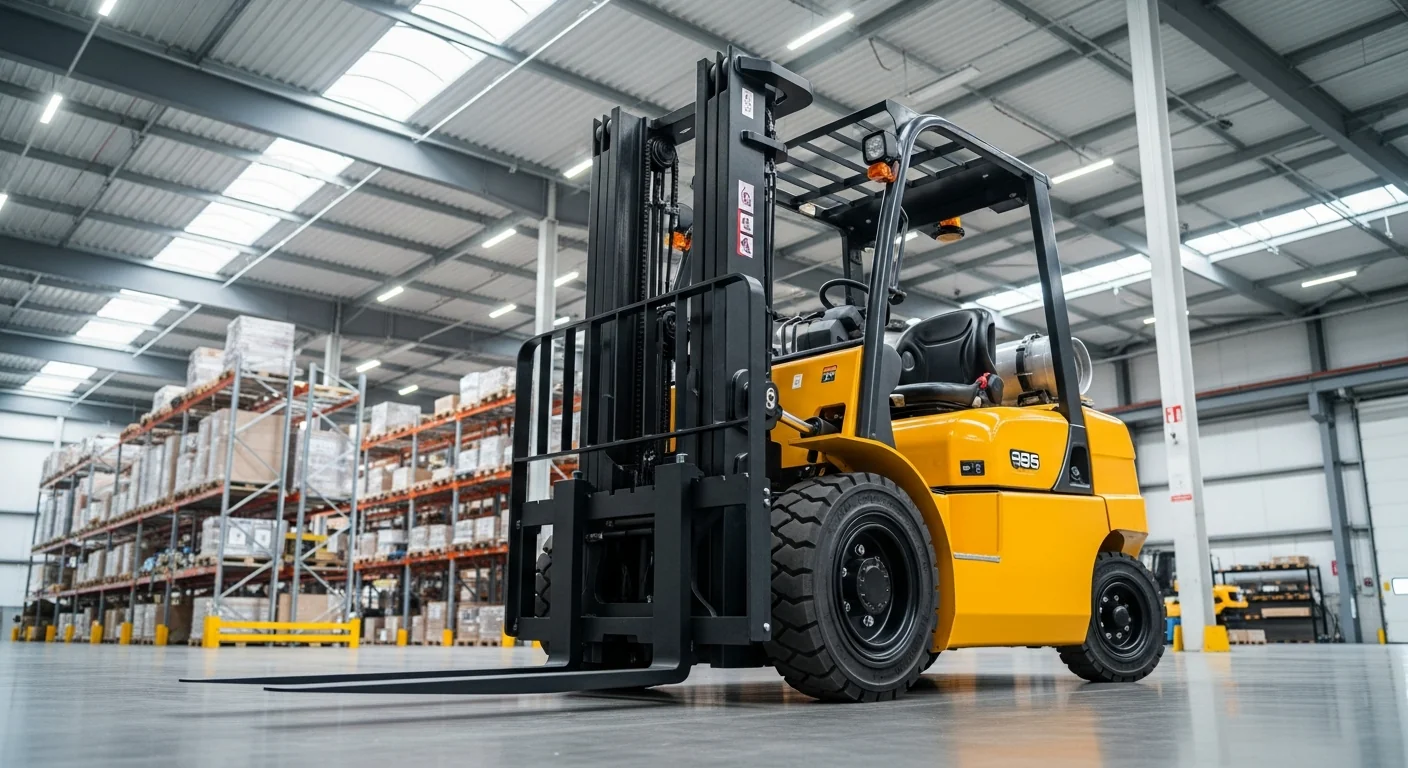
New forklift prices by capacity tell the story: 3,000 lb electric models start around $15,000-$25,000, while 5,000 lb propane units range $18,000-$35,000. Heavy-duty 8,000+ lb diesel forklifts command $25,000-$55,000+ for new units. But here's what dealers won't tell you upfront: fuel type dramatically affects both purchase price and operating costs.
Used forklifts follow predictable depreciation curves that smart buyers exploit. 2020-2025 models with under 5,000 hours typically cost 40-60% of new price. A $30,000 new Toyota might sell used for $18,000-$20,000 with 3,000 hours. 2010-2019 models with 5,000-10,000 hours: expect 20-40% of original new price.
Pre-2010 forklifts represent the biggest financing challenge. Most lenders won't finance equipment over 12-15 years old, forcing cash purchases or specialty high-rate financing. A 2008 Crown with 8,000 hours might sell for $8,000-$12,000, but you'll likely need 30%+ down if financing is even available.
Toyota, Crown, Hyster, and Yale command 15-25% price premiums but hold residual value better—critical for financing approval. Mid-tier brands like Komatsu and Mitsubishi offer solid value, while budget brands may cost less upfront but result in higher down payments due to lower collateral value.
Electric forklifts carry the highest purchase prices—often 20-30% more than propane equivalents—but offer the lowest operating costs at roughly $2-3 per 8-hour shift in electricity. Propane units balance purchase price with operating flexibility, costing $8-12 per shift in fuel. Diesel models excel in outdoor heavy-duty applications but burn $10-15 per shift in fuel.
The financing math matters: electric units may qualify for state clean energy incentives, effectively reducing the purchase price. Propane units offer the broadest lender acceptance due to proven reliability and strong resale markets.
Here's what most people miss: forklift financing isn't just about your credit score—it's about the equipment's age, hours, and brand. Ameris Bank, a representative equipment lender, requires minimum 620 FICO, at least 1 year in business, and $100,000+ annual revenue. But these are baseline requirements. Your rate depends on multiple factors.
A-Tier borrowers (680+ FICO, 2+ years in business, strong cash flow) typically see 6-9% APR with minimal or zero down payment. These deals close fastest because lenders compete aggressively for quality borrowers.
B-Tier borrowers (620-679 FICO, 1-2 years in business, adequate cash flow) face 9-13% APR with 10-20% down payment requirements. Term lengths may be shorter (36-48 months instead of 60-84).
Startup and challenged credit borrowers (below 620 FICO or less than 1 year in business) see 11-16% APR with 20-30% down payments. Anything above 18% APR should trigger scrutiny—you might be looking at a Merchant Cash Advance disguised as equipment financing.
Zero-down financing exists but requires top-tier credit and newer equipment. A-tier borrowers financing 2020+ forklifts with under 5,000 hours often qualify for 100% financing. SBA 504 loans offer another path to low down payments: just 10% down on purchases above $50,000, with the SBA backing 40% and a traditional lender covering 50%.
Equipment age drives down payment requirements more than credit scores. Lenders typically require 15-25% down on forklifts over 7 years old, regardless of your credit profile. This reflects the equipment's declining collateral value and harder resale market for older units.
This guide doesn't exist anywhere else, but it should. Forklifts 0-7 years old with under 8,000 hours get standard rates and minimal down payments. Banks understand these units' residual values and approve them readily.
Forklifts 7-12 years old with 8,000-12,000 hours face higher rates and 15-25% down payment requirements. Lenders view these as higher-risk collateral but still financeable with proper credit profiles.
Forklifts 12+ years old with 12,000+ hours represent the financing danger zone. Many lenders won't touch them at all. Those that will often require 30%+ down and charge near-credit card rates.
Brand matters enormously here. A 10-year-old Toyota with 9,000 hours gets better financing terms than a 7-year-old budget brand with 6,000 hours. Lenders know Toyota holds value.
The rental trap catches businesses that don't run the numbers. Renting a comparable IC pneumatic 5,000 lb forklift costs roughly $1,610 per month. A $30,000 forklift financed at 6% over 60 months costs approximately $580 monthly. Break-even occurs at 18-20 months, making financing the clear winner for sustained operations beyond 2 years.
Run the 5-year math: financing totals $34,800 in payments, after which you own a $12,000-15,000 asset. Renting totals $96,600 with no ownership. The difference: $61,800 in your pocket, plus you own equipment worth $12,000+.
Factor in Section 179 tax savings to accelerate the math. That $30,000 purchase creates $6,300-$10,500 in immediate tax savings (depending on your bracket), effectively reducing your cost to $19,500-23,700. Now you're comparing $580/month financing on a net $23,700 cost versus $1,610/month rental building zero equity.
Renting wins for short-term projects under 12 months, seasonal spikes where you need extra capacity temporarily, or when testing a new capacity size before committing to purchase. If you're renting the same forklift for more than 18 months, the math says you should own it.
Operating leases keep equipment off your balance sheet and provide predictable monthly costs including maintenance. Capital leases function like financing—you own the equipment at the end and can claim Section 179 deductions. Traditional financing gives you immediate ownership and maximum tax benefits. Learn more about forklift types and uses to determine which ownership path aligns with your operational needs.Section 179 applies to purchases and capital leases but not operating leases. If tax deductions matter to your business, financing or capital leasing beats operating leases significantly.
According to IRS Publication 946, the 2026 Section 179 deduction limit is $2,560,000, allowing businesses to deduct the full purchase price of qualifying equipment in the year it's placed in service. Forklifts qualify as tangible personal property used in business.
For a $50,000 forklift purchase, Section 179 creates $10,500 in immediate tax savings at the 21% corporate rate. This effectively reduces the price to $39,500—a 21% immediate cash recovery that makes financing mathematically superior to renting in almost every scenario.
Bonus depreciation for 2026 adds another layer: 20% first-year deduction on any remaining cost basis after Section 179. While most forklift purchases under $2.56M get fully covered by Section 179, larger fleet purchases can capture bonus depreciation on the overflow.
The deadline matters: equipment must be purchased AND placed in service by December 31, 2026. Q4 purchases often provide the best tax strategy, but Q1 purchases typically offer better pricing as dealers clear inventory.
Under OSHA standard 29 CFR 1910.178, all forklift operators must complete formal training including classroom instruction, practical training, and evaluation. Operators must be at least 18 years old, and certification requires renewal every 3 years. Training costs run $200-$300 per operator—multiply by your workforce size.
OSHA penalties for non-compliance reach up to $16,550 per serious violation and $165,514 per willful or repeated violation. Over $8 million in total penalties were issued for Powered Industrial Truck Standard violations. The Powered Industrial Truck standard consistently ranks in OSHA's top 10 most-cited violations annually.
Beyond OSHA compliance, budget for liability insurance ($500-$2,000/year), annual maintenance and inspections ($1,500-$3,500/year), fuel costs ($2,000-$5,000/year), and tire replacements ($500-$1,500/year). Total hidden costs: $4,700-$12,300 annually above your equipment payment.
For a $25,000 forklift with a 10-year useful life, total cost of ownership reaches $72,000-$148,000 including all operating costs, maintenance, compliance, and insurance. Factor these costs into your financing decision—a slightly higher monthly payment that includes warranty coverage might cost less than self-insuring maintenance on an older unit.
Because forklift financing varies dramatically based on equipment age, hours, and brand—plus your credit profile—the key is getting multiple lenders to compete for your deal. When 3-4 lenders compete, rates typically drop 0.5-2 percentage points compared to going direct to one bank.
Our AI advisor Ava analyzes your specific forklift requirements (capacity, fuel type, age), business profile, and credit situation. This isn't generic matching—Ava understands that a 2015 Toyota with 6,000 hours gets better financing terms than a 2010 Hyster with 12,000 hours.
Ava connects you with 3-4 lenders from our network who specialize in your equipment type and credit tier. Banks reject 67% of used equipment loans over 7 years old—Ava finds lenders who understand forklift residual values and won't automatically decline older units.
See exactly how each offer affects your cash flow. A-tier borrowers (680+ FICO) typically see 6-9% APR, while B-tier (620-679 FICO) ranges from 9-13%. You'll see real numbers: monthly payments, down payment requirements, and total interest costs.
You choose the offer that works best for your business. No pressure, no obligation. Most contractors close within 24-48 hours of selecting their preferred lender.
Because forklift financing varies dramatically based on equipment age, hours, and brand—plus your credit profile—the key is getting multiple lenders to compete for your deal. When 3-4 lenders compete, rates typically drop 0.5-2 percentage points compared to going direct to one bank.
Our AI advisor Ava analyzes your specific forklift requirements (capacity, fuel type, age), business profile, and credit situation. This isn't generic matching—Ava understands that a 2015 Toyota with 6,000 hours gets better financing terms than a 2010 Hyster with 12,000 hours.
Ava connects you with 3-4 lenders from our network who specialize in your equipment type and credit tier. Banks reject 67% of used equipment loans over 7 years old—Ava finds lenders who understand forklift residual values and won't automatically decline older units.
See exactly how each offer affects your cash flow. A-tier borrowers (680+ FICO) typically see 6-9% APR, while B-tier (620-679 FICO) ranges from 9-13%. You'll see real numbers: monthly payments, down payment requirements, and total interest costs.
You choose the offer that works best for your business. No pressure, no obligation. Most contractors close within 24-48 hours of selecting their preferred lender.
Because forklift financing varies dramatically based on equipment age, hours, and brand—plus your credit profile—the key is getting multiple lenders to compete for your deal. When 3-4 lenders compete, rates typically drop 0.5-2 percentage points compared to going direct to one bank.
Our AI advisor Ava analyzes your specific forklift requirements (capacity, fuel type, age), business profile, and credit situation. This isn't generic matching—Ava understands that a 2015 Toyota with 6,000 hours gets better financing terms than a 2010 Hyster with 12,000 hours.
Ava connects you with 3-4 lenders from our network who specialize in your equipment type and credit tier. Banks reject 67% of used equipment loans over 7 years old—Ava finds lenders who understand forklift residual values and won't automatically decline older units.
See exactly how each offer affects your cash flow. A-tier borrowers (680+ FICO) typically see 6-9% APR, while B-tier (620-679 FICO) ranges from 9-13%. You'll see real numbers: monthly payments, down payment requirements, and total interest costs.
You choose the offer that works best for your business. No pressure, no obligation. Most contractors close within 24-48 hours of selecting their preferred lender.
When 3-4 lenders compete for the same deal, rates typically drop 0.5-2 percentage points compared to applying direct to one bank. Banks reject 67% of used equipment loans over 7 years old, but Ava finds lenders who specialize in older forklift financing and understand residual values.
Our AI advisor understands that a 2015 Toyota with 6,000 hours gets vastly different treatment than a 2010 budget brand with 12,000 hours. Ava matches you with lenders who approve your specific equipment profile instead of wasting time on lenders who'll automatically decline.
Every day without equipment costs money. Most contractors get matched with competing lenders within 24 hours and close their chosen deal within 48 hours. No weeks-long approval processes or endless paperwork loops.
See what you qualify for with no commitment and no credit impact during the initial matching phase. You choose the best offer from multiple lenders, or walk away if none work for your business. The power stays with you.
When 3-4 lenders compete for the same deal, rates typically drop 0.5-2 percentage points compared to applying direct to one bank. Banks reject 67% of used equipment loans over 7 years old, but Ava finds lenders who specialize in older forklift financing and understand residual values.
Our AI advisor understands that a 2015 Toyota with 6,000 hours gets vastly different treatment than a 2010 budget brand with 12,000 hours. Ava matches you with lenders who approve your specific equipment profile instead of wasting time on lenders who'll automatically decline.
Every day without equipment costs money. Most contractors get matched with competing lenders within 24 hours and close their chosen deal within 48 hours. No weeks-long approval processes or endless paperwork loops.
See what you qualify for with no commitment and no credit impact during the initial matching phase. You choose the best offer from multiple lenders, or walk away if none work for your business. The power stays with you.
When 3-4 lenders compete for the same deal, rates typically drop 0.5-2 percentage points compared to applying direct to one bank. Banks reject 67% of used equipment loans over 7 years old, but Ava finds lenders who specialize in older forklift financing and understand residual values.
Our AI advisor understands that a 2015 Toyota with 6,000 hours gets vastly different treatment than a 2010 budget brand with 12,000 hours. Ava matches you with lenders who approve your specific equipment profile instead of wasting time on lenders who'll automatically decline.
Every day without equipment costs money. Most contractors get matched with competing lenders within 24 hours and close their chosen deal within 48 hours. No weeks-long approval processes or endless paperwork loops.
See what you qualify for with no commitment and no credit impact during the initial matching phase. You choose the best offer from multiple lenders, or walk away if none work for your business. The power stays with you.
When 3-4 lenders compete for the same deal, rates typically drop 0.5-2 percentage points compared to applying direct to one bank. Banks reject 67% of used equipment loans over 7 years old, but Ava finds lenders who specialize in older forklift financing and understand residual values.
Our AI advisor understands that a 2015 Toyota with 6,000 hours gets vastly different treatment than a 2010 budget brand with 12,000 hours. Ava matches you with lenders who approve your specific equipment profile instead of wasting time on lenders who'll automatically decline.
Every day without equipment costs money. Most contractors get matched with competing lenders within 24 hours and close their chosen deal within 48 hours. No weeks-long approval processes or endless paperwork loops.
See what you qualify for with no commitment and no credit impact during the initial matching phase. You choose the best offer from multiple lenders, or walk away if none work for your business. The power stays with you.
.png)