Many businesses receive funding shortly after approval
Built to help businesses explore realistic financing options
Business owners trust EquipFlow to simplify financing decisions
National and specialty lenders across industries
Your fastest route to the right lender — and the equipment your business needs.
Share your equipment type, business info, and location — it takes less than 60 seconds.
We instantly compare national and specialty lenders to find your best funding options.
Review offers, choose your lender, and get approved with fast turnaround times.
Forklift financing is where most buyers leave $5,000-$15,000 on the table—not because they picked the wrong machine, but because they took the first dealer quote without understanding what was underneath it. The dealer says '$580 a month.' Sounds fine. Except nobody told you that's at 13.9% APR, with a $475 doc fee, and a $9,000 residual buyout in month 49 you weren't planning for. That's not financing. That's a trap with a payment schedule.
Here's what most people miss: the average new forklift costs around $30,000 (per industry data from forklifttrader.com), and under the 2026 OBBB-updated tax code, the entire purchase price is deductible in Year 1 under Section 179—up to a $2,560,000 cap, with 100% bonus depreciation restored permanently on top of that. At a 35% effective bracket, that's $10,500 in immediate tax savings on a single forklift. Pay cash and you still get the deduction. Finance smart and you keep the working capital AND get the deduction. The math isn't close.
Let me be direct: the question isn't 'should I finance a forklift?' The question is 'which lender's offer is actually the cheapest after fees, residuals, and tax treatment?' That's what this page solves. Real rate ranges by credit tier. Real payment scenarios. The Section 179 math. SBA fitments. And the OSHA penalty exposure nobody factors in until they get fined $16,550. Ava will match you with 3-4 lenders who compete for your deal—but first, know the numbers cold.
[CTA] Stop letting dealers hide the real cost in your forklift payment. Get competing quotes from specialized lenders in 24 hours and see the actual APR, fees, and terms side-by-side. [Get My Real Rate]
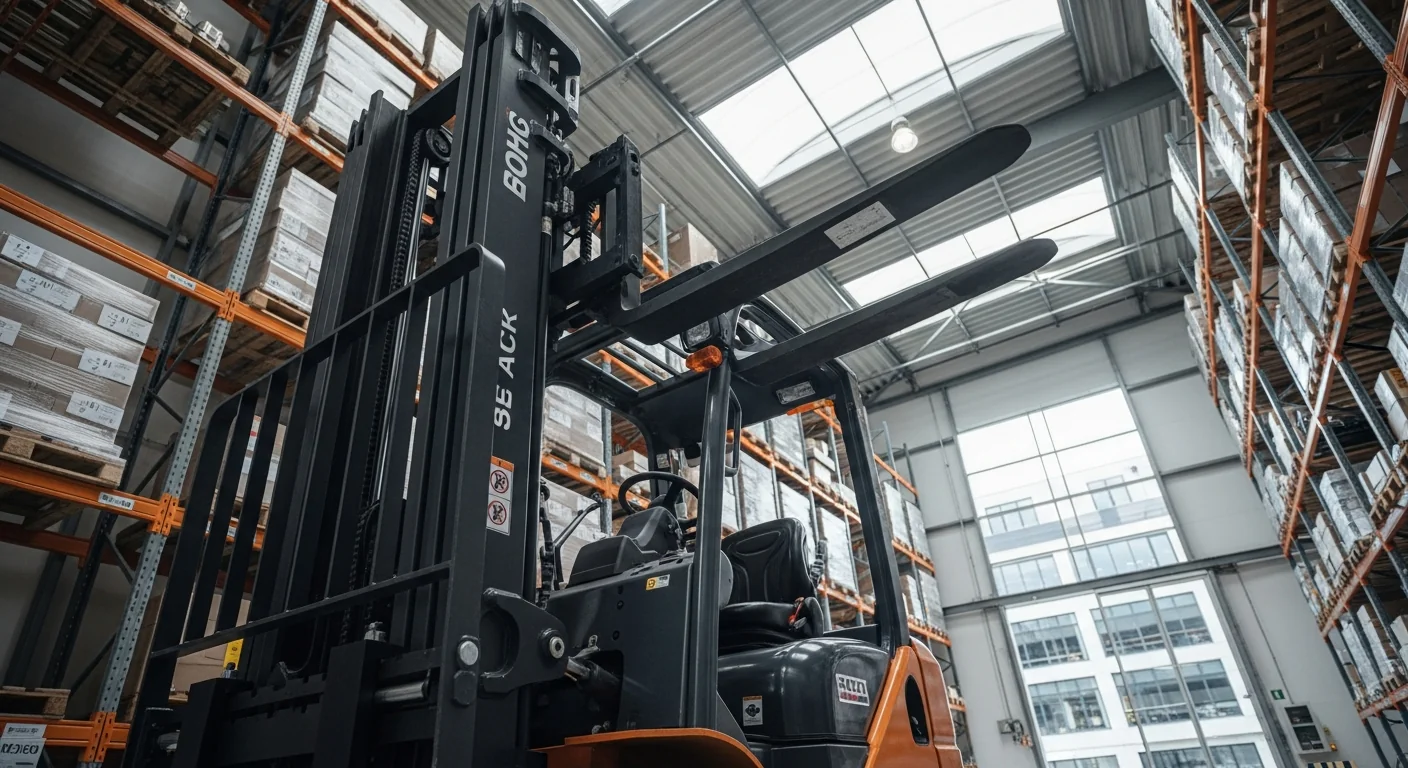
Every competitor page says 'rates vary based on creditworthiness.' That's not helpful. Here's what we typically see, based on a $30,000 forklift financed over 48 months, subject to credit approval. For broader context on equipment selection and operations, explore our complete forklift guide.
Borrowers in the top tier with 2+ years in business and strong cash flow typically see APRs in the 5.5-7.9% range, with mid-band rates around 6.7%, subject to lender approval. On $30K over 48 months, that's roughly $714/month. These borrowers also qualify for $0-down structures and sometimes $1 buyout leases at the most aggressive pricing. If you're here, your only mistake is taking the first offer—captive financing from Toyota or another OEM might match or beat market, but independent lenders compete hard for prime paper.
This is the sweet spot for most established small businesses. Rates typically run 7.5-9.9% APR, mid-band around 8.7%, putting monthly payments near $742 on a $30K/48-month loan, OAC. Most lenders require 0-10% down at this tier. The gap between Excellent and Good is real—about $28/month, or $1,344 over the life of the loan—which is exactly why a soft-pull pre-qualification matters before you sign anything.
Mid-tier credit sees rates in the 9.5-12.9% range, mid-band 11.2%, monthly payments around $778, subject to credit approval. Down payments typically jump to 10-15%. This is where lender matching matters most—two lenders looking at identical files can quote 300 basis points apart. A 9.5% lender vs. a 12.9% lender on $30K/48 months is a $52/month difference and $2,496 over the term.
Fair-credit or startup-tier borrowers typically see 12.0-16.9% APR, with mid-band rates around 14.45%—roughly $827/month on $30K/48 months, OAC. Down payments often run 15-20%. The lenders willing to play in this tier are specialized; banks won't touch most of these deals. This is also where SBA Microloans (covered below) become competitive.
Per forklifttrader.com market data, new forklifts run $15,000 to $50,000+, with an industry average around $30,000. Used units land in the $8,000-$25,000 range depending on hours, age, and class. If you're shopping options, browse forklifts for sale to compare current inventory.
Class I electric riders (warehouse standard) typically run $20K-$35K new. Class IV/V internal combustion (propane, diesel, gasoline) lean higher—$25K-$50K for capable units. Niche categories like narrow-aisle reach trucks can push $45K-$70K. Heavier capacity diesel models (10,000+ lbs) routinely cross $60K.
Here's what dealers don't volunteer: most lenders cap financing on forklifts over 15,000 hours or older than 10 years. We've seen plenty of 'great deal' $9,000 used forklifts that nobody will finance because they're 12 years old with 18,000 hours. The asset just doesn't have enough useful life left to collateralize. If you're buying used, ask hours and year BEFORE you fall in love with the price tag.
On a $30,000 forklift financed over different terms, the math compounds quickly. A 36-month loan has higher monthly payments but less total interest. A 72-month loan flattens cash flow but adds significant interest. The sweet spot for forklifts is typically 48-60 months—matched roughly to the unit's productive economic life.
[CTA] See what your specific forklift qualifies for across multiple lenders. Get pre-qualified rates in 24 hours with no hard credit pull. [Start My Free Quote]
Featured Callout — The Numbers That Change the Deal:
Under the 2026 OBBB tax framework, you can deduct the FULL $30,000 purchase price of a qualifying forklift in Year 1 under Section 179 (well under the $2,560,000 deduction cap per IRS Publication 946). At a 35% effective tax bracket, that generates $10,500 in immediate tax savings—dropping your net effective cost to $19,500. That's a 35% discount the tax code hands you for buying productive equipment.
Forklifts are classified as 5-year MACRS property and qualify for Section 179 expensing as long as you place the unit in service before December 31 of the tax year. New AND used equipment qualifies (this is critical—a lot of bad info online says used doesn't, which is wrong under current rules).
Under OBBB, 100% bonus depreciation has been restored permanently on qualifying equipment—new and used. For most single-forklift buyers, Section 179 alone wipes out the entire deduction, so bonus depreciation is more relevant for businesses purchasing multiple units in the same year or exceeding the Section 179 limit.
A $1 buyout lease (capital lease) is treated like a purchase for tax purposes—you get Section 179. An operating lease (FMV) is deducted as a business expense over the lease term. The math usually favors the capital lease structure if you want the deduction now, but talk to your CPA before you sign.
Featured Callout — Rent vs. Finance:
Daily forklift rental rates run $100-$500/day, monthly $900-$2,000+ depending on class. Finance a $30,000 forklift at ~11.2% over 48 months and your payment lands around $778/month. Rent a forklift for your project at $900/month and you're paying $122 more PER MONTH for zero equity. Break-even on owning vs. renting typically hits at 15-19 months of utilization. Past that, you're literally paying for the forklift twice.
Paying cash for a $30,000 forklift feels safe. It's not. Most operating businesses generate 15-20% ROI on working capital deployed into the business. Tie up $30K in a forklift and you've eliminated $4,500-$6,000/year in opportunity cost. Finance the same forklift at 11.2% and your annual interest cost is roughly $2,000-$2,500 in Year 1. The math: financing is $2,000-$3,500/year CHEAPER than paying cash when you account for opportunity cost. The cash you keep can fund payroll, inventory, growth.
For buyers who don't qualify for conventional equipment financing—or who want longer terms and lower payments—SBA programs are underutilized, subject to SBA approval criteria.
Per SBA.gov, the Microloan program caps at $50,000—perfect for single-forklift purchases. These run through nonprofit intermediary lenders, typically with more flexible credit standards. Ideal for startups, women- and minority-owned businesses, or operators who got declined on conventional equipment loans.
The 7(a) program supports equipment purchases up to $5,000,000 per SBA guidelines. The SBA guarantees 85% on loans of $150,000 or less and 75% on loans above that—which lowers lender risk and makes approval more accessible. Terms can extend to 10 years on equipment. For multi-unit fleet purchases, 7(a) is often the right structure.
The 504 program follows a 50-40-10 structure: 50% from a first-lien lender, 40% from an SBA debenture, and 10% borrower equity. Cap is $5,500,000. This is overkill for a single forklift but excellent for buying a warehouse PLUS the forklift fleet to run it.
This matters for the 'toyota forklift lease' question specifically. Captive (manufacturer-owned) finance arms like Toyota Industries Commercial Finance, Crown Credit, Hyster-Yale Capital exist to move new units off dealer floors.
OEM captives often run promotional rates 50-100 basis points below market on new units during specific quarters—year-end inventory clearance is the classic example. If you're buying new, single-brand, and the promo period aligns, captive financing can be the cheapest option on the market. Toyota in particular runs aggressive lease pricing on Class I and Class V models.
Captive financing is locked to one brand. If you're buying used, mixing brands across a fleet, financing attachments separately, or operating a multi-vendor warehouse, independent lenders in our network typically beat captive pricing—because they're not subsidizing a sale. Independents also tend to be more flexible on hour-meter cutoffs, older equipment, and unusual deal structures. Ava can match you with lenders who specialize in exactly this.
The 'buy now, pay later' framing for forklift financing usually means one of two things: deferred-first-payment financing (no payment for 60-90 days) or step-up payment structures (lower payments in months 1-12, higher thereafter). Both have legitimate use cases, subject to lender approval.
Deferred-first-payment structures are common for seasonal businesses—agricultural operations, holiday retail warehouses, construction outfits ramping for spring. You take delivery in November, payments start in February. The unit generates revenue before you make a single payment. Most lenders in our network offer 30-90 day deferrals for qualified borrowers, sometimes longer for SBA-backed structures.
Step-up payments work for growing businesses where revenue is projected to ramp—say, you're opening a second distribution center and forklift utilization will triple in month 6. Payments start lower, escalate as cash flow grows. The total interest paid is typically a bit higher than a flat payment schedule, but cash flow matching can be worth it.
Here's the catch most buyers don't catch: 'no payments for 90 days' isn't free. Interest typically accrues from day one and gets added to principal. Read the disclosure. If the lender capitalizes interest, you're paying interest on interest. Ava's matched lenders disclose this upfront so you can compare structures honestly.
Forklift leasing splits into two categories that get conflated constantly: short-term (1-24 months) and long-term (24-72 months). They serve completely different needs.
Short-term leases are essentially extended rentals with slightly better economics. Typical pricing runs $400-$1,500/month depending on class and capacity, with no end-of-term purchase option. Use case: seasonal demand spikes, project-specific deployments, or filling capacity while a damaged unit is being repaired. The math rarely favors short-term leasing past 18-24 months—at that point, the finance-vs-rent break-even has long since passed and you're paying for the forklift twice.
Long-term leases are the standard fleet structure. $1 buyout leases (TRAC leases in some structures) function like financed purchases and qualify for Section 179. FMV leases offer lower monthly payments with a residual buyout—useful if you want flexibility to upgrade in 36-48 months without owning a depreciating asset. Lease terms typically match the useful economic life of the forklift class: 36-48 months for heavy-use industrial environments, 60-72 months for lighter-duty applications.
The core decision: do you want the equipment at lease end, or do you want flexibility? Want it? $1 buyout lease or equipment loan. Want flexibility? FMV lease. The lenders in our network offer both structures and can model the total cost of ownership against your actual utilization assumptions.
Here's what most people miss: the forklift purchase is only part of the total cost. Operator certification, insurance, and compliance carry real dollars.
Under OSHA standard 29 CFR 1910.178, every forklift operator must be trained and certified, with recertification every 3 years. Training costs run $150-$300 per operator. Sounds trivial until you multiply by 8 operators across two shifts and realize you're spending $1,200-$2,400 every three years—and you need to budget it.
Per OSHA's published 2025 penalty schedule, serious violations carry up to $16,550. Willful or repeat violations hit $165,514. Small employers (under 25 employees) qualify for up to a 70% reduction—but that's still $4,965 for a serious violation. We've seen operators skip certification to save $200 and eat a $16K fine. That's not financial discipline; that's malpractice.
Lenders almost universally require commercial property insurance on financed equipment, typically running $800-$2,000/year depending on coverage limits, equipment value, and your operational risk profile. This is a non-negotiable line item in the total cost of ownership.
Diesel forklifts manufactured after January 1, 2013 must meet EPA Tier 4 standards and use Ultra-Low Sulfur Diesel (ULSD) fuel. If you're buying used diesel, verify the model year. Pre-2013 units may face state restrictions or require expensive after-treatment retrofits in certain jurisdictions. California operators should also note that CARB's zero-emission forklift mandate takes effect January 1, 2026 for state and local government fleets, with broader phase-outs for private fleets running 2028-2038.
The biggest mistake we see: borrowers submit applications to the dealer's 'financing partner,' which then gets shopped to 8-15 lenders simultaneously. Each lender hard-pulls credit. Each pull drops your FICO 5-10 points. You can lose 30-50 points before you even get to closing.
The smart play: soft-pull pre-qualification. Several lenders in our network offer soft-pull initial matching—Ava reviews your basic profile, matches you with lenders whose criteria fit, and only the lender you choose runs a hard inquiry. Your credit stays intact while you compare offers.
What to have ready before you apply: 2 years of business tax returns, 3 months of business bank statements, an equipment quote from the dealer with VIN/serial number, and a personal financial statement for owners with 20%+ stake. Assemble it once. Submit once. Close once.
Forklift buyers typically get one quote from the dealer's in-house finance arm and assume that's the market. It isn't. Here's the process that actually gets you competitive offers, subject to lender approval.
You tell Ava the basics—new or used, Class I-V (electric, internal combustion, narrow aisle, etc.), price range, your time in business, rough credit tier, and intended use. Two minutes. No hard pull. Ava is built to diagnose which lender profiles fit your specific deal: a startup with 18 months in business needs a completely different lender than an established warehouse operator buying a $45K Toyota.
Ava matches you with 3-4 lenders in our network whose underwriting boxes actually fit your profile, subject to their credit approval criteria. This is the part dealers skip—they shop your application to whoever pays them the highest referral fee, not whoever gives you the best rate. When lenders compete for the same deal, rates typically drop 0.5-2 percentage points. On a $30K, 48-month loan, that's $1,200-$4,800 in interest you don't pay.
You see the offers side-by-side: APR, monthly payment, term length, doc fees, residual structure (lease) or amortization (loan). No more 'compare apples to apples' guesswork. The TILA disclosure or lease schedule is right there. You'll see exactly how each offer affects your monthly cash flow and total interest paid.
You pick. No pressure, no obligation, no penalty for walking away. Most approvals close in 24-72 hours once docs are submitted, subject to final credit review. The lender funds the dealer directly, the UCC-1 gets filed, and you're operating the forklift typically within a week of accepted offer.
[CTA] Ready to see competing offers? Start your no-obligation match with specialized forklift lenders in under 2 minutes. [Compare Lender Offers]
Forklift buyers typically get one quote from the dealer's in-house finance arm and assume that's the market. It isn't. Here's the process that actually gets you competitive offers, subject to lender approval.
You tell Ava the basics—new or used, Class I-V (electric, internal combustion, narrow aisle, etc.), price range, your time in business, rough credit tier, and intended use. Two minutes. No hard pull. Ava is built to diagnose which lender profiles fit your specific deal: a startup with 18 months in business needs a completely different lender than an established warehouse operator buying a $45K Toyota.
Ava matches you with 3-4 lenders in our network whose underwriting boxes actually fit your profile, subject to their credit approval criteria. This is the part dealers skip—they shop your application to whoever pays them the highest referral fee, not whoever gives you the best rate. When lenders compete for the same deal, rates typically drop 0.5-2 percentage points. On a $30K, 48-month loan, that's $1,200-$4,800 in interest you don't pay.
You see the offers side-by-side: APR, monthly payment, term length, doc fees, residual structure (lease) or amortization (loan). No more 'compare apples to apples' guesswork. The TILA disclosure or lease schedule is right there. You'll see exactly how each offer affects your monthly cash flow and total interest paid.
You pick. No pressure, no obligation, no penalty for walking away. Most approvals close in 24-72 hours once docs are submitted, subject to final credit review. The lender funds the dealer directly, the UCC-1 gets filed, and you're operating the forklift typically within a week of accepted offer.
[CTA] Ready to see competing offers? Start your no-obligation match with specialized forklift lenders in under 2 minutes. [Compare Lender Offers]
Forklift buyers typically get one quote from the dealer's in-house finance arm and assume that's the market. It isn't. Here's the process that actually gets you competitive offers, subject to lender approval.
You tell Ava the basics—new or used, Class I-V (electric, internal combustion, narrow aisle, etc.), price range, your time in business, rough credit tier, and intended use. Two minutes. No hard pull. Ava is built to diagnose which lender profiles fit your specific deal: a startup with 18 months in business needs a completely different lender than an established warehouse operator buying a $45K Toyota.
Ava matches you with 3-4 lenders in our network whose underwriting boxes actually fit your profile, subject to their credit approval criteria. This is the part dealers skip—they shop your application to whoever pays them the highest referral fee, not whoever gives you the best rate. When lenders compete for the same deal, rates typically drop 0.5-2 percentage points. On a $30K, 48-month loan, that's $1,200-$4,800 in interest you don't pay.
You see the offers side-by-side: APR, monthly payment, term length, doc fees, residual structure (lease) or amortization (loan). No more 'compare apples to apples' guesswork. The TILA disclosure or lease schedule is right there. You'll see exactly how each offer affects your monthly cash flow and total interest paid.
You pick. No pressure, no obligation, no penalty for walking away. Most approvals close in 24-72 hours once docs are submitted, subject to final credit review. The lender funds the dealer directly, the UCC-1 gets filed, and you're operating the forklift typically within a week of accepted offer.
[CTA] Ready to see competing offers? Start your no-obligation match with specialized forklift lenders in under 2 minutes. [Compare Lender Offers]
The difference between getting a good rate and getting taken on a forklift loan is almost entirely about who's competing for your business. Here's how the EquipFlow process works in your favor.
When 3-4 lenders compete for the same deal, rates typically drop 0.5-2 percentage points compared to a single-source quote, subject to final lender approval. On a $30,000 forklift financed over 48 months, that's $1,200-$4,800 you keep instead of paying it in interest. The dealer's in-house finance arm has zero incentive to give you the lowest rate—their referral commission is baked into the spread. Competing lenders are the only mechanism that actually drives pricing down.
Forklift financing has weird quirks—hour-meter cutoffs, brand-specific captive deals, used-equipment age limits, EPA Tier 4 compliance issues on diesel units. Ava is built specifically to match your forklift profile against lender underwriting boxes that actually fit. A Class I electric warehouse forklift goes to a different lender than a 2008 diesel reach truck with 12,000 hours. Ava handles that matching automatically.
Dealer financing takes 12-21 days because lenders re-request the same documents three times. Lenders matched through Ava typically issue decisions in 24-48 hours once your docs are submitted, subject to credit review. Every day without your forklift is potentially $500-$2,000 in lost revenue or rental costs—speed matters.
The matching process uses soft-pull data only. You see your options before any lender hard-pulls credit. You're never obligated to take any offer Ava presents. If the numbers don't work, you walk—no penalty, no impact to your credit score. EquipFlow connects you with specialty equipment-finance lenders covering deal sizes from $15K to $250M across new and used equipment. Partners specialize in different borrower profiles — startups, established mid-market businesses, story credits, and asset-rich sale-leasebacks — matched to your specific equipment type, credit profile, and deal size.
[CTA] Ready to see what competing lenders offer? Get your no-obligation rate match in under 2 minutes—no hard credit pull required. [Get My Real Rate]
The difference between getting a good rate and getting taken on a forklift loan is almost entirely about who's competing for your business. Here's how the EquipFlow process works in your favor.
When 3-4 lenders compete for the same deal, rates typically drop 0.5-2 percentage points compared to a single-source quote, subject to final lender approval. On a $30,000 forklift financed over 48 months, that's $1,200-$4,800 you keep instead of paying it in interest. The dealer's in-house finance arm has zero incentive to give you the lowest rate—their referral commission is baked into the spread. Competing lenders are the only mechanism that actually drives pricing down.
Forklift financing has weird quirks—hour-meter cutoffs, brand-specific captive deals, used-equipment age limits, EPA Tier 4 compliance issues on diesel units. Ava is built specifically to match your forklift profile against lender underwriting boxes that actually fit. A Class I electric warehouse forklift goes to a different lender than a 2008 diesel reach truck with 12,000 hours. Ava handles that matching automatically.
Dealer financing takes 12-21 days because lenders re-request the same documents three times. Lenders matched through Ava typically issue decisions in 24-48 hours once your docs are submitted, subject to credit review. Every day without your forklift is potentially $500-$2,000 in lost revenue or rental costs—speed matters.
The matching process uses soft-pull data only. You see your options before any lender hard-pulls credit. You're never obligated to take any offer Ava presents. If the numbers don't work, you walk—no penalty, no impact to your credit score. EquipFlow connects you with specialty equipment-finance lenders covering deal sizes from $15K to $250M across new and used equipment. Partners specialize in different borrower profiles — startups, established mid-market businesses, story credits, and asset-rich sale-leasebacks — matched to your specific equipment type, credit profile, and deal size.
[CTA] Ready to see what competing lenders offer? Get your no-obligation rate match in under 2 minutes—no hard credit pull required. [Get My Real Rate]
The difference between getting a good rate and getting taken on a forklift loan is almost entirely about who's competing for your business. Here's how the EquipFlow process works in your favor.
When 3-4 lenders compete for the same deal, rates typically drop 0.5-2 percentage points compared to a single-source quote, subject to final lender approval. On a $30,000 forklift financed over 48 months, that's $1,200-$4,800 you keep instead of paying it in interest. The dealer's in-house finance arm has zero incentive to give you the lowest rate—their referral commission is baked into the spread. Competing lenders are the only mechanism that actually drives pricing down.
Forklift financing has weird quirks—hour-meter cutoffs, brand-specific captive deals, used-equipment age limits, EPA Tier 4 compliance issues on diesel units. Ava is built specifically to match your forklift profile against lender underwriting boxes that actually fit. A Class I electric warehouse forklift goes to a different lender than a 2008 diesel reach truck with 12,000 hours. Ava handles that matching automatically.
Dealer financing takes 12-21 days because lenders re-request the same documents three times. Lenders matched through Ava typically issue decisions in 24-48 hours once your docs are submitted, subject to credit review. Every day without your forklift is potentially $500-$2,000 in lost revenue or rental costs—speed matters.
The matching process uses soft-pull data only. You see your options before any lender hard-pulls credit. You're never obligated to take any offer Ava presents. If the numbers don't work, you walk—no penalty, no impact to your credit score. EquipFlow connects you with specialty equipment-finance lenders covering deal sizes from $15K to $250M across new and used equipment. Partners specialize in different borrower profiles — startups, established mid-market businesses, story credits, and asset-rich sale-leasebacks — matched to your specific equipment type, credit profile, and deal size.
[CTA] Ready to see what competing lenders offer? Get your no-obligation rate match in under 2 minutes—no hard credit pull required. [Get My Real Rate]
The difference between getting a good rate and getting taken on a forklift loan is almost entirely about who's competing for your business. Here's how the EquipFlow process works in your favor.
When 3-4 lenders compete for the same deal, rates typically drop 0.5-2 percentage points compared to a single-source quote, subject to final lender approval. On a $30,000 forklift financed over 48 months, that's $1,200-$4,800 you keep instead of paying it in interest. The dealer's in-house finance arm has zero incentive to give you the lowest rate—their referral commission is baked into the spread. Competing lenders are the only mechanism that actually drives pricing down.
Forklift financing has weird quirks—hour-meter cutoffs, brand-specific captive deals, used-equipment age limits, EPA Tier 4 compliance issues on diesel units. Ava is built specifically to match your forklift profile against lender underwriting boxes that actually fit. A Class I electric warehouse forklift goes to a different lender than a 2008 diesel reach truck with 12,000 hours. Ava handles that matching automatically.
Dealer financing takes 12-21 days because lenders re-request the same documents three times. Lenders matched through Ava typically issue decisions in 24-48 hours once your docs are submitted, subject to credit review. Every day without your forklift is potentially $500-$2,000 in lost revenue or rental costs—speed matters.
The matching process uses soft-pull data only. You see your options before any lender hard-pulls credit. You're never obligated to take any offer Ava presents. If the numbers don't work, you walk—no penalty, no impact to your credit score. EquipFlow connects you with specialty equipment-finance lenders covering deal sizes from $15K to $250M across new and used equipment. Partners specialize in different borrower profiles — startups, established mid-market businesses, story credits, and asset-rich sale-leasebacks — matched to your specific equipment type, credit profile, and deal size.
[CTA] Ready to see what competing lenders offer? Get your no-obligation rate match in under 2 minutes—no hard credit pull required. [Get My Real Rate]
.png)