Many businesses receive funding shortly after approval
Built to help businesses explore realistic financing options
Business owners trust EquipFlow to simplify financing decisions
National and specialty lenders across industries
Your fastest route to the right lender — and the equipment your business needs.
Share your equipment type, business info, and location — it takes less than 60 seconds.
We instantly compare national and specialty lenders to find your best funding options.
Review offers, choose your lender, and get approved with fast turnaround times.
Forklift rental rates of $150–$269 per day seem reasonable—until you realize the rental company didn't mention the 35% in hidden costs that'll blindside you at checkout. That 'simple' daily rate becomes $203–$363 once you factor in mandatory damage waivers, delivery fees, propane refills, security deposits, and sales tax. What's worse? At just 1–2 days of monthly use, you'd spend less owning a used forklift than renting one.
Here's what rental companies don't want you to know: a $3,000 used Bobcat forklift financed at 17% APR costs approximately $74 monthly versus $150–$269 daily rental rates. The math is brutal—ownership breaks even within your first day or two of monthly use. Factor in Section 179 tax deductions of up to $2,560,000 for 2026, and financing becomes mathematically smarter for any business using a forklift regularly.
This comprehensive breakdown shows you the real all-in cost of forklift rental, the hidden fees no competitor discloses, and exactly when buying makes more sense than bleeding cash on rentals that build zero equity.
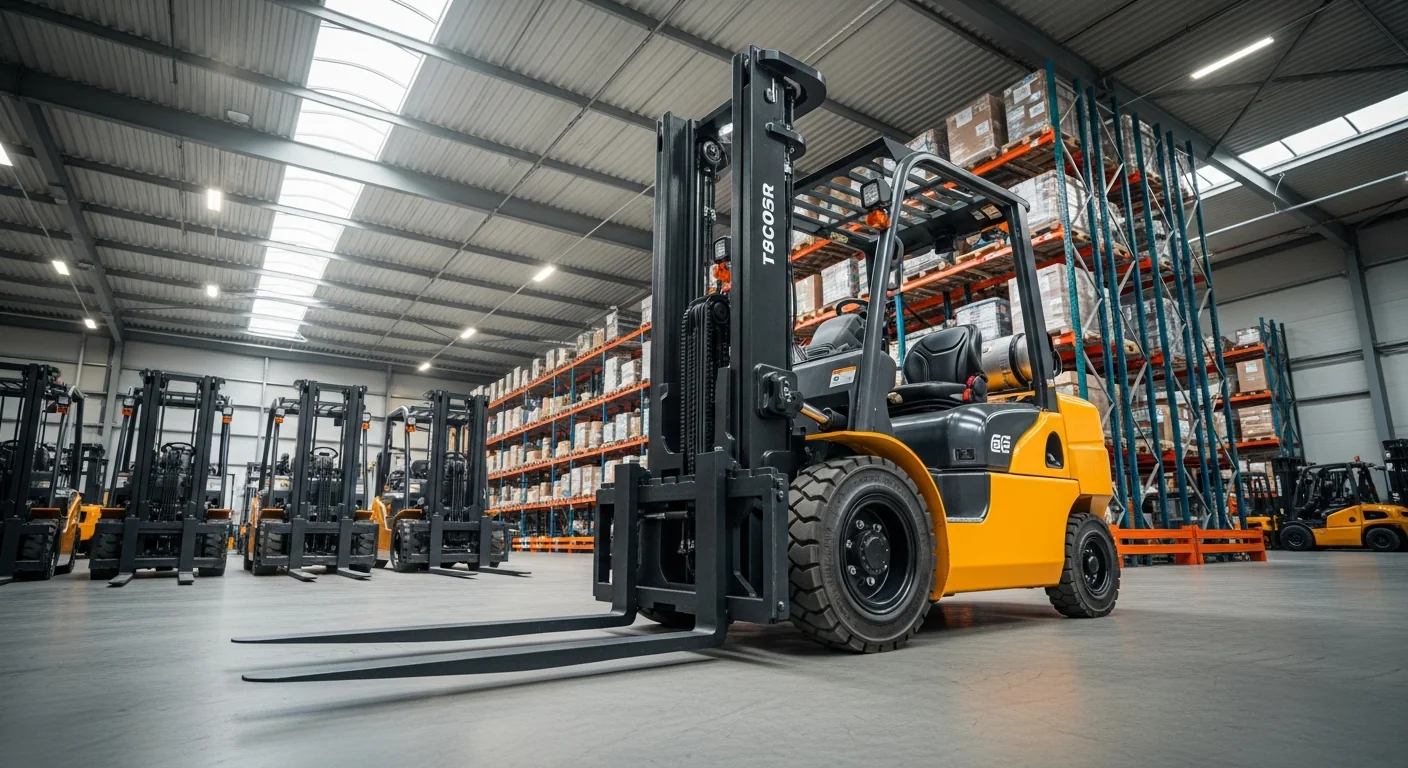
That $150–$269 daily forklift rental quote you received? It's missing about 35% of your actual costs. Here's the complete breakdown no rental company advertises upfront:
Base daily rates range from $150–$269 depending on capacity and type. A standard 5,000-lb warehouse forklift averages $175–$225 daily, while rough terrain models run $250–$400 daily.
Damage waiver fees add 10–20% to your daily rate—another $15–$54 daily that most companies require, not suggest. Skip it, and you're liable for thousands in repair costs.
Delivery and pickup charges range from free (within 15–25 miles) to $200+ each way for distant locations. Factor $3–$5 per mile beyond the free zone.
Fuel return policies sting with hidden costs. Propane refills run $30–$80, and many companies require full tanks at return regardless of usage. Electric units may require full charges.
Security deposits demand $500–$5,000+ upfront, tying up working capital. Larger capacity and rough terrain units command higher deposits.
Sales tax varies dramatically by state—0% in Oregon, Montana, Delaware, and New Hampshire versus 8%+ in California and Tennessee. A $1,000 monthly rental costs $1,080 in high-tax states.
Need weekend access? Many providers charge 1.5–2× standard rates for Saturday-Sunday rentals. That $200 daily rate becomes $300–$400 for weekend work.
Minimum rental periods typically enforce 1-day (8-hour) charges even for 3-hour jobs. You pay for a full day regardless of actual usage.
Late return penalties cost 1.5–2× the daily rate per day. A project running one day over schedule on a $200 rental could trigger $300–$400 in penalties.
The math says you should own it: At these inflated all-in rates, you're essentially making loan payments on equipment you'll never own. Instead of building zero equity through endless rental fees, smart businesses pivot to competitive financing that transforms monthly expenses into business assets. EquipFlow's lender network specializes in forklift financing specifically because rental math makes no sense for ongoing use.
The numbers don't lie—at any regular usage level, owning destroys rental on total cost.
A $3,000 used Bobcat forklift financed at 17% APR over 60 months costs approximately $74 monthly. Compare that to $150–$269 daily rental rates. Ownership breaks even within 1–2 days of monthly use.
A $25,000 new forklift financed at 7% over 60 months runs about $495 monthly. Factor in insurance ($500–$1,500 annually) and maintenance ($2,000–$5,000 annually), and your total monthly ownership cost reaches $700–$950.
Meanwhile, full-time rental of the same class forklift costs $2,400–$5,380 monthly. Ownership saves $1,700–$4,630 monthly for consistent use.
According to IRS Publication 946, the Section 179 deduction limit for 2026 is $2,560,000. This means businesses can deduct the full purchase price of qualifying equipment in the year purchased, creating immediate tax savings.
For a $25,000 forklift purchase, Section 179 delivers $5,250 in Year 1 tax savings at the 21% corporate rate—effectively reducing your net equipment cost to $19,750.
Stop building zero equity through rental fees when smart financing creates immediate tax advantages plus asset ownership. The mathematical reality is clear: if you're renting regularly, you should own it instead. EquipFlow's lender network understands forklift depreciation curves and structures loans that leverage these tax benefits for maximum business advantage.
Class I Electric Motor (Cushion Tire): Indoor warehouse work on smooth floors. 3,000–6,500 lb capacity. Rental: $125–$225 daily.
Class II Electric Narrow Aisle: Reach trucks and order pickers for tight spaces. Rental: $175–$300 daily.
Class III Hand/Manual Forklifts: Pallet jacks and walkie stackers. The most economical option at $30–$100 daily.
Class IV Internal Combustion (Cushion Tire): Indoor/outdoor versatility on smooth surfaces. Rental: $150–$275 daily.
Class V Pneumatic Tire: Outdoor work on rough surfaces and construction sites. Rental: $175–$350 daily.
Rough Terrain Forklifts: Heavy-duty construction and lumber yard applications. Rental: $250–$450 daily.
Truck-Mounted Forklifts: Self-unloading delivery vehicles. Specialty rental: $300–$500 daily.
Portable/Transportable Units: Compact, towable models. Rental: $100–$200 daily.
The financing reality: Every forklift type listed above becomes more economical through ownership financing when used 2+ times monthly. Rather than hemorrhaging cash on rental rates that build zero business equity, EquipFlow's lender network offers specialized financing for every forklift class. Our AI matches your specific equipment type with lenders who understand that equipment's depreciation schedule and residual value.
Renting a forklift takes 10 minutes. Getting hit with OSHA violations because your operators aren't certified takes even less time—and costs up to $165,514 for willful violations.
Under 29 CFR 1910.178, every forklift operator must hold current certification through formal classroom training, practical evaluation, and workplace-specific training. Operators must be at least 18 years old, and certification expires every 3 years.
Certification costs run $75–$300 per operator through OSHA-authorized training providers. For a company with three uncertified operators, budget $225–$900 in training costs before the rental equipment arrives.
OSHA penalty structure for 2026 includes serious violations from $1,190–$16,550 per incident, and willful violations reaching $165,514. The rental company hands you the keys—they're not responsible for your operators' certification.
Smart businesses stop renting and start owning partly because OSHA compliance becomes a one-time certification cost rather than ongoing rental liability. When you own your forklift through financing, you control operator training schedules and build long-term OSHA compliance into your business operations instead of scrambling for certifications every rental period. Find a quality forklift for sale and start building equity in equipment your team already depends on.## When Financing Beats Rental (Spoiler: Almost Always)
Current forklift financing rates for 2026:
- A-Tier credit (700+ FICO): 6%–9% APR
- B-Tier credit (600–699): 9%–13% APR
- Startup/challenged credit: 11%–16% APR
SBA financing options include Microloan programs up to $50,000 (perfect for single forklift purchases), 7(a) loans up to $5,000,000, and 504 loans up to $5,500,000 for larger fleet acquisitions.
Even at startup rates of 16%, the monthly payment on a $15,000 used forklift over 48 months runs about $445. Compare that to $2,400–$5,380 monthly for full-time rental, and financing wins overwhelmingly.
Bonus depreciation for 2026 allows a 20% first-year deduction on qualifying new and used equipment, further improving the purchase economics versus rental.
The breakeven math is simple: if you need a forklift more than 2–3 days monthly on an ongoing basis, the numbers favor ownership through financing over rental bleeding. The math says you should own it—and EquipFlow's lender competition drives your financing rate lower than what any single bank offers direct.
When the math shows ownership beats rental, getting the right financing rate becomes critical. Here's how EquipFlow's lender-matching platform works:
Our AI advisor Ava analyzes your specific forklift requirements, business profile, and financial situation. She needs to know your equipment type, capacity needs, new vs. used preference, and timeline to match you with the right lenders.
Ava connects you with lenders who specialize in forklift financing and actively compete for your business. When multiple lenders compete for the same deal, rates typically drop 0.5–2 percentage points compared to going direct to a single bank.
Review competing offers side-by-side with clear monthly payment calculations, terms, and total costs. See exactly how each option affects your cash flow compared to continued rental expenses.
You control the decision—no pressure, no obligation. Most approvals happen within 24–48 hours, letting you transition from expensive rental to profitable ownership quickly.
When the math shows ownership beats rental, getting the right financing rate becomes critical. Here's how EquipFlow's lender-matching platform works:
Our AI advisor Ava analyzes your specific forklift requirements, business profile, and financial situation. She needs to know your equipment type, capacity needs, new vs. used preference, and timeline to match you with the right lenders.
Ava connects you with lenders who specialize in forklift financing and actively compete for your business. When multiple lenders compete for the same deal, rates typically drop 0.5–2 percentage points compared to going direct to a single bank.
Review competing offers side-by-side with clear monthly payment calculations, terms, and total costs. See exactly how each option affects your cash flow compared to continued rental expenses.
You control the decision—no pressure, no obligation. Most approvals happen within 24–48 hours, letting you transition from expensive rental to profitable ownership quickly.
When the math shows ownership beats rental, getting the right financing rate becomes critical. Here's how EquipFlow's lender-matching platform works:
Our AI advisor Ava analyzes your specific forklift requirements, business profile, and financial situation. She needs to know your equipment type, capacity needs, new vs. used preference, and timeline to match you with the right lenders.
Ava connects you with lenders who specialize in forklift financing and actively compete for your business. When multiple lenders compete for the same deal, rates typically drop 0.5–2 percentage points compared to going direct to a single bank.
Review competing offers side-by-side with clear monthly payment calculations, terms, and total costs. See exactly how each option affects your cash flow compared to continued rental expenses.
You control the decision—no pressure, no obligation. Most approvals happen within 24–48 hours, letting you transition from expensive rental to profitable ownership quickly.
When 3–4 lenders compete for your forklift financing, rates typically drop 0.5–2 percentage points compared to going direct to a single bank. Our network creates a bidding environment that benefits you.
Our AI advisor Ava knows which lenders specialize in equipment financing, understand forklift depreciation curves, and approve deals other banks reject. She matches your specific equipment and credit profile with the right lending partners.
Every day paying rental rates while waiting for financing approval costs you money. Most lenders in our network provide decisions within 24–48 hours, letting you transition from rental to ownership quickly.
Compare multiple offers with no commitment and no hard credit pulls during the matching process. You maintain complete control over your financing decision while accessing competitive market rates through lender competition.
When 3–4 lenders compete for your forklift financing, rates typically drop 0.5–2 percentage points compared to going direct to a single bank. Our network creates a bidding environment that benefits you.
Our AI advisor Ava knows which lenders specialize in equipment financing, understand forklift depreciation curves, and approve deals other banks reject. She matches your specific equipment and credit profile with the right lending partners.
Every day paying rental rates while waiting for financing approval costs you money. Most lenders in our network provide decisions within 24–48 hours, letting you transition from rental to ownership quickly.
Compare multiple offers with no commitment and no hard credit pulls during the matching process. You maintain complete control over your financing decision while accessing competitive market rates through lender competition.
When 3–4 lenders compete for your forklift financing, rates typically drop 0.5–2 percentage points compared to going direct to a single bank. Our network creates a bidding environment that benefits you.
Our AI advisor Ava knows which lenders specialize in equipment financing, understand forklift depreciation curves, and approve deals other banks reject. She matches your specific equipment and credit profile with the right lending partners.
Every day paying rental rates while waiting for financing approval costs you money. Most lenders in our network provide decisions within 24–48 hours, letting you transition from rental to ownership quickly.
Compare multiple offers with no commitment and no hard credit pulls during the matching process. You maintain complete control over your financing decision while accessing competitive market rates through lender competition.
When 3–4 lenders compete for your forklift financing, rates typically drop 0.5–2 percentage points compared to going direct to a single bank. Our network creates a bidding environment that benefits you.
Our AI advisor Ava knows which lenders specialize in equipment financing, understand forklift depreciation curves, and approve deals other banks reject. She matches your specific equipment and credit profile with the right lending partners.
Every day paying rental rates while waiting for financing approval costs you money. Most lenders in our network provide decisions within 24–48 hours, letting you transition from rental to ownership quickly.
Compare multiple offers with no commitment and no hard credit pulls during the matching process. You maintain complete control over your financing decision while accessing competitive market rates through lender competition.
.png)