Many businesses receive funding shortly after approval
Built to help businesses explore realistic financing options
Business owners trust EquipFlow to simplify financing decisions
National and specialty lenders across industries
Your fastest route to the right lender — and the equipment your business needs.
Share your equipment type, business info, and location — it takes less than 60 seconds.
We instantly compare national and specialty lenders to find your best funding options.
Review offers, choose your lender, and get approved with fast turnaround times.
Skid steer rental rates look straightforward until you see your invoice. That $350/day rate you found? Add damage waiver ($50/day), delivery ($300), pickup ($250), refueling ($75), and sales tax, and your 5-day project just jumped from $1,750 to $2,625—a 50% budget overrun before you break ground.
Here's what nobody tells you: if you're renting more than 100 days a year, you're likely burning $20,000+ in unnecessary costs annually. A contractor renting 120 days/year at $350/day spends $42,000+ after fees, while financing a $52,618 Bobcat S450 at 6% over 60 months costs roughly $1,020/month plus $5,000 in annual maintenance and insurance—totaling $17,240/year. That's $24,760 in annual savings by owning instead of renting.
This guide shows you the true all-in cost of renting a skid steer, the exact break-even math between renting and buying, plus the OSHA compliance requirements and insurance obligations that every rental company conveniently forgets to mention. Because while renting might seem safer, the math often says otherwise.
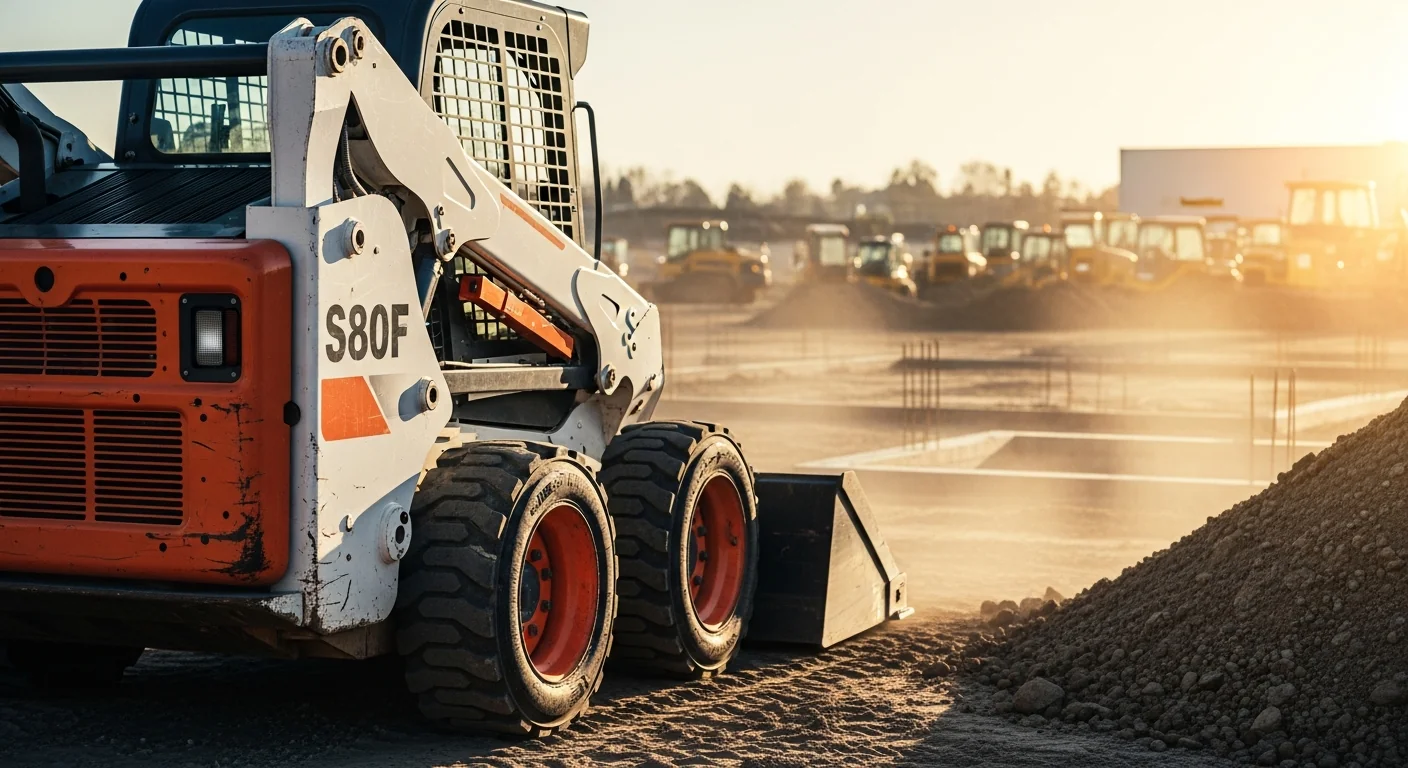
Base rental rates tell only part of the story. According to market data from AllSeasons Rental, a Kubota SSV65 skid steer rents for $199 per day or $349 per week. BigRentz shows daily rates from $104-$368 depending on size class, with monthly rates spanning $773-$2,825. But these base rates exclude the fees that typically add 40-60% to your total cost.
Damage waiver or Loss Damage Waiver (LDW) runs $30-$75 per day—essentially mandatory insurance that caps your liability for equipment damage to a $500-$1,000 deductible. On a 5-day rental, that's $150-$375 extra. Delivery fees typically cost $150-$400 depending on distance, and pickup is another $150-$400. Return the machine without refueling and expect a $50-$125 charge. Sales tax varies by state but can add 6-7% to the total.
Environmental and administrative fees often appear as line items—another $15-$50. Security deposits tie up $500-$2,000 of your working capital, though they're refundable if you return the equipment undamaged.
Let's work the math on that $350/day mid-size skid steer for a 5-day grading project: Base rental ($1,750) + damage waiver ($250) + delivery ($300) + pickup ($250) + refueling ($75) + sales tax ($127 at 6%) = $2,752 total. That's 57% higher than the advertised daily rate.
Rental companies structure pricing to incentivize longer commitments. The same Kubota SSV65 that costs $199 per day drops to $349 per week—meaning a 5-day project costs $995 at daily rates but only $349 at weekly rates, saving $646.
The decision matrix is straightforward: For 1-2 days, daily rates win. For 3-5 days, weekly rates save 30-50%. For 2-3 weeks, monthly rates often beat two weekly rentals. For 4+ weeks, book monthly and negotiate a 10-15% long-term discount.
Construction season (May-October) brings 20-40% rate premiums and requires 2-3 weeks advance booking for equipment availability. Off-season (November-April) offers same-day availability and rates 15-30% below peak pricing. Strategic contractors schedule non-urgent projects for winter months to save $50-$125 per day.
The utilization threshold determines everything. Under 50 days per year, rent without question. At $350/day for 50 days, you'll spend $17,500 annually—roughly what ownership costs before you turn the key. Between 50-150 days annually, evaluate leasing or purchasing. Over 150 days per year, the math overwhelmingly favors ownership.
For a contractor renting 120 days annually at $350 per day, the numbers look like this: Base rental costs $42,000. Add damage waiver ($6,000 at $50/day), delivery and pickup fees ($4,800 assuming 10 mobilizations), and you're at $52,800 annually with zero equity to show for it.
Compare that to financing a $52,618 Bobcat S450 at 6% over 60 months. Monthly payments run approximately $1,020, totaling $12,240 annually. Add $2,500 for insurance, $3,000-$5,000 for maintenance, and $1,000-$3,000 for storage, and your total annual ownership cost ranges from $18,740-$22,740. That's $30,060-$34,060 in annual savings by owning instead of renting.
Rental costs qualify as 100% deductible ordinary business expenses in the year incurred—no depreciation schedule required. For a business in the 35% tax bracket, $42,000 in annual rental costs generates $14,700 in tax savings, making the after-tax cost $27,300.
Purchased equipment follows different rules. According to IRS Publication 946, businesses can elect Section 179 deductions up to $2,560,000 in 2026, allowing immediate deduction of the full purchase price. Alternatively, equipment qualifies for 100% bonus depreciation in 2026, plus standard MACRS 5-year recovery.
Based on EquipFlow's analysis of IRS data, Section 179 creates significant first-year tax savings: $12,389 on a $35,396 skid steer at 35% tax bracket, $11,327 at 32% bracket, or $8,849 at 25% bracket. For higher-end equipment, these savings can exceed $15,000 in year one.
Section 179 effectively creates a 21% liquidity multiplier for corporate buyers. Purchase a $52,618 machine, claim $11,050 in immediate tax recovery at 21% corporate rate, and your net equipment investment becomes $41,568—21% lower than the sticker price.
Single projects and seasonal work under 50 days annually favor renting. Equipment testing before purchase makes sense—try CAT versus Bobcat versus Kubota models before committing to ownership. Avoiding storage and maintenance burden appeals to some operators. Peak-season overflow situations when your owned machine is already deployed. Specialty attachments needed once or twice annually justify rental over purchase.
Every contractor renting a skid steer faces compliance obligations that rental companies never explain. Under OSHA standard 29 CFR 1926.602, employers must ensure skid steer operators are competent through documented training. Unlike forklifts, which require formal certification under 1910.178, skid steers don't need certification cards—but employer-documented training programs are mandatory.
OSHA penalties for serious violations range from $1,190-$16,550 per incident. Willful or repeat violations can reach $165,514. If an untrained operator injures someone, you're looking at maximum penalties plus potential lawsuits that your insurance may refuse to cover.
Most rental companies require Certificates of Insurance showing $1,000,000-$2,000,000 in general liability coverage, with the rental company named as additional insured. Allow 2-5 business days for your insurance provider to issue this certificate—don't wait until delivery day.
Without adequate insurance, you can purchase damage waivers from rental companies at $30-$75 per day, capping your liability for equipment damage to a $500-$1,000 deductible. For rentals exceeding 2 weeks, an inland marine or equipment floater policy at $100-$300 monthly beats daily damage waiver costs of $600-$1,500 monthly.
If you're ready to stop renting and commit to ownership, you can browse skid steer models for sale to compare pricing. For those who need purchasing support, options to finance a skid steer with flexible terms can make ownership more accessible. To better understand which machine fits your workload, learn more about skid steer equipment and uses.Without damage waiver or adequate insurance coverage, renters owe full replacement value—$30,000-$90,000 for most skid steers. Rental agreements make you the bailee, liable for equipment from delivery to return. Theft from unsecured job sites represents one of the most financially devastating scenarios for unprepared renters.
This is exactly why smart contractors evaluate financing instead. Own the equipment, control the insurance coverage, and build equity instead of paying someone else's equipment note while assuming all the liability.
When the math says you should own instead of rent, EquipFlow's lender-matching platform gets you there faster and cheaper than going to banks one by one.
Provide details about the skid steer you need—size class, planned usage, and your business situation. Ava analyzes which lenders specialize in your equipment type and credit profile. Unlike generic loan brokers, Ava understands that a Bobcat S450 has different lending requirements than a CAT 272D.
Instead of calling banks individually and hoping for approval, Ava connects you with lenders who actively compete for skid steer deals. When lenders know they're competing, rates typically drop 0.5-2 percentage points. This competition happens automatically—no negotiations required.
Receive detailed proposals showing monthly payments, total interest costs, and how each offer affects your cash flow. See exactly how 6.5% APR at 60 months compares to 8.2% at 48 months, including the total cost differences.
Select the offer that works best for your cash flow and timeline. Your chosen lender handles all paperwork and funding. You maintain full control—no pressure, no obligation to accept any offer.
When the math says you should own instead of rent, EquipFlow's lender-matching platform gets you there faster and cheaper than going to banks one by one.
Provide details about the skid steer you need—size class, planned usage, and your business situation. Ava analyzes which lenders specialize in your equipment type and credit profile. Unlike generic loan brokers, Ava understands that a Bobcat S450 has different lending requirements than a CAT 272D.
Instead of calling banks individually and hoping for approval, Ava connects you with lenders who actively compete for skid steer deals. When lenders know they're competing, rates typically drop 0.5-2 percentage points. This competition happens automatically—no negotiations required.
Receive detailed proposals showing monthly payments, total interest costs, and how each offer affects your cash flow. See exactly how 6.5% APR at 60 months compares to 8.2% at 48 months, including the total cost differences.
Select the offer that works best for your cash flow and timeline. Your chosen lender handles all paperwork and funding. You maintain full control—no pressure, no obligation to accept any offer.
When the math says you should own instead of rent, EquipFlow's lender-matching platform gets you there faster and cheaper than going to banks one by one.
Provide details about the skid steer you need—size class, planned usage, and your business situation. Ava analyzes which lenders specialize in your equipment type and credit profile. Unlike generic loan brokers, Ava understands that a Bobcat S450 has different lending requirements than a CAT 272D.
Instead of calling banks individually and hoping for approval, Ava connects you with lenders who actively compete for skid steer deals. When lenders know they're competing, rates typically drop 0.5-2 percentage points. This competition happens automatically—no negotiations required.
Receive detailed proposals showing monthly payments, total interest costs, and how each offer affects your cash flow. See exactly how 6.5% APR at 60 months compares to 8.2% at 48 months, including the total cost differences.
Select the offer that works best for your cash flow and timeline. Your chosen lender handles all paperwork and funding. You maintain full control—no pressure, no obligation to accept any offer.
When the math says you should own instead of rent, EquipFlow's platform solves the three biggest obstacles to equipment financing: finding the right lenders, getting competitive rates, and closing deals quickly.
Banks don't compete when you apply individually—they quote whatever rate your credit profile suggests and move on. When EquipFlow matches you with 3-4 lenders simultaneously, they know they're competing for your business. This competition typically drops rates 0.5-2 percentage points below what you'd get going to banks one by one. Over a 60-month term, that's $2,000-$8,000 in total savings on a $50,000 machine.
Generic loan brokers treat all equipment the same. Ava understands that banks reject 67% of skid steer loans over 7 years old, while specialty lenders focus on exactly those deals. Ava knows which lenders offer the best rates for new Bobcat purchases, which ones specialize in used CAT equipment, and which ones finance a skid steer with flexible options for smaller contractors that banks typically decline.
Every day without equipment costs money—whether it's paying crews to wait or missing project deadlines. EquipFlow's network provides initial approvals within 24-48 hours, letting you move forward with equipment purchase while your competitors are still waiting for bank callbacks. Speed beats rental when you're bleeding $500-$1,000 daily on stalled projects.
When the math says you should own instead of rent, EquipFlow's platform solves the three biggest obstacles to equipment financing: finding the right lenders, getting competitive rates, and closing deals quickly.
Banks don't compete when you apply individually—they quote whatever rate your credit profile suggests and move on. When EquipFlow matches you with 3-4 lenders simultaneously, they know they're competing for your business. This competition typically drops rates 0.5-2 percentage points below what you'd get going to banks one by one. Over a 60-month term, that's $2,000-$8,000 in total savings on a $50,000 machine.
Generic loan brokers treat all equipment the same. Ava understands that banks reject 67% of skid steer loans over 7 years old, while specialty lenders focus on exactly those deals. Ava knows which lenders offer the best rates for new Bobcat purchases, which ones specialize in used CAT equipment, and which ones finance a skid steer with flexible options for smaller contractors that banks typically decline.
Every day without equipment costs money—whether it's paying crews to wait or missing project deadlines. EquipFlow's network provides initial approvals within 24-48 hours, letting you move forward with equipment purchase while your competitors are still waiting for bank callbacks. Speed beats rental when you're bleeding $500-$1,000 daily on stalled projects.
When the math says you should own instead of rent, EquipFlow's platform solves the three biggest obstacles to equipment financing: finding the right lenders, getting competitive rates, and closing deals quickly.
Banks don't compete when you apply individually—they quote whatever rate your credit profile suggests and move on. When EquipFlow matches you with 3-4 lenders simultaneously, they know they're competing for your business. This competition typically drops rates 0.5-2 percentage points below what you'd get going to banks one by one. Over a 60-month term, that's $2,000-$8,000 in total savings on a $50,000 machine.
Generic loan brokers treat all equipment the same. Ava understands that banks reject 67% of skid steer loans over 7 years old, while specialty lenders focus on exactly those deals. Ava knows which lenders offer the best rates for new Bobcat purchases, which ones specialize in used CAT equipment, and which ones finance a skid steer with flexible options for smaller contractors that banks typically decline.
Every day without equipment costs money—whether it's paying crews to wait or missing project deadlines. EquipFlow's network provides initial approvals within 24-48 hours, letting you move forward with equipment purchase while your competitors are still waiting for bank callbacks. Speed beats rental when you're bleeding $500-$1,000 daily on stalled projects.
When the math says you should own instead of rent, EquipFlow's platform solves the three biggest obstacles to equipment financing: finding the right lenders, getting competitive rates, and closing deals quickly.
Banks don't compete when you apply individually—they quote whatever rate your credit profile suggests and move on. When EquipFlow matches you with 3-4 lenders simultaneously, they know they're competing for your business. This competition typically drops rates 0.5-2 percentage points below what you'd get going to banks one by one. Over a 60-month term, that's $2,000-$8,000 in total savings on a $50,000 machine.
Generic loan brokers treat all equipment the same. Ava understands that banks reject 67% of skid steer loans over 7 years old, while specialty lenders focus on exactly those deals. Ava knows which lenders offer the best rates for new Bobcat purchases, which ones specialize in used CAT equipment, and which ones finance a skid steer with flexible options for smaller contractors that banks typically decline.
Every day without equipment costs money—whether it's paying crews to wait or missing project deadlines. EquipFlow's network provides initial approvals within 24-48 hours, letting you move forward with equipment purchase while your competitors are still waiting for bank callbacks. Speed beats rental when you're bleeding $500-$1,000 daily on stalled projects.
.png)