Many businesses receive funding shortly after approval
Built to help businesses explore realistic financing options
Business owners trust EquipFlow to simplify financing decisions
National and specialty lenders across industries
Your fastest route to the right lender — and the equipment your business needs.
Share your equipment type, business info, and location — it takes less than 60 seconds.
We instantly compare national and specialty lenders to find your best funding options.
Review offers, choose your lender, and get approved with fast turnaround times.
Skid steer rental rates have jumped 23% in the last 18 months, which means contractors paying $1,575 monthly for a medium-frame unit are bleeding $18,900 annually with zero equity to show for it. Meanwhile, financing that same machine costs roughly $1,016 per month—and here's the kicker: Section 179 tax deductions can save you $7,358 to $16,956 in the first year alone, making ownership mathematically smarter than renting within 23 months.
What most contractors miss is the hidden math. That '0% for 36 months' dealer promotion? It's available on select new models, requires top-tier credit, and locks you into a 3-year term that might cost you more than 6.5% financing over 60 months when you run the actual numbers. In our experience, contractors who finance through competing lenders rather than accepting the dealer's first offer save an average of 1.2 percentage points.
Here's what the equipment dealers won't tell you: when 3-4 lenders compete for your business, rates drop. When you understand Section 179's 21% liquidity multiplier effect, financing becomes a strategic cash flow tool rather than debt. And when you factor in the opportunity cost of tying up $50,000 in working capital, paying cash starts looking like the expensive option.
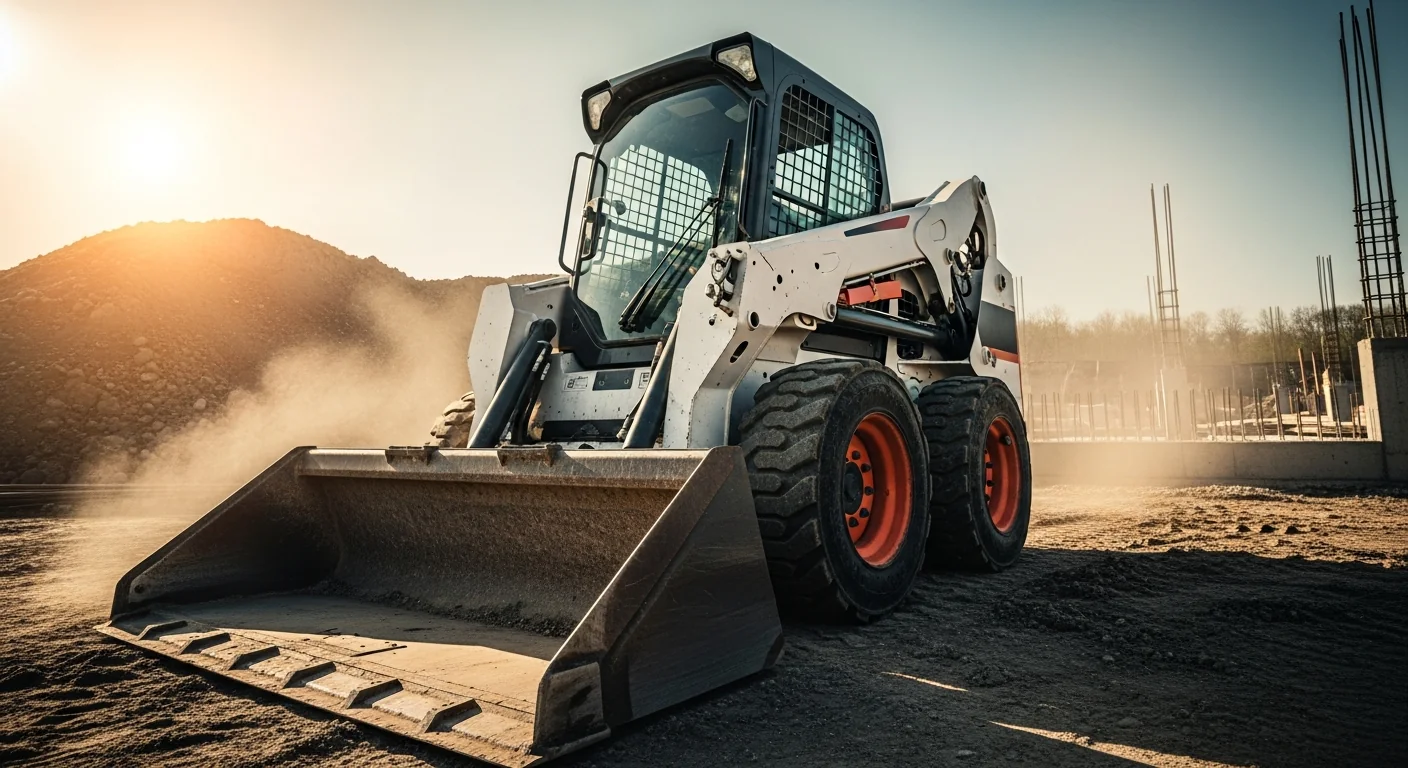
Here's the financial reality most dealers won't show you upfront: skid steer financing typically ranges from 6.5% to 18% APR depending on your credit profile, with monthly payments spanning $580 to $1,160 for machines in the $30,000-$60,000 range. But that's just the surface—the real story is in the credit tiers and total cost mathematics.
A-tier borrowers with 720+ FICO scores typically see 6.5-9.5% APR with $0-down options available. B-tier contractors with 650-719 credit scores face 9.5-14% rates and usually need 10-20% down. Startup businesses or those with challenged credit land in the 12-18% range with 20%+ down payments required. Here's what this means in real dollars: a $48,446 skid steer financed at 8% over 60 months costs $984 monthly, while the same machine at 14% jumps to $1,147—a $163 monthly difference that adds up to $9,780 over the loan term.
What we typically see is contractors accepting dealer financing without shopping around. That's leaving money on the table. When lenders compete for the same deal, rates drop because they're bidding for your business.
According to IRS Publication 946, the 2026 Section 179 deduction limit is $2,560,000—which means you can write off your entire skid steer purchase this year if you buy and place it in service by December 31st. This isn't theoretical tax advice; it's immediate cash flow mathematics.
For a $29,433 machine, Section 179 generates $7,358 in tax savings at the 25% bracket, $9,419 at 32%, and $10,302 at 35%. Scale that up to a $48,446 machine and you're looking at $12,112, $15,503, and $16,956 respectively. This creates what we call a 21% liquidity multiplier—immediate Year 1 tax recovery that can be reinvested or applied toward financing payments.
Here's the math that matters: finance a skid steer at 8% over 60 months for $48,446, and your total cost is approximately $59,040. Apply Section 179 at the 32% bracket, and your effective cost drops to $43,537—making financing cheaper than many cash deals when you factor in opportunity cost.
Based on current market data, medium-frame skid steer rentals cost approximately $1,575 monthly. Finance that same capability for $1,016 monthly, and you break even around month 34 without tax benefits. Add Section 179 tax savings reducing your effective monthly cost to roughly $688, and breakeven accelerates to just 23 months.
The hidden costs of renting compound: you're building zero equity, have no asset for resale, and can't depreciate rental payments beyond ordinary business expenses. If you're using a skid steer more than 15 days per month, the mathematics favor ownership.
What most financing guides skip entirely is regulatory compliance—but these costs matter when you're budgeting a $30,000-$60,000 equipment purchase. Under 29 CFR 1926.602, employers must ensure operators are trained on material handling equipment. While skid steers don't require formal certification like forklifts, training is mandatory.
OSHA penalties for willful violations range from $11,524 to $165,514 per instance. Even serious violations carry $1,190 to $16,550 fines. Budget $150-$500 per operator for proper training—it's a small cost compared to penalty exposure, and it's tax-deductible.
Lenders require comprehensive coverage through inland marine or equipment floater policies. Annual premiums typically run $1,200-$3,000 depending on equipment value and usage. Factor this into your total cost of ownership calculations alongside your monthly payment.
Seasonal income creates financing challenges, but smart structuring solves them. Some lenders offer deferred payment programs allowing you to skip up to 3 months during slow season. Others provide skip-payment options where you defer 2-3 months annually to align with revenue patterns.
For businesses under 2 years old, the SBA Microloan program provides up to $50,000—perfect for small to medium-frame machines. Processing takes longer than equipment-specific lenders, but rates can be competitive for startups who don't qualify for traditional equipment financing.
New skid steers range from $29,512 for a basic Bobcat S70 to over $62,000 for large-frame loaders. Used machines typically run $15,000-$40,000 depending on age, hours, and condition. Both new and used equipment qualify for Section 179 deductions, but financing terms differ.
Most lenders cap used equipment financing at 7-10 years old with under 5,000 hours. Rates typically run 0.5-2% higher for used equipment, but the lower purchase price can offset higher borrowing costs. Run the total cost mathematics: a $35,000 used machine at 10% might cost less over 60 months than a $55,000 new machine at 7%.
Some lenders in our network offer balloon payment structures where you finance 70-80% of the purchase price and pay a lump sum at term end. This reduces monthly payments by $200-$400, freeing cash flow for operations. The balloon can be refinanced, or the equipment can be traded for newer models.
Skid steers hold approximately 60% of their value after 5 years with proper maintenance, making balloon payments viable for contractors planning equipment upgrades. However, this structure requires disciplined financial planning—that balloon payment comes due regardless of business conditions.
When lenders compete for your skid steer financing, rates drop 0.5-2 percentage points. Here's exactly how we make that happen:
Ava, our AI advisor, analyzes your specific needs—whether you're financing a $29,512 Bobcat S70 for landscaping or a $62,000 large-frame loader for heavy construction. She factors in your credit profile, seasonal income patterns, and how quickly you need the equipment. This isn't a generic application—it's a diagnostic that matches your situation with lenders who actually approve deals like yours.
Here's where the magic happens. Instead of walking into a dealership and accepting whatever rate they offer, you get 3-4 lenders bidding for your business simultaneously. Ava specializes in finding lenders who understand skid steer depreciation curves and aren't spooked by seasonal contractor income.
See exactly how each offer affects your monthly cash flow. Compare a 36-month term at 6.5% versus 60 months at 8%—then factor in Section 179 tax savings that could reduce your effective monthly cost from $1,016 to $688. The math matters, and you'll have all the numbers before making a decision.
You're in control. Pick the lender whose terms work best for your operation—whether that's $0 down, deferred payments during slow season, or the lowest total cost. No pressure, no obligation, just better financing because lenders competed for it.
When lenders compete for your skid steer financing, rates drop 0.5-2 percentage points. Here's exactly how we make that happen:
Ava, our AI advisor, analyzes your specific needs—whether you're financing a $29,512 Bobcat S70 for landscaping or a $62,000 large-frame loader for heavy construction. She factors in your credit profile, seasonal income patterns, and how quickly you need the equipment. This isn't a generic application—it's a diagnostic that matches your situation with lenders who actually approve deals like yours.
Here's where the magic happens. Instead of walking into a dealership and accepting whatever rate they offer, you get 3-4 lenders bidding for your business simultaneously. Ava specializes in finding lenders who understand skid steer depreciation curves and aren't spooked by seasonal contractor income.
See exactly how each offer affects your monthly cash flow. Compare a 36-month term at 6.5% versus 60 months at 8%—then factor in Section 179 tax savings that could reduce your effective monthly cost from $1,016 to $688. The math matters, and you'll have all the numbers before making a decision.
You're in control. Pick the lender whose terms work best for your operation—whether that's $0 down, deferred payments during slow season, or the lowest total cost. No pressure, no obligation, just better financing because lenders competed for it.
When lenders compete for your skid steer financing, rates drop 0.5-2 percentage points. Here's exactly how we make that happen:
Ava, our AI advisor, analyzes your specific needs—whether you're financing a $29,512 Bobcat S70 for landscaping or a $62,000 large-frame loader for heavy construction. She factors in your credit profile, seasonal income patterns, and how quickly you need the equipment. This isn't a generic application—it's a diagnostic that matches your situation with lenders who actually approve deals like yours.
Here's where the magic happens. Instead of walking into a dealership and accepting whatever rate they offer, you get 3-4 lenders bidding for your business simultaneously. Ava specializes in finding lenders who understand skid steer depreciation curves and aren't spooked by seasonal contractor income.
See exactly how each offer affects your monthly cash flow. Compare a 36-month term at 6.5% versus 60 months at 8%—then factor in Section 179 tax savings that could reduce your effective monthly cost from $1,016 to $688. The math matters, and you'll have all the numbers before making a decision.
You're in control. Pick the lender whose terms work best for your operation—whether that's $0 down, deferred payments during slow season, or the lowest total cost. No pressure, no obligation, just better financing because lenders competed for it.
Most contractors make the mistake of walking into a dealership and accepting whatever financing they're offered. That's like buying the first house you see without checking comparable sales. Here's why lender competition changes everything:
When 3-4 lenders in our network compete for your skid steer financing, rates drop 0.5-2 percentage points because they're bidding for your business. We've seen A-tier borrowers get 6.5% instead of 8.5% simply because lenders knew they were competing. Over a 60-month term on $50,000, that's $5,400 in interest savings.
Ava specializes in matching contractors with lenders who understand skid steer financing. She knows which banks reject used equipment over 7 years old and which alternative lenders don't. She factors in seasonal income patterns that spook traditional banks but don't faze equipment-focused lenders. Most importantly, she knows which lenders are actively competing for market share and offering aggressive rates.
Every day without equipment costs money. If you're paying $1,575 monthly in rental fees, a 30-day delay costs $1,575 in pure expense with zero equity building. Ava can match you with competing lenders in 24 hours, with most approvals completed within 48 hours.
Comparing multiple offers doesn't obligate you to choose any of them. If dealer financing beats lenders in our network, take the dealer deal. But in our experience, contractors who shop rates save an average of 1.2 percentage points—and that adds up to thousands over the loan term.
Most contractors make the mistake of walking into a dealership and accepting whatever financing they're offered. That's like buying the first house you see without checking comparable sales. Here's why lender competition changes everything:
When 3-4 lenders in our network compete for your skid steer financing, rates drop 0.5-2 percentage points because they're bidding for your business. We've seen A-tier borrowers get 6.5% instead of 8.5% simply because lenders knew they were competing. Over a 60-month term on $50,000, that's $5,400 in interest savings.
Ava specializes in matching contractors with lenders who understand skid steer financing. She knows which banks reject used equipment over 7 years old and which alternative lenders don't. She factors in seasonal income patterns that spook traditional banks but don't faze equipment-focused lenders. Most importantly, she knows which lenders are actively competing for market share and offering aggressive rates.
Every day without equipment costs money. If you're paying $1,575 monthly in rental fees, a 30-day delay costs $1,575 in pure expense with zero equity building. Ava can match you with competing lenders in 24 hours, with most approvals completed within 48 hours.
Comparing multiple offers doesn't obligate you to choose any of them. If dealer financing beats lenders in our network, take the dealer deal. But in our experience, contractors who shop rates save an average of 1.2 percentage points—and that adds up to thousands over the loan term.
Most contractors make the mistake of walking into a dealership and accepting whatever financing they're offered. That's like buying the first house you see without checking comparable sales. Here's why lender competition changes everything:
When 3-4 lenders in our network compete for your skid steer financing, rates drop 0.5-2 percentage points because they're bidding for your business. We've seen A-tier borrowers get 6.5% instead of 8.5% simply because lenders knew they were competing. Over a 60-month term on $50,000, that's $5,400 in interest savings.
Ava specializes in matching contractors with lenders who understand skid steer financing. She knows which banks reject used equipment over 7 years old and which alternative lenders don't. She factors in seasonal income patterns that spook traditional banks but don't faze equipment-focused lenders. Most importantly, she knows which lenders are actively competing for market share and offering aggressive rates.
Every day without equipment costs money. If you're paying $1,575 monthly in rental fees, a 30-day delay costs $1,575 in pure expense with zero equity building. Ava can match you with competing lenders in 24 hours, with most approvals completed within 48 hours.
Comparing multiple offers doesn't obligate you to choose any of them. If dealer financing beats lenders in our network, take the dealer deal. But in our experience, contractors who shop rates save an average of 1.2 percentage points—and that adds up to thousands over the loan term.
Most contractors make the mistake of walking into a dealership and accepting whatever financing they're offered. That's like buying the first house you see without checking comparable sales. Here's why lender competition changes everything:
When 3-4 lenders in our network compete for your skid steer financing, rates drop 0.5-2 percentage points because they're bidding for your business. We've seen A-tier borrowers get 6.5% instead of 8.5% simply because lenders knew they were competing. Over a 60-month term on $50,000, that's $5,400 in interest savings.
Ava specializes in matching contractors with lenders who understand skid steer financing. She knows which banks reject used equipment over 7 years old and which alternative lenders don't. She factors in seasonal income patterns that spook traditional banks but don't faze equipment-focused lenders. Most importantly, she knows which lenders are actively competing for market share and offering aggressive rates.
Every day without equipment costs money. If you're paying $1,575 monthly in rental fees, a 30-day delay costs $1,575 in pure expense with zero equity building. Ava can match you with competing lenders in 24 hours, with most approvals completed within 48 hours.
Comparing multiple offers doesn't obligate you to choose any of them. If dealer financing beats lenders in our network, take the dealer deal. But in our experience, contractors who shop rates save an average of 1.2 percentage points—and that adds up to thousands over the loan term.
.png)