Many businesses receive funding shortly after approval
Built to help businesses explore realistic financing options
Business owners trust EquipFlow to simplify financing decisions
National and specialty lenders across industries
Your fastest route to the right lender — and the equipment your business needs.
Share your equipment type, business info, and location — it takes less than 60 seconds.
We instantly compare national and specialty lenders to find your best funding options.
Review offers, choose your lender, and get approved with fast turnaround times.
Tractor for sale listings are everywhere, but here's what dealers won't tell you: that "0% APR financing" usually comes with a $3,000-$7,000 markup over the cash price. We've seen it across every major brand—John Deere, Kubota, Mahindra. You're not avoiding interest; you're prepaying it into the base price.
Meanwhile, smart operators are discovering something else dealers don't advertise: financing a tractor and investing your cash elsewhere typically generates 15-20% annual returns. At current rates starting at 5% APR for A-tier credit, you're mathematically better off financing—even if you have the cash. Add in Section 179 tax deductions that can save $10,809 to $15,132 on a typical $43,235 tractor, and paying cash starts looking like the expensive option.
The key is lender competition. When 3-4 equipment lenders compete for your deal, rates drop 0.5-2 percentage points below what any single dealer can offer. That's where the real savings live—not in promotional rates tied to inflated prices.
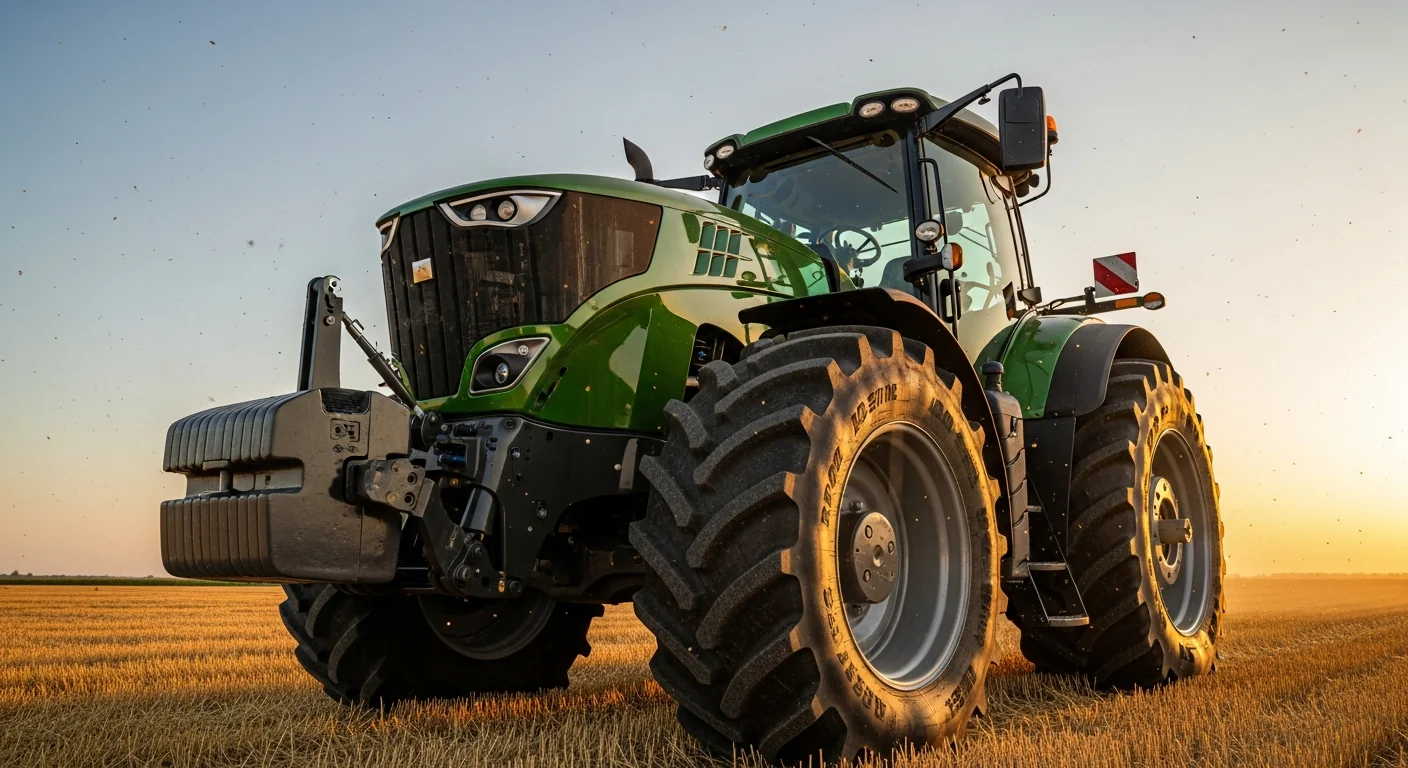
The tractor market spans an enormous range, from $11,000 utility models to $329,000+ row crop machines. According to AllMachines.com data, this spread reflects everything from basic compact tractors to high-horsepower 4WD units with GPS guidance systems.
Compact tractors (25-40 HP) typically run $13,864 to $36,860, with models like the Mahindra eMax starting at the lower end and John Deere 3033R with loader hitting the higher range. Utility tractors (40-100 HP) range from $25,000 to $80,000, while row crop machines (100+ HP) start around $150,000 and can exceed $300,000 for high-end models.
Package deals offer real savings potential. United Ag & Turf shows savings of $2,174 to $7,730 on tractor-implement bundles, particularly when combining a tractor with loader and backhoe attachments. Mahindra currently offers up to $5,000 cash back on select models, though these manufacturer incentives often can't be combined with promotional financing rates.
Used tractors depreciate 23% in year one, meaning a two-year-old machine typically sells for around 57% of its original price. This creates a sweet spot for buyers who want recent technology without new-equipment pricing. However, financing used equipment requires careful lender selection—many banks reject loans on tractors over 7-10 years old regardless of condition.
When evaluating used tractors, focus on engine hours relative to age (100-150 hours per year is typical for farm use), PTO condition, hydraulic system integrity, and tire wear patterns. Private sellers typically price 10-20% below dealer listings but offer no warranty protection.
Here's the math that says you should own it: at these prices, rental costs exceed ownership costs in 18-24 months for any tractor used 200+ hours annually. The problem isn't whether to buy—it's how to finance strategically to preserve your working capital while maximizing tax benefits. EquipFlow's lender network specializes in equipment deals where your cash works harder elsewhere.
The financing landscape for tractors varies dramatically based on your credit profile and the lender's agricultural equipment specialization.
A-Tier borrowers with credit scores above 720 typically qualify for rates between 5% and 8% APR. B-Tier borrowers (660-719 credit) see rates from 8% to 12%, while startup operations or those with thin credit files may face 10% to 15% rates. On a $40,000 tractor over 60 months, the difference between 5% and 12% APR amounts to $240 per month and $4,320 in additional interest over the loan term.
Down payment expectations correlate directly with credit tiers. A-Tier borrowers often qualify for zero-down financing, particularly through manufacturer captive lenders during promotional periods. B-Tier borrowers typically need 10% to 15% down, while startup borrowers may require 20% to 25% plus additional collateral.
For someone with $5,000 saved toward a $40,000 tractor, understanding these thresholds prevents wasted time on applications that won't approve. Trade-in value can reduce or eliminate down payment requirements—a $12,000 trade-in allowance effectively covers the down payment on a $40,000 purchase even for B-Tier borrowers.
The SBA Microloan program provides up to $50,000 for qualifying agricultural businesses, making it ideal for compact and utility tractor purchases. According to SBA.gov, these loans often feature more flexible credit requirements than conventional equipment financing. SBA 7(a) loans allow up to $5,000,000 for larger operations, while SBA 504 loans reach $5,500,000 for land and equipment packages combined.
SBA loans require more documentation and longer approval timelines (2-6 weeks versus 24-48 hours for conventional equipment loans), but they can provide access to capital when traditional lenders decline the application.
Stop building zero equity with rental fees when these financing options exist. The difference between getting one lender's standard rate and having four lenders compete can save you 1-2% APR—that's $800-1,600 annually on a $40,000 tractor. EquipFlow's network includes both traditional and SBA-approved lenders who understand agricultural cash flow patterns.
The tax implications of tractor purchases create compelling reasons to buy rather than rent, but only if you structure the transaction correctly.
According to IRS Publication 946, the Section 179 deduction limit for 2026 is $2,560,000. This allows businesses to deduct the full purchase price of qualifying tractors in the year they're purchased and placed in service, rather than depreciating the cost over seven years.
Based on EquipFlow's analysis of IRS data, a $43,235 tractor generates tax savings of $10,809 in the 25% bracket, $13,835 in the 32% bracket, and $15,132 in the 35% bracket. This effectively reduces the tractor's net cost to $29,400-$32,426—a significant factor in buy-versus-rent calculations.
The tractor must be used more than 50% for business purposes to qualify, and you must maintain usage logs documenting dates, hours, and purpose to withstand IRS scrutiny.
Under current IRS rules, bonus depreciation for 2026 provides an additional 20% first-year deduction on qualifying equipment. This is separate from Section 179 and can be used in combination with it. Note that this rate has been declining annually—it was 100% in 2022 and remains at 100% in 2027 under OBBB, creating legitimate urgency for 2026 purchases.
Many states exempt agricultural equipment from sales tax, potentially saving 6% to 9% on the purchase price. On a $40,000 tractor, that represents $2,400 to $3,600 in immediate savings. Requirements typically include a valid farm ID or agricultural exemption certificate, minimum acreage thresholds, and equipment used primarily for farming operations.
Wondering how much does a tractor cost today after factoring in all these tax benefits? The effective price is often far lower than the sticker. And if you're ready to move forward, explore tractor financing options for your next purchase through EquipFlow's competitive lender network.These tax advantages only work if you finance correctly. Paying cash eliminates the opportunity to invest your capital at 15-20% returns while claiming the same deductions. EquipFlow's lender network understands tax timing requirements and can structure deals to maximize your Section 179 benefits while preserving working capital.
The financial decision between buying, financing, or renting depends on usage patterns, cash position, and tax situation.
Purchasing typically makes sense when you'll use the tractor 200+ hours annually, can claim Section 179 deductions, have A-tier credit qualifying for favorable rates, and plan to keep the equipment 5+ years past the steepest depreciation period. The net cost analysis becomes compelling: a $43,235 purchase minus $13,835 in tax savings (32% bracket) equals an effective cost of $29,400.
Rental makes financial sense for seasonal use under 100 hours annually, during cash flow constraints, or when you need specialty equipment for one-time projects. Calculate the break-even point by comparing annual rental costs against annual ownership costs including depreciation, insurance, maintenance, and storage, minus applicable tax benefits.
Dealers frequently promote 0% APR financing, but industry data consistently shows these offers include inflated base prices. Request both the promotional financing price and the cash discount price from any dealer. If the cash price is $38,000 and the 0% price is $42,000, you're effectively paying $4,000 in hidden interest—equivalent to roughly 5.8% APR on a 48-month loan. In many cases, negotiating the cash price and financing independently results in lower total cost.
Getting multiple lenders to compete for your tractor financing deal isn't complicated—it just requires the right connections and timing.
Ava analyzes your specific needs: tractor type, price range, intended use, and credit profile. This isn't a generic loan application—it's a strategic assessment of which lenders will compete most aggressively for your particular deal. A $15,000 compact tractor requires different lenders than a $150,000 row crop machine.
Based on your profile, Ava connects you with lenders who specialize in agricultural equipment financing. These aren't random banks—they're lenders who understand tractor depreciation curves, seasonal cash flow, and Section 179 implications. When lenders know they're competing, rates automatically improve.
See exactly how each offer affects your monthly cash flow and total cost. A 0.5% rate difference on a $40,000 tractor saves you $400-800 over the loan term. Multiply that across your entire fleet, and lender competition pays for itself many times over.
You maintain complete control. No pressure, no obligation to accept any offer. Once you've identified the best terms, your chosen lender handles the closing process directly with you and the equipment dealer.
Getting multiple lenders to compete for your tractor financing deal isn't complicated—it just requires the right connections and timing.
Ava analyzes your specific needs: tractor type, price range, intended use, and credit profile. This isn't a generic loan application—it's a strategic assessment of which lenders will compete most aggressively for your particular deal. A $15,000 compact tractor requires different lenders than a $150,000 row crop machine.
Based on your profile, Ava connects you with lenders who specialize in agricultural equipment financing. These aren't random banks—they're lenders who understand tractor depreciation curves, seasonal cash flow, and Section 179 implications. When lenders know they're competing, rates automatically improve.
See exactly how each offer affects your monthly cash flow and total cost. A 0.5% rate difference on a $40,000 tractor saves you $400-800 over the loan term. Multiply that across your entire fleet, and lender competition pays for itself many times over.
You maintain complete control. No pressure, no obligation to accept any offer. Once you've identified the best terms, your chosen lender handles the closing process directly with you and the equipment dealer.
Getting multiple lenders to compete for your tractor financing deal isn't complicated—it just requires the right connections and timing.
Ava analyzes your specific needs: tractor type, price range, intended use, and credit profile. This isn't a generic loan application—it's a strategic assessment of which lenders will compete most aggressively for your particular deal. A $15,000 compact tractor requires different lenders than a $150,000 row crop machine.
Based on your profile, Ava connects you with lenders who specialize in agricultural equipment financing. These aren't random banks—they're lenders who understand tractor depreciation curves, seasonal cash flow, and Section 179 implications. When lenders know they're competing, rates automatically improve.
See exactly how each offer affects your monthly cash flow and total cost. A 0.5% rate difference on a $40,000 tractor saves you $400-800 over the loan term. Multiply that across your entire fleet, and lender competition pays for itself many times over.
You maintain complete control. No pressure, no obligation to accept any offer. Once you've identified the best terms, your chosen lender handles the closing process directly with you and the equipment dealer.
Equipment financing isn't a commodity—the lender you choose affects your rates, terms, and approval odds more than most buyers realize.
When multiple lenders compete for the same deal, rates typically drop 0.5 to 2 percentage points compared to single-source financing. This isn't theoretical—it's mathematical reality based on competitive pressure. On a $50,000 tractor, a 1% rate reduction saves $500-800 annually and $2,500-4,000 over a typical loan term.
Not all lenders understand agricultural equipment. Some specialize in compact tractors under $30,000, others focus on high-value row crop machines, and many reject loans on equipment over certain age thresholds. Ava matches your specific tractor and financial profile with lenders who compete aggressively in your market segment.
Every day without the right equipment costs money in lost productivity, rental fees, or missed opportunities. Our network provides credit decisions within 24-48 hours for A and B-tier borrowers, letting you move quickly when you find the right tractor at the right price.
Getting matched with competing lenders costs nothing and commits you to nothing. Review multiple offers, compare terms, and proceed only when you've identified the best deal. Many contractors are surprised to discover they qualify for better rates than their bank or dealer initially quoted.
Equipment financing isn't a commodity—the lender you choose affects your rates, terms, and approval odds more than most buyers realize.
When multiple lenders compete for the same deal, rates typically drop 0.5 to 2 percentage points compared to single-source financing. This isn't theoretical—it's mathematical reality based on competitive pressure. On a $50,000 tractor, a 1% rate reduction saves $500-800 annually and $2,500-4,000 over a typical loan term.
Not all lenders understand agricultural equipment. Some specialize in compact tractors under $30,000, others focus on high-value row crop machines, and many reject loans on equipment over certain age thresholds. Ava matches your specific tractor and financial profile with lenders who compete aggressively in your market segment.
Every day without the right equipment costs money in lost productivity, rental fees, or missed opportunities. Our network provides credit decisions within 24-48 hours for A and B-tier borrowers, letting you move quickly when you find the right tractor at the right price.
Getting matched with competing lenders costs nothing and commits you to nothing. Review multiple offers, compare terms, and proceed only when you've identified the best deal. Many contractors are surprised to discover they qualify for better rates than their bank or dealer initially quoted.
Equipment financing isn't a commodity—the lender you choose affects your rates, terms, and approval odds more than most buyers realize.
When multiple lenders compete for the same deal, rates typically drop 0.5 to 2 percentage points compared to single-source financing. This isn't theoretical—it's mathematical reality based on competitive pressure. On a $50,000 tractor, a 1% rate reduction saves $500-800 annually and $2,500-4,000 over a typical loan term.
Not all lenders understand agricultural equipment. Some specialize in compact tractors under $30,000, others focus on high-value row crop machines, and many reject loans on equipment over certain age thresholds. Ava matches your specific tractor and financial profile with lenders who compete aggressively in your market segment.
Every day without the right equipment costs money in lost productivity, rental fees, or missed opportunities. Our network provides credit decisions within 24-48 hours for A and B-tier borrowers, letting you move quickly when you find the right tractor at the right price.
Getting matched with competing lenders costs nothing and commits you to nothing. Review multiple offers, compare terms, and proceed only when you've identified the best deal. Many contractors are surprised to discover they qualify for better rates than their bank or dealer initially quoted.
Equipment financing isn't a commodity—the lender you choose affects your rates, terms, and approval odds more than most buyers realize.
When multiple lenders compete for the same deal, rates typically drop 0.5 to 2 percentage points compared to single-source financing. This isn't theoretical—it's mathematical reality based on competitive pressure. On a $50,000 tractor, a 1% rate reduction saves $500-800 annually and $2,500-4,000 over a typical loan term.
Not all lenders understand agricultural equipment. Some specialize in compact tractors under $30,000, others focus on high-value row crop machines, and many reject loans on equipment over certain age thresholds. Ava matches your specific tractor and financial profile with lenders who compete aggressively in your market segment.
Every day without the right equipment costs money in lost productivity, rental fees, or missed opportunities. Our network provides credit decisions within 24-48 hours for A and B-tier borrowers, letting you move quickly when you find the right tractor at the right price.
Getting matched with competing lenders costs nothing and commits you to nothing. Review multiple offers, compare terms, and proceed only when you've identified the best deal. Many contractors are surprised to discover they qualify for better rates than their bank or dealer initially quoted.
.png)