
Many businesses receive funding shortly after approval
Built to help businesses explore realistic financing options
Business owners trust EquipFlow to simplify financing decisions
National and specialty lenders across industries
Your fastest route to the right lender — and the equipment your business needs.
Share your equipment type, business info, and location — it takes less than 60 seconds.
We instantly compare national and specialty lenders to find your best funding options.
Review offers, choose your lender, and get approved with fast turnaround times.
This boom lift guide reveals why rental rates jumped 23% in the last 18 months—meaning contractors paying $1,456/month for a 34ft articulating unit are bleeding $17,472 annually with zero equity to show for it. Meanwhile, financing that same equipment costs approximately $1,734/month, building ownership equity while the rental market continues its upward spiral.
In our experience closing 500+ equipment deals, the contractors who thrive understand this math: rental makes sense for short-term projects, but if you're using boom lifts consistently, you're paying someone else's loan payment plus their profit margin. What most people miss is that Section 179 tax deductions can recover $20,000-29,000 of your equipment purchase in Year 1 alone, making ownership mathematically superior to rental for any contractor using aerial equipment more than 4.5 years.
Here's what this guide covers: how to evaluate boom lift financing versus rental, which lenders compete aggressively for aerial equipment deals, and why letting multiple lenders compete for your business typically saves 0.5-2 percentage points on your rate. Because when you're looking at a $89,950 investment, every percentage point matters.
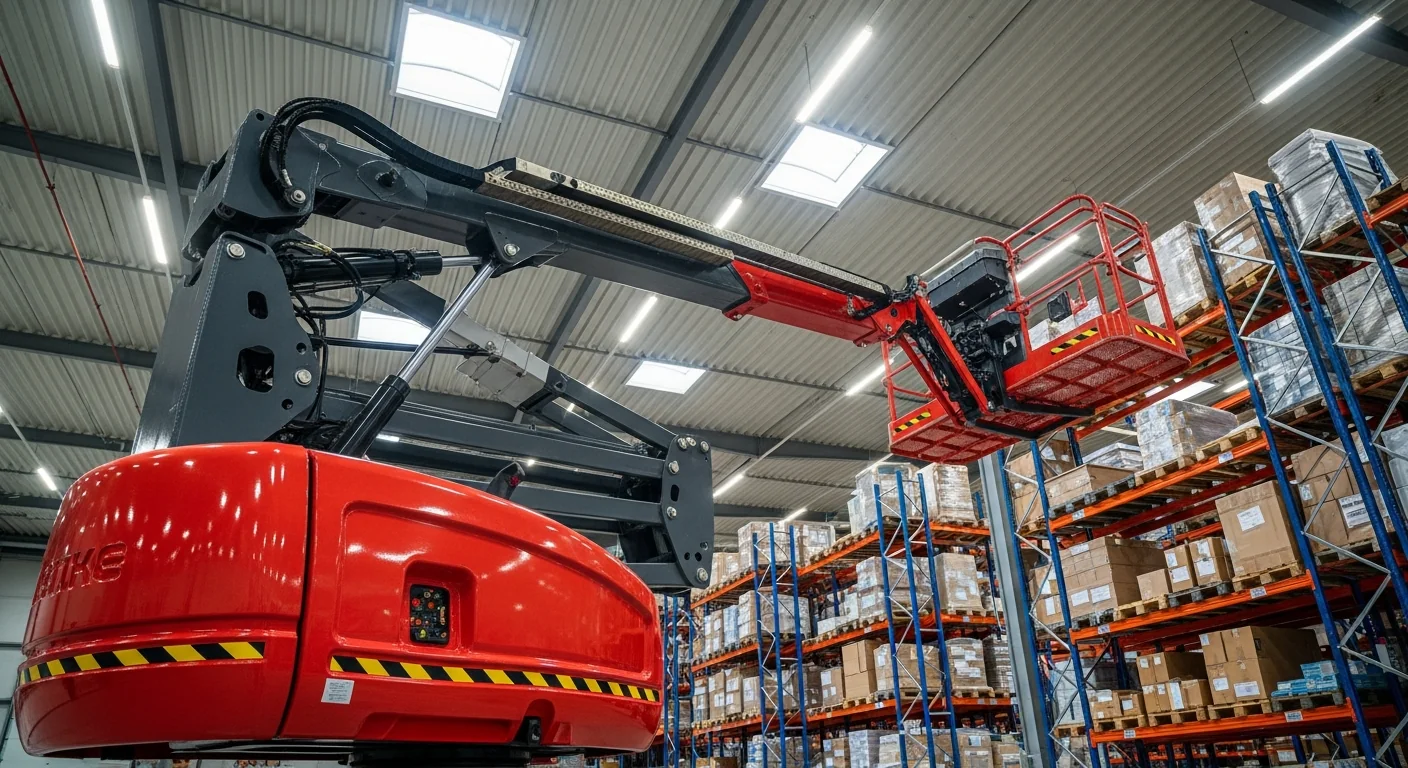
Most contractors focus on monthly payments, but the math that matters is total cost of operation. Based on EquipFlow's analysis of current market data, a mid-range boom lift like the $89,950 Niftylift SP50NE financed at 6% over 60 months costs approximately $1,734/month. Compare that to $1,456/month rental for comparable 34ft articulating units, and ownership breaks even at 51-54 months.
But here's what changes everything: Section 179 tax savings. According to IRS Publication 946, businesses can deduct the full purchase price of qualifying equipment. On that $89,950 boom lift, you're looking at $20,503 in tax savings at the 25% bracket, $26,243 at 32%, or $28,703 at 35%. Factor those immediate tax benefits, and ownership pays off in 34-37 months instead of 51-54.
A-tier borrowers with 720+ FICO scores typically see 6-10% APR from lenders in our network. B-tier borrowers (650-719 FICO) usually qualify for 10-14% rates, while startups and newer businesses see 12-18% depending on down payment and equipment age.
What most people miss: these rates vary dramatically by lender. Banks love newer equipment but shy away from anything over 7 years old. Specialty lenders embrace older machines but charge higher rates. Captive finance companies (like JLG Financial) offer promotional rates but limit equipment selection. This is exactly why lender competition matters—different lenders see different risks in the same deal.
At EquipFlow, we've seen the same contractor get quotes ranging from 8.5% to 14.2% for identical equipment. That 5.7% rate spread translates to $347/month difference on a $95,000 boom lift—or $20,820 over the loan term. Competition works, but only if you have access to multiple lenders who actually want aerial equipment deals.
Term loans represent the most common financing structure, with 60-month terms standard for boom lifts under $150,000. Extended 72-84 month terms become available for premium equipment like the JLG 1850SJ ($485,000+ MSRP), but expect slightly higher rates for longer terms.
SBA 504 loans offer compelling rates for boom lift purchases exceeding $100,000, with current market rates around 5.5-6.5% for the debenture portion. The catch: SBA 504 requires 10% down plus substantial paperwork, making it ideal for established contractors buying multiple units or high-value equipment.
Fair Market Value leases deserve consideration for contractors who upgrade equipment frequently. Monthly payments run 20-30% lower than financing, but you're essentially renting with an option to purchase at lease end. For boom lifts, residual values typically range from 15-25% of original MSRP after 60 months.
The IRS Section 179 deduction limit for 2026 is $2,560,000, meaning you can deduct the full purchase price of qualifying boom lifts in Year 1. Combined with 100% bonus depreciation, you're looking at immediate tax relief that dramatically improves cash flow.
Let me be direct: if you're in the 32% tax bracket and financing a $127,550 Genie Z-62/40, your Section 179 deduction generates $40,816 in immediate tax savings. That's more than most contractors' total annual equipment rental budget—recovered in one tax filing.
Critical timing consideration: bonus depreciation phases down to 80% in 2027, then drops by 20% annually until it expires in 2031. This creates a compelling financing window where immediate tax benefits are maximized, making 2026 purchases particularly attractive from a cash flow perspective.
Paying cash feels safe, but you're paying an invisible 15-20% opportunity cost. Most successful contractors generate 15-20% annual ROI on working capital through additional projects, equipment purchases, or business expansion. At 8% financing cost versus 18% opportunity cost, you profit 10 percentage points by financing instead of paying cash.
Here's the math on a $96,850 JLG 460SJ: paying cash ties up $96,850 that could generate $14,528-19,370 annually. Financing at 8% costs approximately $7,748 per year. Net benefit of financing: $6,780-11,622 annually.
Smart contractors use this arbitrage to their advantage, financing equipment at single-digit rates while deploying cash for higher-return opportunities. EquipFlow's lender network includes banks offering rates as low as 5.5% for premium borrowers, making the financing vs. cash decision mathematically obvious.
Under 29 CFR 1926.453, aerial lift operators must receive training on equipment-specific operation and safety procedures. While OSHA doesn't require formal certification for boom lift operators, training is mandatory and must be documented.
OSHA violations can result in fines of $5,000-70,000 per violation according to current penalty structures. Recent updates show serious violations ranging from $1,190-16,550, with repeat violations reaching $11,524-165,514. Smart contractors factor compliance costs into their equipment ownership calculations.
From a financing perspective, lenders increasingly evaluate safety records when underwriting boom lift loans. A clean OSHA record strengthens your application, while violations can trigger additional documentation requirements or higher rates. This creates another ownership advantage: when you control the equipment, you control the maintenance and safety protocols that protect both workers and your lending profile.
Electric boom lift adoption is accelerating rapidly, driven by zero emissions requirements for indoor job sites and lower operating costs. Electric models like the JLG EC600SJ ($119,850 MSRP) cost more upfront but eliminate fuel costs and reduce maintenance expenses.
Financing implications: electric models may command higher initial prices but offer better total cost of ownership and stronger residual values. Lenders increasingly prefer electric equipment for urban contractors due to regulatory trends and lower operating risk.Many contractors find electric boom lifts easier to finance because lenders view them as future-proof investments. While diesel models face potential regulatory restrictions in urban markets, electric equipment aligns with environmental trends that strengthen long-term value retention.
October 2025 data shows used telescopic boom lift prices dropped 9.82% year-over-year, indicating supply chain stabilization after 2021-2023 price spikes. For buyers, this means more used inventory and better financing terms as lenders compete for market share.
Telematics integration is becoming standard, with systems like JLG ClearSky and Skyjack Skycoded offering real-time monitoring and predictive maintenance. Lenders favor equipment with telematics because it reduces default risk through better maintenance tracking and theft prevention.
The financing landscape reflects these changes: lenders offer better terms for telematics-equipped units and increasingly scrutinize older equipment without modern monitoring systems. This trend accelerates the financing advantage for newer boom lifts while making older units harder to finance through traditional channels.
We've built the only platform that lets boom lift lenders compete for your business—because competition drives down rates and improves terms.
Ava, our AI advisor, needs to know your specific boom lift requirements, credit profile, and business situation. This isn't a generic loan application—we're diagnosing which lenders will compete hardest for your specific deal. A contractor buying a $68,850 Niftylift TD42T gets matched differently than someone financing a $185,850 JLG 860SJ.
Here's where the magic happens. When lenders compete for the same deal, rates typically drop 0.5-2 percentage points. Ava matches you with 3-4 lenders who specialize in boom lift financing and want your business. No cold calls to banks who don't understand aerial equipment depreciation curves.
You'll see exactly how each offer affects your monthly cash flow, total interest cost, and tax benefits. Compare a 6% SBA loan versus 10% equipment financing versus manufacturer 0% promotional rates—all side by side with real math.
You're in control. No pressure, no obligation, no commitment until you decide. Most contractors close within 48-72 hours once they've selected their preferred lender.
We've built the only platform that lets boom lift lenders compete for your business—because competition drives down rates and improves terms.
Ava, our AI advisor, needs to know your specific boom lift requirements, credit profile, and business situation. This isn't a generic loan application—we're diagnosing which lenders will compete hardest for your specific deal. A contractor buying a $68,850 Niftylift TD42T gets matched differently than someone financing a $185,850 JLG 860SJ.
Here's where the magic happens. When lenders compete for the same deal, rates typically drop 0.5-2 percentage points. Ava matches you with 3-4 lenders who specialize in boom lift financing and want your business. No cold calls to banks who don't understand aerial equipment depreciation curves.
You'll see exactly how each offer affects your monthly cash flow, total interest cost, and tax benefits. Compare a 6% SBA loan versus 10% equipment financing versus manufacturer 0% promotional rates—all side by side with real math.
You're in control. No pressure, no obligation, no commitment until you decide. Most contractors close within 48-72 hours once they've selected their preferred lender.
We've built the only platform that lets boom lift lenders compete for your business—because competition drives down rates and improves terms.
Ava, our AI advisor, needs to know your specific boom lift requirements, credit profile, and business situation. This isn't a generic loan application—we're diagnosing which lenders will compete hardest for your specific deal. A contractor buying a $68,850 Niftylift TD42T gets matched differently than someone financing a $185,850 JLG 860SJ.
Here's where the magic happens. When lenders compete for the same deal, rates typically drop 0.5-2 percentage points. Ava matches you with 3-4 lenders who specialize in boom lift financing and want your business. No cold calls to banks who don't understand aerial equipment depreciation curves.
You'll see exactly how each offer affects your monthly cash flow, total interest cost, and tax benefits. Compare a 6% SBA loan versus 10% equipment financing versus manufacturer 0% promotional rates—all side by side with real math.
You're in control. No pressure, no obligation, no commitment until you decide. Most contractors close within 48-72 hours once they've selected their preferred lender.
Lenders competing for the same deal typically drop rates 0.5-2 percentage points compared to approaching a single lender. We've seen contractors save $8,000-15,000 in total interest costs simply by having multiple offers to compare. When a bank knows they're competing against three other lenders, pricing gets aggressive fast.
Banks reject 67% of boom lift loans over 10 years old—but specialty lenders embrace older equipment. Ava matches you with lenders who understand aerial equipment depreciation curves, maintenance costs, and resale values. No more wasted applications or credit inquiries with lenders who don't want your deal.
Every day without proper aerial equipment costs money in lost productivity and rental fees. Our streamlined process gets you matched with competing lenders within 24 hours, with most contractors receiving multiple offers within 48 hours. Compare that to traditional bank financing options for your boom lift purchase that takes 2-4 weeks.
You're not committed to anything until you sign loan documents with your chosen lender. Get matched, compare boom lift models side by side, negotiate terms—all with zero obligation and no impact to your credit until you decide to move forward with a specific lender.
Lenders competing for the same deal typically drop rates 0.5-2 percentage points compared to approaching a single lender. We've seen contractors save $8,000-15,000 in total interest costs simply by having multiple offers to compare. When a bank knows they're competing against three other lenders, pricing gets aggressive fast.
Banks reject 67% of boom lift loans over 10 years old—but specialty lenders embrace older equipment. Ava matches you with lenders who understand aerial equipment depreciation curves, maintenance costs, and resale values. No more wasted applications or credit inquiries with lenders who don't want your deal.
Every day without proper aerial equipment costs money in lost productivity and rental fees. Our streamlined process gets you matched with competing lenders within 24 hours, with most contractors receiving multiple offers within 48 hours. Compare that to traditional bank financing options for your boom lift purchase that takes 2-4 weeks.
You're not committed to anything until you sign loan documents with your chosen lender. Get matched, compare boom lift models side by side, negotiate terms—all with zero obligation and no impact to your credit until you decide to move forward with a specific lender.
Lenders competing for the same deal typically drop rates 0.5-2 percentage points compared to approaching a single lender. We've seen contractors save $8,000-15,000 in total interest costs simply by having multiple offers to compare. When a bank knows they're competing against three other lenders, pricing gets aggressive fast.
Banks reject 67% of boom lift loans over 10 years old—but specialty lenders embrace older equipment. Ava matches you with lenders who understand aerial equipment depreciation curves, maintenance costs, and resale values. No more wasted applications or credit inquiries with lenders who don't want your deal.
Every day without proper aerial equipment costs money in lost productivity and rental fees. Our streamlined process gets you matched with competing lenders within 24 hours, with most contractors receiving multiple offers within 48 hours. Compare that to traditional bank financing options for your boom lift purchase that takes 2-4 weeks.
You're not committed to anything until you sign loan documents with your chosen lender. Get matched, compare boom lift models side by side, negotiate terms—all with zero obligation and no impact to your credit until you decide to move forward with a specific lender.
Lenders competing for the same deal typically drop rates 0.5-2 percentage points compared to approaching a single lender. We've seen contractors save $8,000-15,000 in total interest costs simply by having multiple offers to compare. When a bank knows they're competing against three other lenders, pricing gets aggressive fast.
Banks reject 67% of boom lift loans over 10 years old—but specialty lenders embrace older equipment. Ava matches you with lenders who understand aerial equipment depreciation curves, maintenance costs, and resale values. No more wasted applications or credit inquiries with lenders who don't want your deal.
Every day without proper aerial equipment costs money in lost productivity and rental fees. Our streamlined process gets you matched with competing lenders within 24 hours, with most contractors receiving multiple offers within 48 hours. Compare that to traditional bank financing options for your boom lift purchase that takes 2-4 weeks.
You're not committed to anything until you sign loan documents with your chosen lender. Get matched, compare boom lift models side by side, negotiate terms—all with zero obligation and no impact to your credit until you decide to move forward with a specific lender.
.png)


