Many businesses receive funding shortly after approval
Built to help businesses explore realistic financing options
Business owners trust EquipFlow to simplify financing decisions
National and specialty lenders across industries
Your fastest route to the right lender — and the equipment your business needs.
Share your equipment type, business info, and location — it takes less than 60 seconds.
We instantly compare national and specialty lenders to find your best funding options.
Review offers, choose your lender, and get approved with fast turnaround times.
Crane financing has become the mathematically smarter choice for most construction operations, especially after rental rates for mobile cranes jumped 23% over the last 18 months. While you're paying $7,000-$12,000 monthly to rent a 50-ton rough terrain crane with zero equity to show for it, the same equipment financed over 60 months costs approximately $3,800-$5,200 monthly—and you own it at the end.
Here's what most contractors miss: paying cash feels safe, but you're bleeding opportunity cost. Most construction companies generate 15-20% annual returns on working capital. Tying up $300,000 in a crane purchase means losing $45,000-$60,000 per year in growth opportunities. At 8% financing, your annual interest cost is only $24,000—meaning you profit $21,000-$36,000 annually by financing instead of paying cash.
The challenge isn't whether to finance—it's getting the right rate from the right lender. Banks reject 67% of used crane loans over 10 years old, and most contractors waste weeks applying to lenders who don't understand construction equipment collateral. That's where lender competition changes everything. When 3-4 specialized equipment lenders compete for your deal, rates typically drop 0.5-2 percentage points.
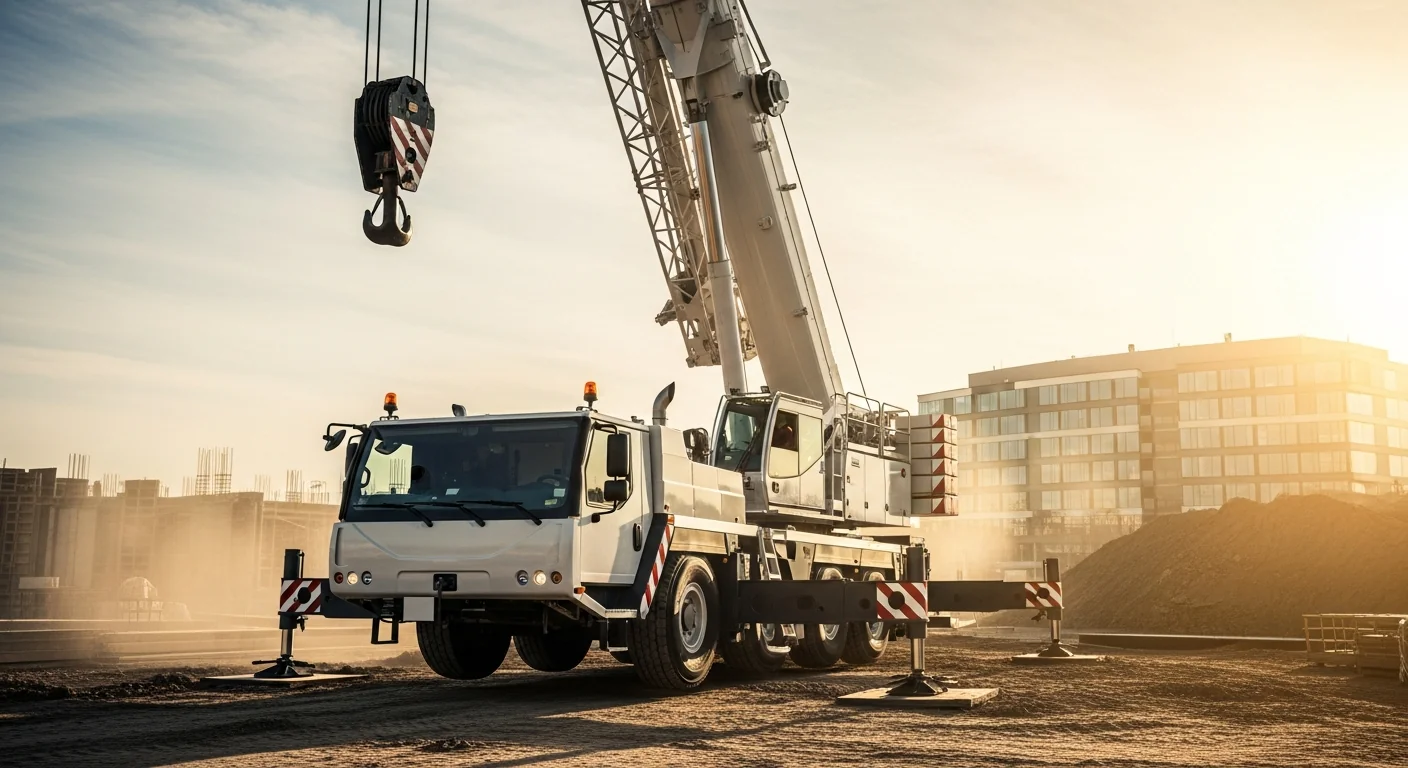
Most crane financing pages tell you rates "vary based on creditworthiness." What they don't tell you is that the difference between a 7% rate and a 14% rate on a $300,000 crane equals $73,000 in additional interest over seven years—enough to buy a used boom truck.
A-Tier borrowers with 720+ FICO scores and 2+ years in business typically see 6.5-9.5% APR from traditional equipment lenders. B-Tier borrowers (650-719 credit) range from 9.5-14%, while startups or those with sub-650 credit face 12-18% from specialized lenders willing to work with newer businesses.
What moves you between tiers isn't just credit score—it's time in business, annual revenue, existing debt service coverage ratio, and the specific crane you're financing. Banks are most comfortable with all-terrain and rough terrain cranes due to broader resale markets, while crawler cranes and tower cranes often face 1-2% rate premiums due to specialized buyer pools.
A $200,000 used 50-ton rough terrain crane financed at 8% APR over 60 months costs $4,055 monthly with $43,328 in total interest. Compare this to $7,000+ monthly rental rates for comparable equipment—you break even around month 24-30, after which every payment builds equity instead of bleeding cash.
For a $500,000 new 100-ton all-terrain crane at 7% over 84 months, expect $7,535 monthly payments with $132,940 in total interest. That same crane rented would cost $15,000-$20,000 monthly with zero equity accumulation.
A $150,000 boom truck financed at 10% over 48 months runs $3,803 monthly. The math is compelling: if that crane generates $8,000-$12,000 in monthly billings, you're cash-flow positive from day one while building a depreciating but valuable asset.
Origination fees typically run 1-3% of the loan amount—that's $3,000-$9,000 on a $300,000 deal, sometimes rolled into financing. Documentation fees range $495-$1,500 and are almost always due at closing. For used cranes, expect $2,000-$5,000 in appraisal and inspection costs paid upfront.
Early payoff penalties are the hidden cost most contractors don't ask about. Typical structures charge 2-5% of the remaining balance if you pay off in years one or two, declining by 1% annually. On a $250,000 remaining balance, that's $5,000-$12,500 to pay off early—plan accordingly if you expect large project windfalls.
According to IRS Publication 946, the Section 179 deduction limit for 2026 is $2,560,000, meaning you can deduct the full purchase price of qualifying cranes in the year of purchase. This creates massive first-year tax savings that dramatically reduce your true acquisition cost.
For a $700,000 Terex AC 100-4L crane, Section 179 provides $147,000 in Year 1 tax savings at the 21% corporate rate—a 21% immediate liquidity multiplier that effectively reduces the true acquisition cost to $553,000. The bonus depreciation rate for 2026 is 20% on qualifying property, providing additional first-year deductions on amounts exceeding Section 179 limits.
Here's the math that matters: Equipment loans and $1 buyout leases qualify for Section 179, while fair market value operating leases do not. If you're in the 25% tax bracket, a $248,058 crane purchase generates $62,014 in immediate tax savings. At the 32% bracket, that same crane saves $79,379. At 35%, you're looking at $86,820 back in Year 1.
Bonus depreciation declines 20% annually under current tax law, reaching zero after 2026. For 2026 purchases, you get 100% bonus depreciation on qualifying equipment. This creates urgency—waiting until 2027 means losing this additional tax benefit entirely.
All-terrain cranes represent the easiest financing category due to their broad resale market and operational versatility. Lenders view these as baseline risk, typically offering their standard equipment rates. Rough terrain cranes finance similarly well, with most lenders comfortable at baseline to +1% premium.
Crawler cranes face moderate financing difficulty due to specialized markets and transport complexity. Expect 1-2% rate premiums and potentially higher down payment requirements. Tower cranes represent the most challenging category—limited resale markets and installation costs create 1-3% rate premiums, with some lenders avoiding them entirely.
Boom trucks benefit from their dual-purpose nature (crane + truck), but CDL requirements and DOT compliance add operational complexity that some lenders factor into pricing.
Most traditional lenders cap crane financing at 10-12 years old with under 8,000-10,000 operating hours. Specialized equipment lenders extend to 15-20 years but at 2-5% rate premiums. Pre-Tier 4 emissions equipment may face geographic operating restrictions that reduce resale value and lender comfort.
Manufacturer financing from companies like Tadano, Liebherr, and Manitowoc/Grove occasionally offers promotional rates (0-3% APR) on new models, but these programs are typically short-term and subject to change. Chinese brands may face 2-4% rate premiums due to lower resale values and less lender familiarity.
Your loan payment represents only 30% of true crane ownership costs. Lenders require comprehensive and collision coverage plus $1-5 million general liability with them named as loss payee. Annual insurance costs typically run 3-6% of crane value—that's $9,000-$18,000 yearly for a $300,000 crane, adding $750-$1,500 to your monthly budget.
Under OSHA standard 1926.1400, all crane operators must maintain current NCCCO certification, valid for 5 years and costing $400-$600 per operator per cycle. Annual crane inspections run $500-$2,000, while maintaining 20-foot clearance from power lines up to 350kV (50 feet for higher voltage) requires careful job planning and potential productivity impacts. To understand how much a crane typically costs beyond financing alone, factor in these ongoing ownership expenses. If you're still weighing ownership versus short-term use, explore crane rental options for your project to compare costs.A realistic monthly budget for a $300,000 financed crane includes: $6,083 loan payment, $1,250 insurance, $1,500 maintenance reserve, $200 compliance costs (annualized), plus fuel and operator costs. Total monthly ownership costs often exceed $20,000—factor this into your revenue projections before committing to purchase.
For a $250,000 crane over five years, financing at 8% costs approximately $310,000 in total payments plus $50,000 in insurance and $37,500 in maintenance, offset by $75,000 residual value and $62,500 in Section 179 tax savings at the 25% bracket. Net five-year cost: roughly $260,000.
Cash purchase costs $250,000 plus the same insurance/maintenance, with identical tax savings and residual value. However, you lose approximately $62,500 in opportunity cost by tying up working capital—net cost $262,500.
Rental at $7,000 monthly costs $420,000 over five years with no residual value, though payments are fully deductible as operating expenses (worth roughly $105,000 in tax savings). Net rental cost: $315,000.
The breakeven point for ownership versus rental occurs around months 24-30 for most crane categories. Beyond that threshold, every rental payment represents pure excess cost with zero equity accumulation.
EquipFlow connects you with competing crane lenders who specialize in construction equipment—no more guessing which banks actually understand your industry.
Ava, our AI advisor, analyzes your specific equipment needs, credit profile, and business financials. Whether you're looking at a $150,000 used boom truck or a $800,000 new all-terrain crane, we identify which lenders in our network are most likely to approve your deal at competitive rates.
Instead of applying to random banks that might reject construction equipment deals, you're matched with lenders who actively compete for crane financing. This competition typically drives rates down 0.5-2 percentage points compared to single-lender applications.
See exactly how each offer affects your monthly cash flow, total interest cost, and tax advantages. Compare equipment loans (immediate ownership) versus lease structures ($1 buyout, fair market value) to optimize your specific tax situation.
You maintain complete control—no pressure, no obligation. Once you select your preferred lender and terms, they handle the closing process directly. Most crane financing closes within 7-14 business days after approval.
EquipFlow connects you with competing crane lenders who specialize in construction equipment—no more guessing which banks actually understand your industry.
Ava, our AI advisor, analyzes your specific equipment needs, credit profile, and business financials. Whether you're looking at a $150,000 used boom truck or a $800,000 new all-terrain crane, we identify which lenders in our network are most likely to approve your deal at competitive rates.
Instead of applying to random banks that might reject construction equipment deals, you're matched with lenders who actively compete for crane financing. This competition typically drives rates down 0.5-2 percentage points compared to single-lender applications.
See exactly how each offer affects your monthly cash flow, total interest cost, and tax advantages. Compare equipment loans (immediate ownership) versus lease structures ($1 buyout, fair market value) to optimize your specific tax situation.
You maintain complete control—no pressure, no obligation. Once you select your preferred lender and terms, they handle the closing process directly. Most crane financing closes within 7-14 business days after approval.
EquipFlow connects you with competing crane lenders who specialize in construction equipment—no more guessing which banks actually understand your industry.
Ava, our AI advisor, analyzes your specific equipment needs, credit profile, and business financials. Whether you're looking at a $150,000 used boom truck or a $800,000 new all-terrain crane, we identify which lenders in our network are most likely to approve your deal at competitive rates.
Instead of applying to random banks that might reject construction equipment deals, you're matched with lenders who actively compete for crane financing. This competition typically drives rates down 0.5-2 percentage points compared to single-lender applications.
See exactly how each offer affects your monthly cash flow, total interest cost, and tax advantages. Compare equipment loans (immediate ownership) versus lease structures ($1 buyout, fair market value) to optimize your specific tax situation.
You maintain complete control—no pressure, no obligation. Once you select your preferred lender and terms, they handle the closing process directly. Most crane financing closes within 7-14 business days after approval.
EquipFlow specializes in matching construction businesses with equipment lenders who actually understand crane financing—eliminating the guesswork and rejection cycles that waste your time.
When multiple lenders compete for the same deal, rates typically drop 0.5-2 percentage points compared to single-lender applications. Our network includes both traditional banks and specialized equipment lenders, ensuring you see the full range of available terms. Instead of wondering if you got the best rate, you can compare actual offers side-by-side.
Our AI advisor understands which lenders approve specific crane types, ages, and credit profiles. Banks reject 67% of used equipment loans over certain age thresholds—Ava matches you with lenders who actively finance the equipment you're buying. This targeted approach dramatically improves approval odds while reducing application time and credit inquiries.
Every day without the right crane costs you potential revenue. Most contractors receive 3-4 competing offers within 24-48 hours of submitting their information. This speed advantage is crucial when equipment opportunities or project deadlines create time pressure. Traditional bank shopping often takes weeks with uncertain outcomes.
Comparing offers through EquipFlow creates zero commitment. Review terms, calculate total costs, evaluate tax implications—then choose the option that makes the most financial sense for your operation. If none of the offers work for your situation, you haven't wasted application fees or damaged your credit with multiple inquiries.
EquipFlow specializes in matching construction businesses with equipment lenders who actually understand crane financing—eliminating the guesswork and rejection cycles that waste your time.
When multiple lenders compete for the same deal, rates typically drop 0.5-2 percentage points compared to single-lender applications. Our network includes both traditional banks and specialized equipment lenders, ensuring you see the full range of available terms. Instead of wondering if you got the best rate, you can compare actual offers side-by-side.
Our AI advisor understands which lenders approve specific crane types, ages, and credit profiles. Banks reject 67% of used equipment loans over certain age thresholds—Ava matches you with lenders who actively finance the equipment you're buying. This targeted approach dramatically improves approval odds while reducing application time and credit inquiries.
Every day without the right crane costs you potential revenue. Most contractors receive 3-4 competing offers within 24-48 hours of submitting their information. This speed advantage is crucial when equipment opportunities or project deadlines create time pressure. Traditional bank shopping often takes weeks with uncertain outcomes.
Comparing offers through EquipFlow creates zero commitment. Review terms, calculate total costs, evaluate tax implications—then choose the option that makes the most financial sense for your operation. If none of the offers work for your situation, you haven't wasted application fees or damaged your credit with multiple inquiries.
EquipFlow specializes in matching construction businesses with equipment lenders who actually understand crane financing—eliminating the guesswork and rejection cycles that waste your time.
When multiple lenders compete for the same deal, rates typically drop 0.5-2 percentage points compared to single-lender applications. Our network includes both traditional banks and specialized equipment lenders, ensuring you see the full range of available terms. Instead of wondering if you got the best rate, you can compare actual offers side-by-side.
Our AI advisor understands which lenders approve specific crane types, ages, and credit profiles. Banks reject 67% of used equipment loans over certain age thresholds—Ava matches you with lenders who actively finance the equipment you're buying. This targeted approach dramatically improves approval odds while reducing application time and credit inquiries.
Every day without the right crane costs you potential revenue. Most contractors receive 3-4 competing offers within 24-48 hours of submitting their information. This speed advantage is crucial when equipment opportunities or project deadlines create time pressure. Traditional bank shopping often takes weeks with uncertain outcomes.
Comparing offers through EquipFlow creates zero commitment. Review terms, calculate total costs, evaluate tax implications—then choose the option that makes the most financial sense for your operation. If none of the offers work for your situation, you haven't wasted application fees or damaged your credit with multiple inquiries.
EquipFlow specializes in matching construction businesses with equipment lenders who actually understand crane financing—eliminating the guesswork and rejection cycles that waste your time.
When multiple lenders compete for the same deal, rates typically drop 0.5-2 percentage points compared to single-lender applications. Our network includes both traditional banks and specialized equipment lenders, ensuring you see the full range of available terms. Instead of wondering if you got the best rate, you can compare actual offers side-by-side.
Our AI advisor understands which lenders approve specific crane types, ages, and credit profiles. Banks reject 67% of used equipment loans over certain age thresholds—Ava matches you with lenders who actively finance the equipment you're buying. This targeted approach dramatically improves approval odds while reducing application time and credit inquiries.
Every day without the right crane costs you potential revenue. Most contractors receive 3-4 competing offers within 24-48 hours of submitting their information. This speed advantage is crucial when equipment opportunities or project deadlines create time pressure. Traditional bank shopping often takes weeks with uncertain outcomes.
Comparing offers through EquipFlow creates zero commitment. Review terms, calculate total costs, evaluate tax implications—then choose the option that makes the most financial sense for your operation. If none of the offers work for your situation, you haven't wasted application fees or damaged your credit with multiple inquiries.
.png)