Many businesses receive funding shortly after approval
Built to help businesses explore realistic financing options
Business owners trust EquipFlow to simplify financing decisions
National and specialty lenders across industries
Your fastest route to the right lender — and the equipment your business needs.
Share your equipment type, business info, and location — it takes less than 60 seconds.
We instantly compare national and specialty lenders to find your best funding options.
Review offers, choose your lender, and get approved with fast turnaround times.
Food truck rental sounds like the safe play—monthly payments of $1,000 to $5,000 with no massive upfront purchase. What rental companies don't advertise: that $2,500/month truck actually requires $8,000 to $15,000 in upfront capital before you serve your first customer. We're talking security deposits (typically 1-2 months' rent), first and last month payments, commercial insurance that runs $300-$1,000 monthly, health department permits ($300-$1,500), mandatory commissary kitchen access ($200-$800/month), and initial inventory ($2,000-$5,000). The math gets worse from there. At $2,500 monthly, you'll spend $90,000 over three years renting a truck worth $65,000-$80,000—with zero equity to show for it. Here's what most people miss: somewhere around month 18, you cross the invisible line where cumulative rental payments exceed what you'd pay financing the same truck. Banks won't touch startup food truck loans—they want 620+ FICO scores, one year in business, and $300,000 in annual revenue according to Ameris Bank's lending requirements. But here's the thing about smart operators: they use rental strategically as a bridge to ownership, not a permanent solution.
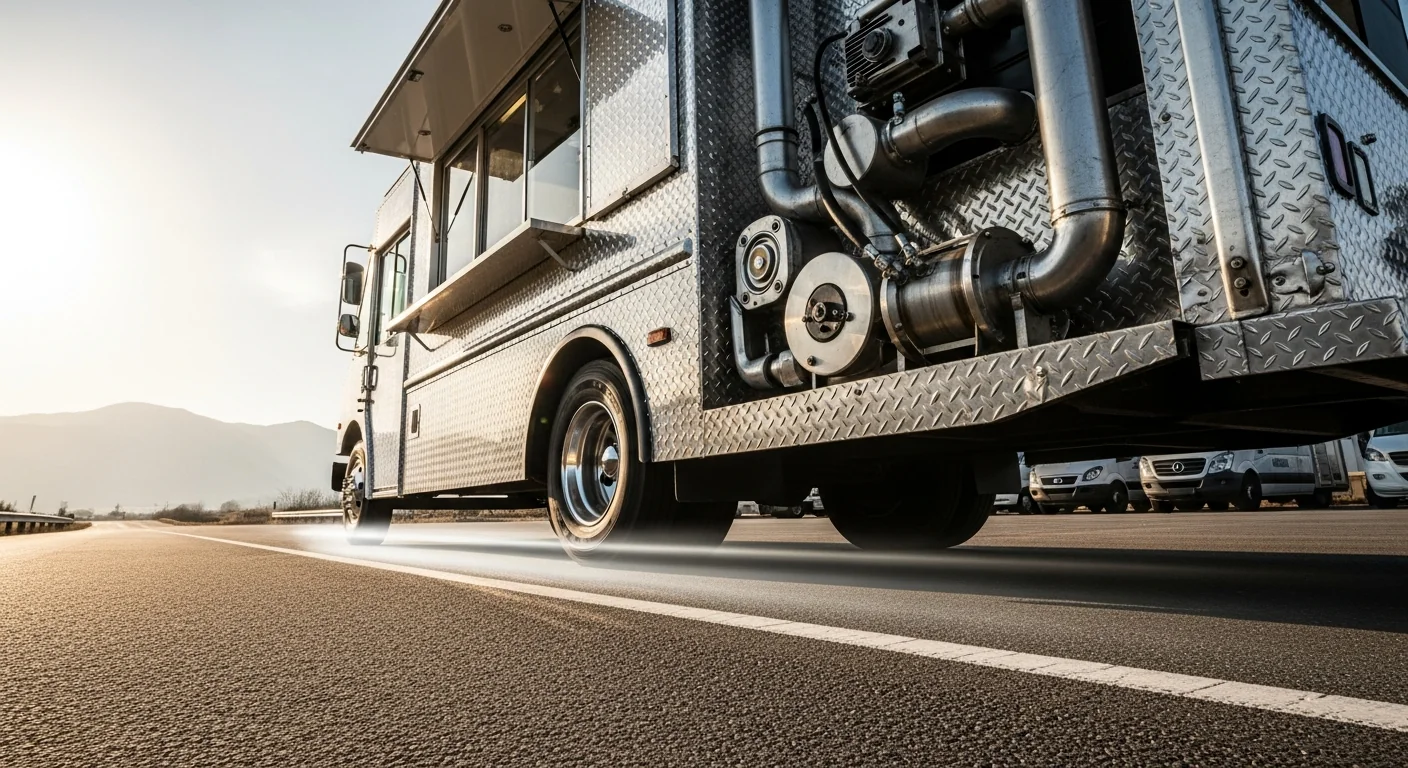
Rental companies quote $1,000-$5,000 monthly rates, but that's just the starting line. Here's the real math most operators discover too late—and why the math says you should own it instead.
That $2,500/month rental truck requires serious upfront cash:
- Security deposit: $2,500-$5,000 (1-2 months' rent)
- First and last month: $5,000
- Commercial insurance deposit: $600-$2,000
- Health department permits: $300-$1,500
- Commissary kitchen first month: $200-$800
- Initial food inventory: $2,000-$5,000
- Working capital buffer: $2,000-$4,000
Total upfront: $12,600-$20,800 before selling a single item.
For startups who need bridge capital, the SBA Microloan program provides up to $50,000 specifically for new businesses that traditional banks won't touch.
Rental rates almost never include the real operating expenses:
- Commercial insurance: $300-$1,000/month (general liability, commercial auto, workers' comp)
- Commissary parking/prep: $200-$800/month (mandatory in most cities)
- Propane and generator fuel: $200-$600/month depending on usage
- Fire suppression inspections: $200-$400 semi-annually
- Maintenance reserves: $200-$500/month for repairs you're responsible for
A $2,500 rental can easily become $3,500-$4,200 in total monthly costs.
Stop building zero equity. That same $15,000 upfront rental capital often covers the down payment on financing your own truck. The difference: you're building toward ownership instead of perpetual payments with nothing to show for it. Our lender network specializes in turning rental down payments into ownership down payments—often with better monthly cash flow.
Here's the math rental companies hope you never calculate. A typical food truck worth $65,000-$80,000 can be financed through SBA 7(a) loans up to $5,000,000 with significantly lower down payments than conventional loans.
Pure Rental Route:
- Monthly cost: $2,500 + $800 insurance + $400 commissary = $3,700
- 36-month total: $133,200
- Equity built: $0
SBA Financing Route:
- $75,000 truck, 20% down ($15,000), 8.5% APR, 84 months
- Monthly payment: $1,245
- Total paid over 36 months: $44,820 + $15,000 down = $59,820
- Remaining loan balance: $54,735
- Asset value after 3 years: ~$52,000-$57,000
- Net equity position: $52,000-$57,000 asset minus $54,735 owed = Break-even to $2,265 equity
The Kicker: Tax Benefits You Can't Get From Renting
According to IRS Publication 946, Section 179 allows deducting up to $2,560,000 of equipment purchases in Year 1. On a $75,000 food truck, that's $18,750 in immediate tax savings at a 25% bracket—enough to cover your entire down payment.
Bonus depreciation adds another 20% first-year deduction in 2026, creating additional tax advantages that pure rental can never match.
At 25-30% net margins (typical for food trucks), here's the monthly gross revenue you need just to cover rental costs:
This assumes 25-30% net margin after food costs (28-35%), labor, fuel, and other operating expenses.
The bottom line: if you can hit these revenue numbers consistently, you can afford to own. Our AI matches you with lenders who understand food truck cash flow patterns and structure payments around your actual earning potential, not rental company profit margins.
Most rental agreements favor the owner heavily. Look for:
Maintenance liability: Who pays when the refrigeration dies? Generator needs repair? Many contracts make YOU responsible for everything except engine/transmission.
Insurance minimums: Many require $2M general liability (not $1M) for access to profitable festivals and events. Budget accordingly.
Mileage restrictions: Some contracts limit you to 1,000-2,000 miles monthly. Exceed it and face $0.25-$0.50 per mile penalties.
Modification policies: Most prohibit vehicle wraps or permanent signage. If you invest $4,000 in custom branding, it's a total loss at lease end.
Early termination: Expect 30-60 day penalties if you need to exit early. Some require paying remaining months.
Condition return standards: "Normal wear and tear" is subjective. Document everything with photos before taking possession.
Subletting restrictions: Most prohibit hiring other operators or drivers without approval.
Some operators offer lease-to-own with 20-50% of monthly payments credited toward purchase. The math:
- 30% rent credit: $2,500/month = $750/month toward ownership
- After 24 months: $18,000 in purchase credits
- Remaining balance on $75,000 truck: $57,000
This works IF the purchase price is fair market value, not inflated retail pricing.
Here's what rental contracts won't tell you: Every restriction, penalty, and limitation disappears when you own the truck outright. No mileage limits, no modification restrictions, no early termination fees. Plus, you control the maintenance schedule and can build relationships with preferred repair shops instead of dealing with rental company-approved vendors at inflated rates. EquipFlow's lender network helps you escape rental restrictions faster than you think possible.
Permit timelines vary drastically by state. California can take 8-16 weeks while Texas might approve in 2-4 weeks. Critical: start the permit process BEFORE signing rental agreements to avoid paying rent with zero revenue capability.
Some jurisdictions restrict permits to trucks under 10 years old or require specific equipment certifications. Verify your rental truck qualifies before committing.
Required: fire extinguishers (minimum 2A:10BC rated), first aid kits, slip-resistant flooring, and heat illness prevention when interior temps exceed 80°F.
ANSUL or equivalent fire suppression systems require semi-annual professional inspection ($200-$400 each). Most event venues require proof of current certification—an expired certificate means automatic health department shutdown.
Commercial auto and general liability insurance minimums vary, but $2M general liability is becoming standard for festival access.
The compliance reality check: You're handling all the regulatory headaches of ownership while getting none of the benefits. Every permit, inspection, and insurance requirement hits your cash flow the same whether you rent or own—but only ownership gives you equity and tax advantages in return. Stop shouldering owner responsibilities for renter rewards.
Major lenders like Ameris Bank require minimum 620 FICO scores, at least one year in business, and $300,000+ in annual revenue for traditional equipment financing. But specialty lenders in our network work with:
- Credit scores starting around 580
- Startups with strong business plans
- Lower revenue thresholds ($150,000+ annual)
- Alternative qualification methods
SBA Microloan Program: Up to $50,000 for startups and new businesses. Perfect for covering down payments and working capital during the startup phase.
SBA 7(a) Program: Up to $5,000,000 with lower down payment requirements than conventional loans. Rates typically 2-3% above prime.
SBA 504 Program: Up to $5,500,000 for larger operations or multiple trucks.
Smart operators use their rental period strategically—building credit scores, generating 12 months of P&L statements, and establishing vendor relationships that strengthen loan applications.
After 12-18 months of successful operations, you shift from startup status to established business, dropping down payment requirements from 30% to 10-20% and qualifying for significantly better rates.
Instead of viewing rental as permanent, use it as a qualification period:
1. Months 1-6: Focus on perfecting operations, building customer base
2. Months 7-12: Document all financials, build business credit
3. Months 13-18: Apply for financing while rental provides cash flow stability
4. Month 18+: Transition to ownership with proven track record
This approach costs more upfront but builds toward equity rather than perpetual payments with zero ownership stake.
The math says you should own it. Every month you rent beyond 18 months, you're literally paying more than ownership would cost while building zero equity. EquipFlow's AI advisor knows exactly when your business profile shifts from "startup risk" to "proven operator"—and connects you with lenders who reward that transition with significantly better financing terms.
Most food truck operators rent because they think banks won't approve them. The reality: you need the RIGHT lenders competing for your deal.
Our AI advisor analyzes your specific scenario—credit profile, time in business, revenue history, and the exact truck specifications you need. Unlike banks that want perfect A-tier borrowers, Ava identifies lenders who actually approve startup food truck deals and work with credit scores starting around 580.
This is where the magic happens. Instead of getting rejected by one bank, Ava connects you with 3-4 lenders who specialize in food truck financing and actually compete for your business. When lenders compete, rates typically drop 0.5-2 percentage points—that's $2,000-$8,000 in savings over the loan term.
See exactly how each offer affects your monthly cash flow, total interest cost, and tax benefits. According to IRS Publication 946, Section 179 lets you deduct up to $2,560,000 of equipment purchases in 2026—meaning immediate tax savings that rental can never provide.
You control the decision. No pressure, no obligation. Most operators get offers within 24-48 hours and close within 2-3 weeks. Compare that to 6-12 months of rental payments with zero equity building.
Most food truck operators rent because they think banks won't approve them. The reality: you need the RIGHT lenders competing for your deal.
Our AI advisor analyzes your specific scenario—credit profile, time in business, revenue history, and the exact truck specifications you need. Unlike banks that want perfect A-tier borrowers, Ava identifies lenders who actually approve startup food truck deals and work with credit scores starting around 580.
This is where the magic happens. Instead of getting rejected by one bank, Ava connects you with 3-4 lenders who specialize in food truck financing and actually compete for your business. When lenders compete, rates typically drop 0.5-2 percentage points—that's $2,000-$8,000 in savings over the loan term.
See exactly how each offer affects your monthly cash flow, total interest cost, and tax benefits. According to IRS Publication 946, Section 179 lets you deduct up to $2,560,000 of equipment purchases in 2026—meaning immediate tax savings that rental can never provide.
You control the decision. No pressure, no obligation. Most operators get offers within 24-48 hours and close within 2-3 weeks. Compare that to 6-12 months of rental payments with zero equity building.
Most food truck operators rent because they think banks won't approve them. The reality: you need the RIGHT lenders competing for your deal.
Our AI advisor analyzes your specific scenario—credit profile, time in business, revenue history, and the exact truck specifications you need. Unlike banks that want perfect A-tier borrowers, Ava identifies lenders who actually approve startup food truck deals and work with credit scores starting around 580.
This is where the magic happens. Instead of getting rejected by one bank, Ava connects you with 3-4 lenders who specialize in food truck financing and actually compete for your business. When lenders compete, rates typically drop 0.5-2 percentage points—that's $2,000-$8,000 in savings over the loan term.
See exactly how each offer affects your monthly cash flow, total interest cost, and tax benefits. According to IRS Publication 946, Section 179 lets you deduct up to $2,560,000 of equipment purchases in 2026—meaning immediate tax savings that rental can never provide.
You control the decision. No pressure, no obligation. Most operators get offers within 24-48 hours and close within 2-3 weeks. Compare that to 6-12 months of rental payments with zero equity building.
Most food truck operators waste months getting rejected by banks that don't understand their business model. Here's how we solve that.
When 3-4 lenders compete for the same deal, rates typically drop 0.5-2 percentage points. That's real money—on a $75,000 loan, 1.5% rate reduction saves you $5,600+ over the loan term. Banks don't compete when you approach them individually.
Banks reject 60-70% of food truck loans due to industry bias and strict underwriting boxes. Ava connects you with lenders who specialize in food service equipment and understand your revenue patterns, seasonal fluctuations, and asset values. No more wasting time with lenders who don't "get" your business.
Traditional bank shopping takes 2-4 months of applications, rejections, and starting over. Our network provides competing offers within 24-48 hours. Every day without your own truck is lost revenue—rental fees with zero equity building.
Get matched, see your options, compare offers. No commitment until you find terms that make sense for your business. Most operators are surprised by qualification options they didn't know existed.
Most food truck operators waste months getting rejected by banks that don't understand their business model. Here's how we solve that.
When 3-4 lenders compete for the same deal, rates typically drop 0.5-2 percentage points. That's real money—on a $75,000 loan, 1.5% rate reduction saves you $5,600+ over the loan term. Banks don't compete when you approach them individually.
Banks reject 60-70% of food truck loans due to industry bias and strict underwriting boxes. Ava connects you with lenders who specialize in food service equipment and understand your revenue patterns, seasonal fluctuations, and asset values. No more wasting time with lenders who don't "get" your business.
Traditional bank shopping takes 2-4 months of applications, rejections, and starting over. Our network provides competing offers within 24-48 hours. Every day without your own truck is lost revenue—rental fees with zero equity building.
Get matched, see your options, compare offers. No commitment until you find terms that make sense for your business. Most operators are surprised by qualification options they didn't know existed.
Most food truck operators waste months getting rejected by banks that don't understand their business model. Here's how we solve that.
When 3-4 lenders compete for the same deal, rates typically drop 0.5-2 percentage points. That's real money—on a $75,000 loan, 1.5% rate reduction saves you $5,600+ over the loan term. Banks don't compete when you approach them individually.
Banks reject 60-70% of food truck loans due to industry bias and strict underwriting boxes. Ava connects you with lenders who specialize in food service equipment and understand your revenue patterns, seasonal fluctuations, and asset values. No more wasting time with lenders who don't "get" your business.
Traditional bank shopping takes 2-4 months of applications, rejections, and starting over. Our network provides competing offers within 24-48 hours. Every day without your own truck is lost revenue—rental fees with zero equity building.
Get matched, see your options, compare offers. No commitment until you find terms that make sense for your business. Most operators are surprised by qualification options they didn't know existed.
Most food truck operators waste months getting rejected by banks that don't understand their business model. Here's how we solve that.
When 3-4 lenders compete for the same deal, rates typically drop 0.5-2 percentage points. That's real money—on a $75,000 loan, 1.5% rate reduction saves you $5,600+ over the loan term. Banks don't compete when you approach them individually.
Banks reject 60-70% of food truck loans due to industry bias and strict underwriting boxes. Ava connects you with lenders who specialize in food service equipment and understand your revenue patterns, seasonal fluctuations, and asset values. No more wasting time with lenders who don't "get" your business.
Traditional bank shopping takes 2-4 months of applications, rejections, and starting over. Our network provides competing offers within 24-48 hours. Every day without your own truck is lost revenue—rental fees with zero equity building.
Get matched, see your options, compare offers. No commitment until you find terms that make sense for your business. Most operators are surprised by qualification options they didn't know existed.
.png)