Many businesses receive funding shortly after approval
Built to help businesses explore realistic financing options
Business owners trust EquipFlow to simplify financing decisions
National and specialty lenders across industries
Your fastest route to the right lender — and the equipment your business needs.
Share your equipment type, business info, and location — it takes less than 60 seconds.
We instantly compare national and specialty lenders to find your best funding options.
Review offers, choose your lender, and get approved with fast turnaround times.
Track skid steer rental rates jumped 18% in the last 24 months, with medium-frame units now costing $1,575+ per month when you factor in the hidden fees rental companies don't advertise upfront. That's $18,900 per year with zero equity to show for it—and most contractors don't realize they're paying a markup over the listed daily rate once delivery fees ($150-$500 per trip), damage waivers ($35/day), fuel costs ($80/day at current diesel prices), and sales tax get added to the bill.
Here's what the rental industry doesn't want you to calculate: a contractor renting that same medium-frame track loader at $1,575/month will spend $47,250 over 30 months and own nothing. That same contractor could finance a track skid steer at 6% APR for $1,444/month, spend $43,320 over the same period, and own an asset worth $35,000-$45,000 on the resale market. The math gets even better when you factor in Section 179 tax deductions—according to IRS Publication 946, businesses can deduct up to $2,560,000 in equipment purchases in Year 1, creating immediate tax savings of $15,721 on that track loader at the 21% corporate rate.
Smart contractors aren't asking "should I rent?" anymore. They're asking "can I afford NOT to own?" Because every month you rent is another month you're building someone else's equity instead of your own.
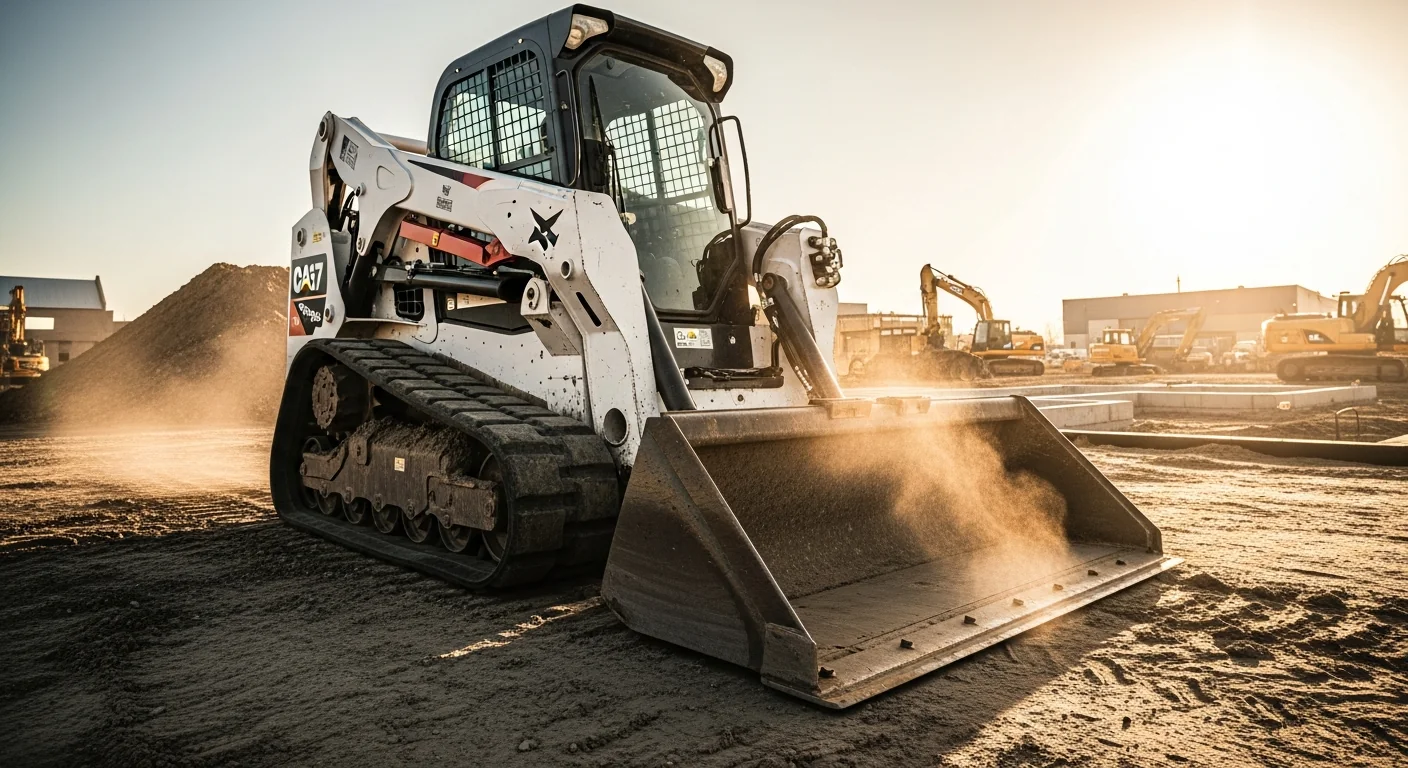
Most contractors get sticker shock when they see their first rental invoice—because the advertised rate is just the starting point. Here's the breakdown by size class and what each category really costs once you add the mandatory extras:
Mini and walk-behind models like the Dingo TXL 2000 or Vermeer S925TX rent for $104-$175 daily, $550-$900 weekly, or $773-$1,400 monthly. These compact units work for tight-access landscaping but have limited lifting capacity at 200-800 lb rated operating capacity (ROC).
Small frame units under 2,000 lb ROC, including the popular Bobcat T450 and Cat 239D3, run $150-$250 daily, $750-$1,250 weekly, or $1,100-$1,800 monthly. These handle light grading and trenching work but struggle with heavy material loads.
Medium frame track loaders (2,000-3,000 lb ROC) like the Bobcat T650 and John Deere 325G command $200-$310 daily, $1,000-$1,600 weekly, or $1,500-$2,300 monthly. This is the sweet spot for general construction and excavation work.
Large frame models exceeding 3,000 lb ROC, such as the Bobcat T870 and Cat 299D3, cost $275-$368 daily, $1,300-$1,900 weekly, or $1,800-$2,825 monthly. These machines handle heavy grading, land clearing, and demolition.
Tracked models consistently cost 15-25% more than equivalent wheeled skid steers due to higher purchase costs and undercarriage maintenance requirements. The tracks provide better flotation and traction but come at a premium.
That $1,575 monthly rate for a medium-frame track loader becomes $2,340-$2,680 once you add the real-world costs rental companies minimize in their advertising. Security deposits range from $500-$5,000 based on equipment value. Damage waivers cost $15-$50 daily but eliminate your deductible risk—skip this at your peril.
Delivery and pickup fees hit $150-$500 per trip depending on distance, though some companies include delivery within a 25-mile radius for monthly rentals. Fuel consumption averages 2.0-3.5 gallons per hour, translating to $56-$126 per 8-hour shift at current diesel prices. Sales tax ranges from 0% in Oregon and Montana to 7.25%+ in California—a significant cost on extended rentals.
Environmental and shop fees, often buried in fine print, add another $5-$25 daily. Late return penalties typically run 150% of the daily rate per day overdue. These aren't optional extras—they're standard industry practice that can increase your total cost by 40-60% over the advertised rate.
Every month you rent a track skid steer instead of financing one, you're potentially leaving money on the table. Here's the mathematical reality contractors need to understand before signing another rental agreement.
A medium-frame track loader scenario shows the stark difference: renting at $1,575 monthly plus $800 in hidden costs totals $2,375 per month with zero asset value at year-end. Over five years, that's $142,500 in rental payments with nothing to show for it.
Financing that same $74,860 Bobcat T650 at 6% APR over 60 months costs $1,444 monthly plus approximately $400 in maintenance reserves. Total five-year cost reaches $110,640, but you own an asset worth $25,000-$35,000 at resale. Net five-year cost: $75,640-$85,640 versus $142,500 for renting.
Cash purchase eliminates interest but ties up working capital. At $74,860 upfront plus $400 monthly maintenance over five years, total investment reaches $98,860. With the same $25,000-$35,000 resale value, net cost drops to $63,860-$73,860—assuming you can afford the cash flow impact.
Used equipment splits the difference. A quality used track loader at $35,000-$45,000 requires higher maintenance reserves ($500-$600 monthly) but offers lower entry costs. Even financed at higher rates typical for used equipment, total ownership costs often beat rental after 24-30 months.
The decision framework is clear: rent if you need equipment less than 60% of the time or for projects under 6 months. Finance if you'll use the equipment for 3+ years and want tax benefits. Buy cash only if you have strong reserves and want to maximize Section 179 deductions without paying interest.
According to IRS Publication 946, the 2026 Section 179 deduction limit is $2,560,000 with a phase-out threshold beginning at $4,090,000 in total qualifying equipment purchases. A $74,860 John Deere 325G delivers $15,721 in Year 1 tax savings at the 21% corporate rate—creating a 21% instant cash recovery multiplier on your equipment investment.
Bonus depreciation adds another layer of savings. The 2026 rate of 20% allows an additional first-year deduction on qualifying property. Combined with Section 179, these tax benefits can generate savings exceeding the typical 20% down payment required for financing.
Rental payments are 100% deductible as operating expenses in the year incurred, providing immediate tax relief without depreciation schedules. But for contractors with multi-year equipment needs, the combination of Section 179 deductions, bonus depreciation, and asset ownership often produces better long-term tax outcomes than rental deductions.
A-tier borrowers with 2+ years in business and 680+ credit scores typically access 6-10% APR through banks and credit unions for 36-72 month terms. B-tier businesses with 1+ year history see 10-14% rates from equipment finance companies on 24-60 month terms. Startups under 12 months face 12-18% rates but can still qualify through specialized lenders with personal guarantees and 10-20% down payments. Contractors evaluating financing options for a track skid steer should compare these tiers carefully before committing.
SBA 7(a) loans offer competitive rates for qualifying equipment purchases up to $5,000,000. Maximum interest rates are base rate plus 6.0-6.5% depending on loan size, with SBA guaranteeing 75% of loans over $150,000 and 85% of loans at or below $150,000.Dealer financing offers convenience but requires scrutiny. Promotional 0% rates often convert to 12%+ after introductory periods, and rates may increase if you negotiate equipment prices down. Always get total financing costs in writing, including any balloon payments at term end. If you're ready to explore your options, you can finance a track skid steer with flexible options, browse track skid steer for sale options, or learn more about track skid steer options to find the best fit for your business.## How to Choose the Right Track Skid Steer for Your ProjectWrong equipment selection costs time and money—either through inadequate capacity or overpaying for capabilities you don't need. Here's how to match equipment specs to job requirements.
Mini and walk-behind units excel in tight-access situations where larger machines can't operate. At 200-800 lb ROC and 2.5-3.5 PSI ground pressure, they handle backyard landscaping, tree work, and residential projects without damaging existing surfaces. Monthly rental costs of $773-$1,400 reflect their specialized but limited application.
Small frame models (1,300-1,999 lb ROC) bridge the gap between mini units and full-size machines. At 4.0-5.0 PSI ground pressure, they work well for light grading, trenching, and residential construction. Popular models like the Bobcat T450 and Cat 239D3 rent for $1,100-$1,800 monthly.
Medium frame track loaders represent the construction industry standard. With 2,000-3,000 lb ROC and 4.3-5.5 PSI ground pressure, machines like the Bobcat T650 and John Deere 325G handle general earthmoving, excavation, and material handling. Monthly rental costs of $1,500-$2,300 reflect their versatility.
Large frame units over 3,000 lb ROC tackle heavy-duty applications like land clearing, demolition, and large-scale grading. At $1,800-$2,825 monthly, they're cost-effective only for contractors with consistent heavy-duty work requirements.
Choose tracks for soft or muddy soil conditions, slopes exceeding 15%, wet environments, or turf-sensitive sites. Tracks distribute weight more evenly, creating 3.5-5.5 PSI ground pressure compared to 5.5-8.0+ PSI for wheeled models. This reduces soil compaction and surface damage.
Wheeled skid steers excel on flat, hard surfaces, paved areas, and applications requiring frequent road travel. They cost 15-25% less to rent because they avoid the high undercarriage replacement costs associated with track systems.
The premium for tracked models reflects real maintenance costs. Track replacement can cost $8,000-$15,000 depending on machine size, while tire replacement runs $2,000-$4,000. Rental companies pass these costs through to customers via higher daily rates.
Renting equipment doesn't transfer your legal obligations as an employer. Understanding these requirements prevents costly violations and protects your workers.
According to OSHA standards, employers—not rental companies—are responsible for ensuring operators are trained and competent on specific equipment types. A wheeled skid steer certification doesn't automatically qualify someone to operate tracked models due to different handling characteristics and safety considerations.
Operators must demonstrate competency in pre-operation inspection procedures, load handling techniques, and hazard recognition specific to track skid steers. Training documentation must be maintained on-site and available for OSHA inspection.
OSHA's current penalty schedule imposes serious financial consequences for violations. Willful violations carry fines from $11,524 to $165,514 per occurrence. Repeat violations face the same range. Even "serious" violations cost $1,190 to $16,550 each. Multiple violations on one job site can stack, creating six-figure penalty exposure.
Most rental companies require a Certificate of Insurance (COI) with $1-2 million general liability coverage naming them as additional insured. Companies lacking commercial insurance face mandatory damage waiver purchases at $15-$50 daily—adding $450-$1,500 to monthly rental costs.
Damage waivers typically cover mechanical failure and accidental damage but exclude negligence, theft, or acts of God. Read the fine print carefully—coverage limitations can leave you liable for major repair costs despite paying for "protection."
Budget impact analysis shows damage waivers can increase total rental costs by 15-20% on monthly agreements. For a $1,575 monthly rental, waiver costs of $35 daily over 22 working days add $770 to your bill—money that could fund equipment maintenance reserves on a financed purchase.
We've seen contractors overpay by thousands because they accepted the first financing offer without shopping around. When lenders compete for your deal, rates typically drop 0.5-2 percentage points—that's real money in your pocket.
Our AI advisor analyzes your specific needs—equipment type, purchase price, credit profile, and business financials. Ava understands which lenders specialize in track skid steers versus general construction equipment, and how factors like equipment age, down payment, and time in business affect your approval odds. This isn't a generic credit check—it's strategic lender matching.
Ava connects you with lenders who actively compete for track skid steer deals in your credit tier. We work with everyone from A-tier banks offering 6-8% APR to startup-friendly lenders at 12-15%. The key is competition—when lenders know they're not the only option, they sharpen their pencils on rates and terms.
See exactly how each offer affects your monthly cash flow, total cost, and tax benefits. We show you the real numbers: a 6% APR at 60 months versus 8% at 48 months, factoring in Section 179 deductions and opportunity cost of your down payment. No guesswork, just math.
You control the process—no pressure, no obligation. Once you select the best offer, that lender handles the paperwork and funds your purchase directly. We don't touch your money or underwrite your loan. We just make sure you get the best deal available in the market.
We've seen contractors overpay by thousands because they accepted the first financing offer without shopping around. When lenders compete for your deal, rates typically drop 0.5-2 percentage points—that's real money in your pocket.
Our AI advisor analyzes your specific needs—equipment type, purchase price, credit profile, and business financials. Ava understands which lenders specialize in track skid steers versus general construction equipment, and how factors like equipment age, down payment, and time in business affect your approval odds. This isn't a generic credit check—it's strategic lender matching.
Ava connects you with lenders who actively compete for track skid steer deals in your credit tier. We work with everyone from A-tier banks offering 6-8% APR to startup-friendly lenders at 12-15%. The key is competition—when lenders know they're not the only option, they sharpen their pencils on rates and terms.
See exactly how each offer affects your monthly cash flow, total cost, and tax benefits. We show you the real numbers: a 6% APR at 60 months versus 8% at 48 months, factoring in Section 179 deductions and opportunity cost of your down payment. No guesswork, just math.
You control the process—no pressure, no obligation. Once you select the best offer, that lender handles the paperwork and funds your purchase directly. We don't touch your money or underwrite your loan. We just make sure you get the best deal available in the market.
We've seen contractors overpay by thousands because they accepted the first financing offer without shopping around. When lenders compete for your deal, rates typically drop 0.5-2 percentage points—that's real money in your pocket.
Our AI advisor analyzes your specific needs—equipment type, purchase price, credit profile, and business financials. Ava understands which lenders specialize in track skid steers versus general construction equipment, and how factors like equipment age, down payment, and time in business affect your approval odds. This isn't a generic credit check—it's strategic lender matching.
Ava connects you with lenders who actively compete for track skid steer deals in your credit tier. We work with everyone from A-tier banks offering 6-8% APR to startup-friendly lenders at 12-15%. The key is competition—when lenders know they're not the only option, they sharpen their pencils on rates and terms.
See exactly how each offer affects your monthly cash flow, total cost, and tax benefits. We show you the real numbers: a 6% APR at 60 months versus 8% at 48 months, factoring in Section 179 deductions and opportunity cost of your down payment. No guesswork, just math.
You control the process—no pressure, no obligation. Once you select the best offer, that lender handles the paperwork and funds your purchase directly. We don't touch your money or underwrite your loan. We just make sure you get the best deal available in the market.
We've structured our platform around the financial realities contractors face—not the marketing fluff most financing companies serve up. When you're comparing a $47,250 rental commitment against a $74,860 purchase, you need real data and competitive options.
Single-lender shopping is how contractors overpay for financing. When 3-4 lenders compete for your deal, rates typically drop 0.5-2 percentage points below their standard pricing. We've seen contractors save $3,000-$8,000 in interest costs simply by having multiple lenders bid on the same transaction.
Ava specializes in matching your credit profile and equipment specs with lenders who actively compete for your business type. Some lenders excel with startup financing at 12-15% APR, while others focus on A-tier deals at 6-8%. Getting matched with the right competition pool is how you unlock your best possible rate.
Not all equipment lenders understand track skid steer residual values, maintenance schedules, or market demand. Ava knows which lenders reject used equipment over 7 years old, which ones require 20% down versus 10%, and which specialize in seasonal businesses common in construction.
This knowledge prevents wasted applications and credit inquiries. Instead of hoping your bank will approve a track loader loan, you get matched with lenders who actively finance a track skid steer with flexible options and understand its collateral value throughout the depreciation curve.
Every day without the right equipment costs money. A medium-frame track skid steer generates $300-500 daily in typical construction applications. Waiting weeks for financing approval means losing $2,100-$3,500 in potential revenue.
Our network operates on construction industry timelines. Most lenders provide initial approval within 24-48 hours, with funding typically complete within 5-7 business days. That's fast enough to capture time-sensitive projects while still allowing thorough rate comparison.
Getting matched with competing lenders doesn't commit you to anything. Review the offers, run your own numbers, and choose the deal that makes sense for your business. If financing doesn't beat your rental costs after factoring in tax benefits and resale value, walk away. But most contractors find that owning beats renting once they see the real math on paper.
We've structured our platform around the financial realities contractors face—not the marketing fluff most financing companies serve up. When you're comparing a $47,250 rental commitment against a $74,860 purchase, you need real data and competitive options.
Single-lender shopping is how contractors overpay for financing. When 3-4 lenders compete for your deal, rates typically drop 0.5-2 percentage points below their standard pricing. We've seen contractors save $3,000-$8,000 in interest costs simply by having multiple lenders bid on the same transaction.
Ava specializes in matching your credit profile and equipment specs with lenders who actively compete for your business type. Some lenders excel with startup financing at 12-15% APR, while others focus on A-tier deals at 6-8%. Getting matched with the right competition pool is how you unlock your best possible rate.
Not all equipment lenders understand track skid steer residual values, maintenance schedules, or market demand. Ava knows which lenders reject used equipment over 7 years old, which ones require 20% down versus 10%, and which specialize in seasonal businesses common in construction.
This knowledge prevents wasted applications and credit inquiries. Instead of hoping your bank will approve a track loader loan, you get matched with lenders who actively finance a track skid steer with flexible options and understand its collateral value throughout the depreciation curve.
Every day without the right equipment costs money. A medium-frame track skid steer generates $300-500 daily in typical construction applications. Waiting weeks for financing approval means losing $2,100-$3,500 in potential revenue.
Our network operates on construction industry timelines. Most lenders provide initial approval within 24-48 hours, with funding typically complete within 5-7 business days. That's fast enough to capture time-sensitive projects while still allowing thorough rate comparison.
Getting matched with competing lenders doesn't commit you to anything. Review the offers, run your own numbers, and choose the deal that makes sense for your business. If financing doesn't beat your rental costs after factoring in tax benefits and resale value, walk away. But most contractors find that owning beats renting once they see the real math on paper.
We've structured our platform around the financial realities contractors face—not the marketing fluff most financing companies serve up. When you're comparing a $47,250 rental commitment against a $74,860 purchase, you need real data and competitive options.
Single-lender shopping is how contractors overpay for financing. When 3-4 lenders compete for your deal, rates typically drop 0.5-2 percentage points below their standard pricing. We've seen contractors save $3,000-$8,000 in interest costs simply by having multiple lenders bid on the same transaction.
Ava specializes in matching your credit profile and equipment specs with lenders who actively compete for your business type. Some lenders excel with startup financing at 12-15% APR, while others focus on A-tier deals at 6-8%. Getting matched with the right competition pool is how you unlock your best possible rate.
Not all equipment lenders understand track skid steer residual values, maintenance schedules, or market demand. Ava knows which lenders reject used equipment over 7 years old, which ones require 20% down versus 10%, and which specialize in seasonal businesses common in construction.
This knowledge prevents wasted applications and credit inquiries. Instead of hoping your bank will approve a track loader loan, you get matched with lenders who actively finance a track skid steer with flexible options and understand its collateral value throughout the depreciation curve.
Every day without the right equipment costs money. A medium-frame track skid steer generates $300-500 daily in typical construction applications. Waiting weeks for financing approval means losing $2,100-$3,500 in potential revenue.
Our network operates on construction industry timelines. Most lenders provide initial approval within 24-48 hours, with funding typically complete within 5-7 business days. That's fast enough to capture time-sensitive projects while still allowing thorough rate comparison.
Getting matched with competing lenders doesn't commit you to anything. Review the offers, run your own numbers, and choose the deal that makes sense for your business. If financing doesn't beat your rental costs after factoring in tax benefits and resale value, walk away. But most contractors find that owning beats renting once they see the real math on paper.
We've structured our platform around the financial realities contractors face—not the marketing fluff most financing companies serve up. When you're comparing a $47,250 rental commitment against a $74,860 purchase, you need real data and competitive options.
Single-lender shopping is how contractors overpay for financing. When 3-4 lenders compete for your deal, rates typically drop 0.5-2 percentage points below their standard pricing. We've seen contractors save $3,000-$8,000 in interest costs simply by having multiple lenders bid on the same transaction.
Ava specializes in matching your credit profile and equipment specs with lenders who actively compete for your business type. Some lenders excel with startup financing at 12-15% APR, while others focus on A-tier deals at 6-8%. Getting matched with the right competition pool is how you unlock your best possible rate.
Not all equipment lenders understand track skid steer residual values, maintenance schedules, or market demand. Ava knows which lenders reject used equipment over 7 years old, which ones require 20% down versus 10%, and which specialize in seasonal businesses common in construction.
This knowledge prevents wasted applications and credit inquiries. Instead of hoping your bank will approve a track loader loan, you get matched with lenders who actively finance a track skid steer with flexible options and understand its collateral value throughout the depreciation curve.
Every day without the right equipment costs money. A medium-frame track skid steer generates $300-500 daily in typical construction applications. Waiting weeks for financing approval means losing $2,100-$3,500 in potential revenue.
Our network operates on construction industry timelines. Most lenders provide initial approval within 24-48 hours, with funding typically complete within 5-7 business days. That's fast enough to capture time-sensitive projects while still allowing thorough rate comparison.
Getting matched with competing lenders doesn't commit you to anything. Review the offers, run your own numbers, and choose the deal that makes sense for your business. If financing doesn't beat your rental costs after factoring in tax benefits and resale value, walk away. But most contractors find that owning beats renting once they see the real math on paper.
.png)