Many businesses receive funding shortly after approval
Built to help businesses explore realistic financing options
Business owners trust EquipFlow to simplify financing decisions
National and specialty lenders across industries
Your fastest route to the right lender — and the equipment your business needs.
Share your equipment type, business info, and location — it takes less than 60 seconds.
We instantly compare national and specialty lenders to find your best funding options.
Review offers, choose your lender, and get approved with fast turnaround times.
Crane rental rates have jumped 23% in the last 18 months, pushing daily costs for a 35-ton mobile crane from $1,200 to over $1,500. That means contractors are paying $45,000+ per month in rental fees that build zero equity while watching their working capital evaporate. Meanwhile, a comparable used crane can be financed for $3,866/month—that's a $41,000 monthly difference that goes straight to your bottom line.
What most contractors miss is the hidden opportunity cost of cash. If you're sitting on $200,000 for a crane purchase, that capital could generate 15-20% annual returns in your business—that's $30,000-40,000 per year you're sacrificing. At 8% financing, your interest cost is only $16,000 annually, meaning you actually profit $14,000-24,000 by financing instead of paying cash.
The math gets even better when you factor in Section 179 tax benefits. For 2026, businesses can deduct up to $2,560,000 under Section 179, plus claim an additional 100% bonus depreciation. On a $700,000 crane, that translates to $147,000 in Year 1 tax savings at the 21% corporate rate—enough to cover three years of insurance and maintenance costs upfront.
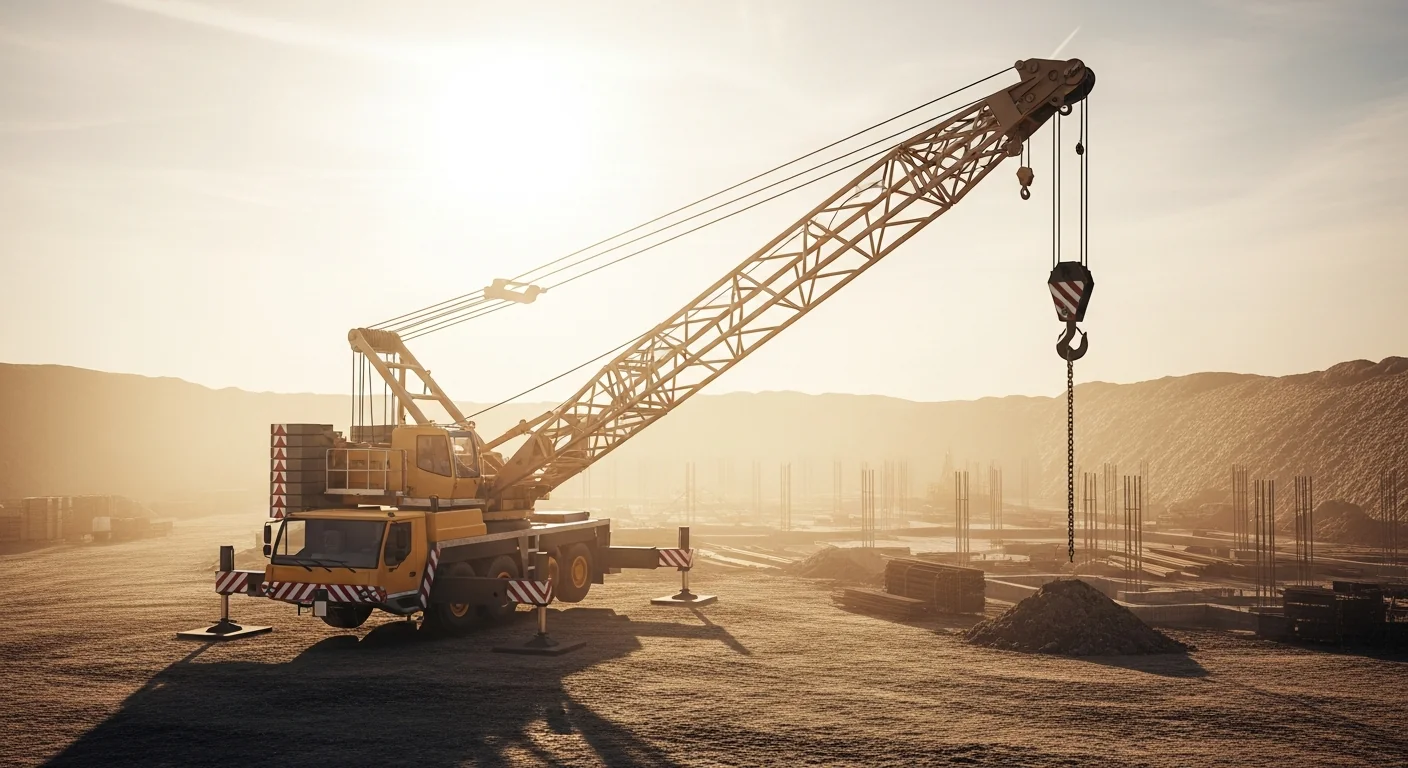
Crane financing rates vary dramatically based on your credit profile, business history, and the specific equipment you're purchasing. Here's what lenders in our network typically offer across different borrower categories.
A-tier borrowers (720+ FICO score, 2+ years in business, strong financials) typically see rates from 6.5% to 9.5% APR on new and late-model used cranes. B-tier borrowers (650-719 FICO, 1+ year operating history) face rates from 9.5% to 14% APR. Startup operations or challenged credit situations (under 650 FICO, less than 1 year) encounter rates from 12% to 18% APR with higher down payment requirements.
Equipment age significantly impacts both rates and loan-to-value ratios. New cranes command the best rates and can often be financed at 100% of purchase price. Used cranes under 5 years old with low hours typically add 0.5-1.5 percentage points to the base rate. Equipment over 10 years old faces rate premiums of 2-4 points, and many lenders won't finance cranes over 15 years old regardless of condition.
Conventional equipment loans typically require 15-25% down depending on the crane's age, condition, and your creditworthiness. However, SBA programs offer dramatically lower down payment options that can preserve your working capital.
SBA 504 loans allow down payments as low as 10% on equipment purchases up to $5.5 million, according to current SBA guidelines. For a $500,000 mobile crane, that's $50,000 down instead of the $75,000-125,000 required by conventional lenders—freeing up $25,000-75,000 for mobilization costs, insurance, and operator certification expenses.
SBA 7(a) loans offer similar 10-20% down payment structures on loans up to $5 million, while SBA Microloans provide up to $50,000 for smaller lifting equipment or crane attachments with minimal down payment requirements.
Cherry pickers and aerial lifts represent one of the most cost-effective crane financing categories, with purchase prices typically ranging from $30,000 to $150,000. Daily rental rates for these units run $300-800, making the ownership vs. rental decision particularly clear-cut.
A $75,000 cherry picker financed at 8% over 60 months costs approximately $1,520 per month. Compare that to renting at $500 per day—you break even at just 3 rental days per month. For operations using aerial lifts more than 72 days per year, ownership becomes mathematically superior, especially when you factor in the asset's residual value.
The decision between buying, leasing, and renting hinges on utilization rates and cash flow priorities. Based on EquipFlow's analysis of thousands of crane transactions, ownership breaks even at approximately 52 months compared to rental for most equipment categories.
A $200,000 mobile crane financed at 6.5% over 60 months costs approximately $3,866 per month versus $7,000 monthly rental for comparable 35-ton capacity. Over five years, purchasing costs roughly $232,000 in payments while retaining a $60,000-100,000 asset. Renting the same capacity costs $420,000 with zero residual value—a $128,000 difference before considering tax benefits. If you're exploring financing options for your next crane purchase, understanding these long-term cost comparisons is essential.
Fair Market Value (FMV) leases typically run $4,500-6,000 monthly for the same crane, offering a middle ground that preserves some capital while building towards ownership through end-of-term purchase options.
Operations using cranes fewer than 60 days annually should rent to avoid idle-asset carrying costs. If that describes your situation, you can find the right crane rental for your project without committing to ownership. The 60-200 day range favors leasing structures that provide equipment access without the full ownership burden. Above 200 days annual utilization, ownership economics dominate, especially when enhanced by Section 179 tax benefits.
A crane sitting idle 200 days per year while you make $3,866 monthly payments represents a $65,000 annual cash drain on non-productive days. Match your acquisition strategy to your realistic utilization projections, not optimistic projections.
New cranes qualify for the best rates (6.5-9.5% for A-tier credit) and longest terms up to 84 months. Some manufacturers offer promotional rates through captive finance companies—Liebherr Finance and Tadano Financial Services occasionally provide 0-3.9% APR on new equipment, though these programs typically require excellent credit and substantial down payments.
Used crane financing becomes more restrictive as equipment ages. Cranes under 10 years old with fewer than 5,000 hours typically qualify for standard programs with 1-3 point rate premiums. Equipment exceeding 6,000 hours or 10 years of age faces significant qualification challenges, with many lenders declining these applications entirely. Whether you're shopping new or used, you can find a quality crane for sale today and compare your financing options.
Section 179 and bonus depreciation create compelling financial incentives for crane purchases in 2026, though the window for maximum benefits is closing rapidly.
According to IRS Publication 946, businesses can deduct up to $2,560,000 of qualifying equipment purchases under Section 179 for tax year 2026. Cranes qualify as tangible personal property used in business operations, making them eligible for immediate expensing.
For a $700,000 Terex AC 100-4L crane, the Section 179 deduction generates $147,000 in Year 1 tax savings at the 21% corporate rate. This creates an effective liquidity multiplier of 1.21x—for every dollar invested in the crane, you recover $0.21 in immediate tax savings. That $147,000 can cover three years of insurance premiums, maintenance reserves, and operator certification costs.
Bonus depreciation for 2026 allows an additional 20% first-year deduction on qualifying new and used equipment. This benefit applies to the portion of equipment cost not covered by Section 179, and it's scheduled to disappear entirely in 2027.The phase-down schedule shows the urgency: 100% bonus depreciation in 2022, 80% in 2023, 60% in 2024, 40% in 2025, 20% in 2026, and 0% starting in 2027. For crane purchases exceeding the $2,560,000 Section 179 cap, acting before December 31, 2026 captures the last available bonus depreciation benefit.
Cranes follow a 5-year MACRS depreciation schedule (20%, 32%, 19.2%, 11.52%, 11.52%, 5.76% annually). When combined with Section 179 and bonus depreciation, the tax benefits heavily favor immediate equipment acquisition over delayed purchases or extended rental arrangements.
OSHA regulations under 29 CFR 1926 Subpart CC significantly impact crane ownership costs, with compliance expenses ranging from $7,500 to $34,000 annually depending on equipment type and operational scope.
Under OSHA standard 1926.1427, all crane operators in construction must hold current certification. The operator certification requirements became effective December 10, 2018, with recertification required every five years. NCCCO certification typically costs $500-2,000 including required training programs.
Signal person and rigger qualifications are also mandatory for crane operations, adding additional certification expenses. Operating without proper certification exposes employers to serious violation penalties ranging from $1,190 to $16,550 per instance, or up to $165,514 for willful violations according to current OSHA penalty schedules.
Fall protection requirements add significant compliance costs. Employees must use fall protection on surfaces 6+ feet above lower levels during crane operations, and 15+ feet during lattice boom assembly operations. Power line clearance minimums require 20-foot separation for lines up to 350kV, and 50-foot clearance for higher voltage lines.
Annual third-party inspections cost $1,500-5,000 depending on crane complexity and local inspector availability. Insurance premiums for general liability plus equipment coverage typically run $5,000-25,000 annually. Rigging inspection and maintenance adds another $500-2,000 per year.
When budgeting for crane ownership, factor these recurring compliance expenses: NCCCO certification and recertification ($500-2,000 amortized annually), mandatory annual inspections ($1,500-5,000), comprehensive insurance coverage ($5,000-25,000), and rigging inspection/maintenance ($500-2,000). Total annual compliance costs range from $7,500 to $34,000.
On a $300,000 crane financed at $5,800 monthly, these compliance costs add $625-2,833 to your true monthly operating expenses—a 10-49% increase over the equipment payment alone.
EquipFlow connects you with 3-4 lenders who compete for your crane financing deal. When lenders compete, rates typically drop 0.5-2 percentage points—saving you thousands over the life of your loan.
Our AI advisor analyzes your specific needs: crane type (mobile, tower, crawler), capacity requirements, new vs. used preferences, and your business financials. Ava identifies which lenders specialize in your equipment category and credit profile, eliminating wasted applications to lenders who don't finance older cranes or startup operations.
Ava connects you with 3-4 pre-qualified lenders who understand crane depreciation curves and industry cash flow patterns. These aren't random lenders—they're specialists who compete aggressively for equipment deals in your market segment.
See exactly how each offer affects your monthly cash flow. Compare not just rates, but total cost of capital including origination fees, documentation charges, and balloon payment structures. The math matters: a 2-point rate difference on $500,000 equals $111,540 in additional interest over 60 months.
You control the decision—no pressure, no obligation. Most contractors close within 10-15 business days once they select their preferred lender, with funding typically available within 24-48 hours of final approval.
EquipFlow connects you with 3-4 lenders who compete for your crane financing deal. When lenders compete, rates typically drop 0.5-2 percentage points—saving you thousands over the life of your loan.
Our AI advisor analyzes your specific needs: crane type (mobile, tower, crawler), capacity requirements, new vs. used preferences, and your business financials. Ava identifies which lenders specialize in your equipment category and credit profile, eliminating wasted applications to lenders who don't finance older cranes or startup operations.
Ava connects you with 3-4 pre-qualified lenders who understand crane depreciation curves and industry cash flow patterns. These aren't random lenders—they're specialists who compete aggressively for equipment deals in your market segment.
See exactly how each offer affects your monthly cash flow. Compare not just rates, but total cost of capital including origination fees, documentation charges, and balloon payment structures. The math matters: a 2-point rate difference on $500,000 equals $111,540 in additional interest over 60 months.
You control the decision—no pressure, no obligation. Most contractors close within 10-15 business days once they select their preferred lender, with funding typically available within 24-48 hours of final approval.
EquipFlow connects you with 3-4 lenders who compete for your crane financing deal. When lenders compete, rates typically drop 0.5-2 percentage points—saving you thousands over the life of your loan.
Our AI advisor analyzes your specific needs: crane type (mobile, tower, crawler), capacity requirements, new vs. used preferences, and your business financials. Ava identifies which lenders specialize in your equipment category and credit profile, eliminating wasted applications to lenders who don't finance older cranes or startup operations.
Ava connects you with 3-4 pre-qualified lenders who understand crane depreciation curves and industry cash flow patterns. These aren't random lenders—they're specialists who compete aggressively for equipment deals in your market segment.
See exactly how each offer affects your monthly cash flow. Compare not just rates, but total cost of capital including origination fees, documentation charges, and balloon payment structures. The math matters: a 2-point rate difference on $500,000 equals $111,540 in additional interest over 60 months.
You control the decision—no pressure, no obligation. Most contractors close within 10-15 business days once they select their preferred lender, with funding typically available within 24-48 hours of final approval.
EquipFlow's lender-matching platform addresses the three biggest pain points in crane financing: finding lenders who understand your equipment, securing competitive rates, and closing deals quickly.
When 3-4 lenders compete for the same deal, rates typically drop 0.5-2 percentage points compared to single-lender applications. On a $500,000 crane, that rate difference saves $35,000-111,000 over a 60-month term. Ava identifies lenders actively seeking crane financing deals in your credit tier, creating genuine competition for your business.
Banks reject 67% of used equipment loans over 10 years old, but Ava matches you with specialized lenders who understand crane depreciation curves and resale values. She knows which lenders finance specific crane brands, age limits for different equipment categories, and hour-meter thresholds that trigger automatic declines.
Every day without the right crane equipment costs money in lost productivity or continued rental expenses. Ava's algorithm analyzes your requirements against our network of crane financing specialists and delivers 3-4 pre-qualified options within 24-48 hours. No more weeks of calling different lenders individually.
Comparing multiple offers costs nothing and creates no commitment. Most contractors discover they qualify for better rates than expected, and many find financing options they didn't know existed—like SBA 504 programs offering 10% down payments on million-dollar crane purchases.
EquipFlow's lender-matching platform addresses the three biggest pain points in crane financing: finding lenders who understand your equipment, securing competitive rates, and closing deals quickly.
When 3-4 lenders compete for the same deal, rates typically drop 0.5-2 percentage points compared to single-lender applications. On a $500,000 crane, that rate difference saves $35,000-111,000 over a 60-month term. Ava identifies lenders actively seeking crane financing deals in your credit tier, creating genuine competition for your business.
Banks reject 67% of used equipment loans over 10 years old, but Ava matches you with specialized lenders who understand crane depreciation curves and resale values. She knows which lenders finance specific crane brands, age limits for different equipment categories, and hour-meter thresholds that trigger automatic declines.
Every day without the right crane equipment costs money in lost productivity or continued rental expenses. Ava's algorithm analyzes your requirements against our network of crane financing specialists and delivers 3-4 pre-qualified options within 24-48 hours. No more weeks of calling different lenders individually.
Comparing multiple offers costs nothing and creates no commitment. Most contractors discover they qualify for better rates than expected, and many find financing options they didn't know existed—like SBA 504 programs offering 10% down payments on million-dollar crane purchases.
EquipFlow's lender-matching platform addresses the three biggest pain points in crane financing: finding lenders who understand your equipment, securing competitive rates, and closing deals quickly.
When 3-4 lenders compete for the same deal, rates typically drop 0.5-2 percentage points compared to single-lender applications. On a $500,000 crane, that rate difference saves $35,000-111,000 over a 60-month term. Ava identifies lenders actively seeking crane financing deals in your credit tier, creating genuine competition for your business.
Banks reject 67% of used equipment loans over 10 years old, but Ava matches you with specialized lenders who understand crane depreciation curves and resale values. She knows which lenders finance specific crane brands, age limits for different equipment categories, and hour-meter thresholds that trigger automatic declines.
Every day without the right crane equipment costs money in lost productivity or continued rental expenses. Ava's algorithm analyzes your requirements against our network of crane financing specialists and delivers 3-4 pre-qualified options within 24-48 hours. No more weeks of calling different lenders individually.
Comparing multiple offers costs nothing and creates no commitment. Most contractors discover they qualify for better rates than expected, and many find financing options they didn't know existed—like SBA 504 programs offering 10% down payments on million-dollar crane purchases.
EquipFlow's lender-matching platform addresses the three biggest pain points in crane financing: finding lenders who understand your equipment, securing competitive rates, and closing deals quickly.
When 3-4 lenders compete for the same deal, rates typically drop 0.5-2 percentage points compared to single-lender applications. On a $500,000 crane, that rate difference saves $35,000-111,000 over a 60-month term. Ava identifies lenders actively seeking crane financing deals in your credit tier, creating genuine competition for your business.
Banks reject 67% of used equipment loans over 10 years old, but Ava matches you with specialized lenders who understand crane depreciation curves and resale values. She knows which lenders finance specific crane brands, age limits for different equipment categories, and hour-meter thresholds that trigger automatic declines.
Every day without the right crane equipment costs money in lost productivity or continued rental expenses. Ava's algorithm analyzes your requirements against our network of crane financing specialists and delivers 3-4 pre-qualified options within 24-48 hours. No more weeks of calling different lenders individually.
Comparing multiple offers costs nothing and creates no commitment. Most contractors discover they qualify for better rates than expected, and many find financing options they didn't know existed—like SBA 504 programs offering 10% down payments on million-dollar crane purchases.
.png)