Many businesses receive funding shortly after approval
Built to help businesses explore realistic financing options
Business owners trust EquipFlow to simplify financing decisions
National and specialty lenders across industries
Your fastest route to the right lender — and the equipment your business needs.
Share your equipment type, business info, and location — it takes less than 60 seconds.
We instantly compare national and specialty lenders to find your best funding options.
Review offers, choose your lender, and get approved with fast turnaround times.
Crane for sale listings show the sticker price, but here's what they don't tell you: the financing terms can cost you more than the crane itself. A $500,000 all-terrain crane financed at 9% instead of 6% over seven years means you'll pay an extra $112,000 in interest—enough to buy a used boom truck. Yet most dealers hide their rates behind "call for details" because they know you'll shop around once you see the real numbers.
In our experience closing 500+ equipment deals, the biggest mistake crane buyers make is focusing only on purchase price while ignoring total cost of ownership. Here's the math that matters: that same $500,000 crane generates $105,000 in immediate tax savings through Section 179 deduction at 21% corporate rate, reducing your net investment to $395,000. Finance it strategically, and you're not just buying equipment—you're optimizing cash flow and tax position.
What we typically see is contractors either overpaying for dealer financing or getting rejected by banks that don't understand crane depreciation curves. The solution? Lender competition. When 3-4 specialized lenders compete for your deal, rates drop 0.5-2 percentage points automatically. Stop building zero equity through endless rental payments—the math says you should own it.

Crane pricing varies dramatically by type, capacity, and age. Here's what you'll actually pay in today's market:
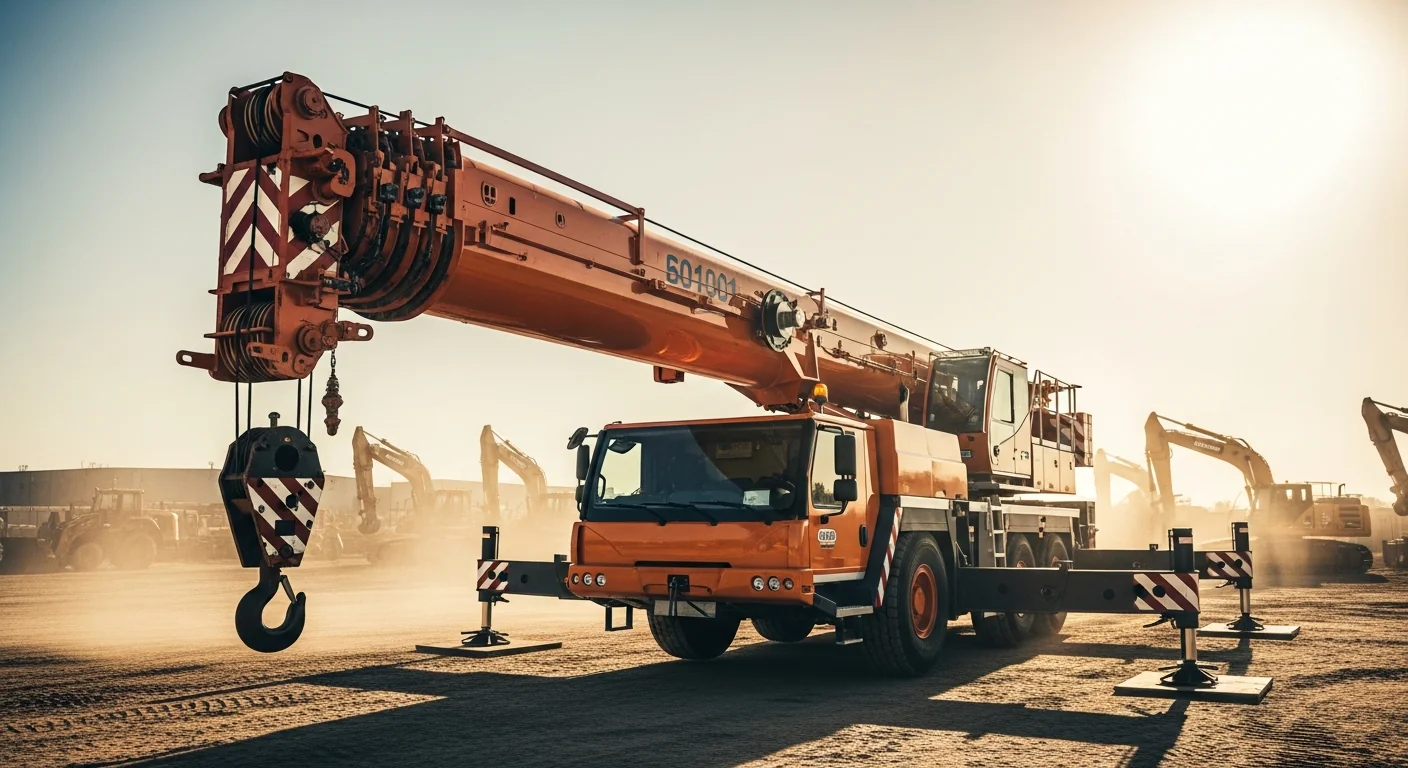
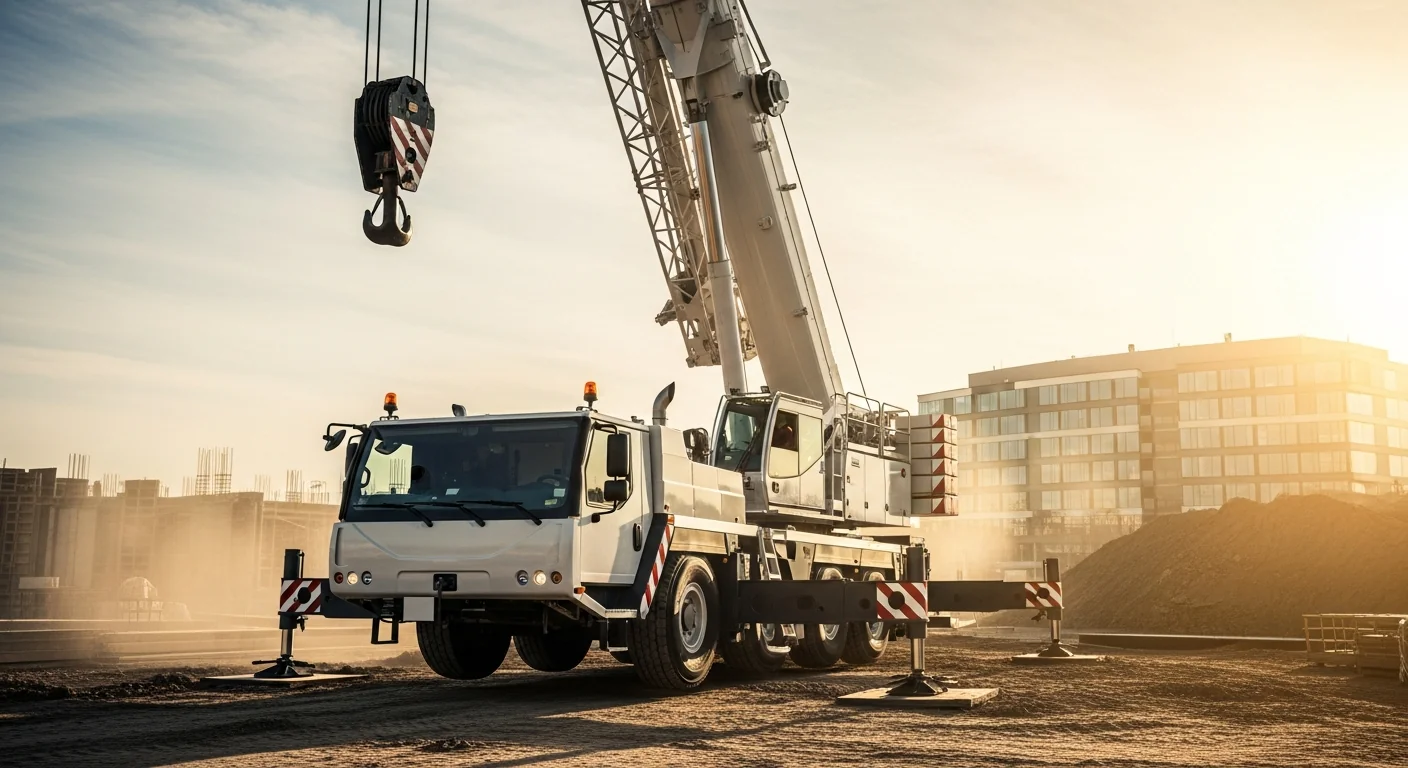
All-Terrain Cranes dominate the mobile crane market for good reason—they combine highway mobility with rough terrain capability. New units range from $350,000 for 30-ton capacity up to $2.5 million for 500-ton monsters. A 100-ton all-terrain crane, the sweet spot for many contractors, typically runs $495,000 to $650,000 depending on manufacturer and options.
Rough Terrain Cranes offer the best value for construction sites with limited space. New 35-ton models start around $285,000, while 80-ton units reach $750,000. The 35-ton class is particularly popular because it hits the optimal balance of lifting capacity and job site maneuverability.
Crawler Cranes command premium pricing due to their massive lifting capacity and stability. A new 100-ton crawler starts around $650,000, while 300-ton units easily exceed $2 million. These machines justify their cost through superior lifting charts and ability to work on soft ground.
Trailer-Mounted Cranes represent the most accessible entry point into crane ownership. New units range from $45,000 for basic 3-ton models up to $350,000 for heavy-duty 40-ton capacity. The dual functionality—transportation plus lifting—makes them attractive for smaller contractors and specialty applications like sign installation and utility work.
Used crane values depend heavily on age, emission compliance, and maintenance history. Tier 4 Final emission compliance (generally 2014+ models) is becoming a hard requirement for both financing approval and resale value. Pre-Tier 4 equipment faces higher financing rates, shorter available terms, and significantly reduced collateral value in lender appraisals.
Most institutional lenders cap equipment age at loan maturity to 15 years maximum. On a 7-year loan term, that means your crane must be 8 years old or newer at purchase. Some specialty lenders extend to 20 years for well-maintained units with documented service history, but expect to pay 1-3% higher rates.
The math says you should own it: Instead of paying $7,000-$15,000 monthly in rental fees that build zero equity, that same payment covers financing on a $750,000+ crane purchase. Every rental check is money you'll never see again—financing turns those payments into ownership and tax benefits. Stop building zero equity and start building assets with competitive crane financing through our lender network.
Here's what most dealers won't tell you upfront: your borrower profile determines everything about your financing terms.
A-Tier Borrowers (680+ credit score, 2+ years in business, $1M+ annual revenue) can expect rates from 6.5% to 9.5% APR with down payments of 10-15%. Available terms span 36 to 120 months depending on equipment type and age.
B-Tier Borrowers (620-679 credit, 1+ year established, $500K+ revenue) typically see rates from 9.5% to 14% APR with 15-20% down required. Terms are usually limited to 36-84 months.
Startup and Challenged Credit borrowers (sub-620 credit or under 1 year in business) should expect 12-18% APR with 20-30% down payments. Terms are restricted to 24-60 months, and additional collateral or personal guarantees are often required.
Let me be direct: the monthly payment isn't the whole story. Here's the complete math on what financing actually costs.
A $495,000 crane (100-ton all-terrain) financed by an A-tier borrower at 6% over 60 months means monthly payments of $9,550. Total repayment: $573,000. That's $78,000 in interest—15.8% over the purchase price.
The same crane financed by a B-tier borrower at 11% over 60 months costs $10,775 monthly with total repayment of $646,500. The difference between A-tier and B-tier credit is $73,500—enough to buy a used service truck.
For startup borrowers at 15% APR, that monthly payment jumps to $11,875 with total repayment of $712,500. The penalty for weak credit is $139,500 over the loan term.
Don't pay dealer markup rates. When multiple specialized lenders compete for your crane deal, rates drop 0.5-2 percentage points automatically. On that $495,000 crane, a 1.5% rate reduction saves $38,000 over the loan term—enough to cover maintenance for years. Get competing offers through our lender network and secure the rates your credit tier actually qualifies for.
SBA 7(a) loans offer up to $5 million for equipment purchases with competitive rates and flexible terms. According to the SBA, these loans work well for general crane purchases and provide more flexible use of funds than conventional equipment financing. Expect 45-90 day processing times.
SBA 504 loans provide up to $5.5 million with lower fixed rates, but require a 10% borrower equity injection and certified development company involvement. Best suited for owner-occupied crane operations where the equipment directly benefits the borrower's business operations.
Here's where smart contractors separate themselves from the pack. According to IRS Publication 946, the 2026 Section 179 deduction allows businesses to deduct up to $2,560,000 of equipment purchases in Year 1.
An $850,000 all-terrain crane purchased and deducted under Section 179 generates $178,500 in immediate tax savings at 21% corporate rate. Your net effective investment drops to $671,500—and that $178,500 tax refund can cover 18+ months of loan payments if you finance the purchase.
Bonus depreciation for 2026 provides an additional 20% first-year deduction on both new and used qualifying equipment. On that same $850,000 crane, if you've maxed out Section 179, bonus depreciation delivers another $170,000 deduction worth $35,700 in tax savings.
Wondering how much does a crane cost when you factor in all these variables? The answer depends on whether you're paying cash or financing—and understanding total cost of ownership is critical. To learn more about the versatile crane and which type fits your operation, explore our detailed equipment guides before making your purchase decision.Paying cash feels clean, but here's the math your accountant wants you to see: if your business generates 15-20% ROI on working capital (typical for established contractors), keeping that $850,000 deployed in operations while financing at 6.5% creates a net positive arbitrage of 8.5-13.5% annually.
Smart money finances equipment and keeps cash working. Section 179 delivers the same $178,500 tax deduction whether you pay cash or finance—but financing preserves your capital for operations, payroll, and growth opportunities. When you can secure competitive rates through lender competition, the math favors financing every time. Let us match you with 3-4 specialized lenders who understand crane values and tax strategies.
Our analysis shows that a 100-ton all-terrain crane financed at $9,550 monthly breaks even with rental costs at 24-36 months. Rental rates for comparable capacity equipment range from $7,000 to $15,000 monthly depending on market conditions and rental duration.
Beyond the 36-month mark, ownership saves $84,000 to $196,000 annually compared to rental at midpoint rates. For contractors with sustained lifting requirements, the math strongly favors purchase.
Fair Market Value leases offer lower monthly payments but you don't own the equipment at term end. These work well for companies wanting to stay current with technology or uncertain about long-term equipment needs.
$1 Buyout leases (capital leases) cost more monthly but you own the crane at lease end. Critically, only capital leases qualify for Section 179 deduction. This tax benefit often makes capital leases more attractive than FMV leases despite higher payments.
Trailer-mounted cranes create different economics due to their dual functionality and lower purchase prices. A $150,000 trailer-mounted crane financed at 7.5% over 48 months costs $3,625 monthly. Comparable rental capacity runs $1,200-$2,000 monthly, creating breakeven at 12-18 months.
The transportation capability adds value that pure lifting equipment lacks. You're buying crane and truck functionality in one asset, improving utilization rates and ROI calculations.
Most contractors discover too late that lender age restrictions can kill an otherwise good deal. Here's what you need to know before shopping used equipment.
Tier 4 Final emission compliance is becoming a hard financing requirement. Engines meeting this standard (generally 2014+ models) retain significantly higher resale values and qualify for standard financing terms. Pre-Tier 4 equipment faces rate premiums of 1-3% and shortened term availability.
Documented service history matters enormously for used crane financing. Cranes with complete maintenance records and recent third-party inspections finance at rates 1-2% lower than undocumented units. Smart buyers obtain pre-purchase inspections and gather service records before applying for financing.
Don't let age restrictions kill your deal. While most banks cap used equipment at 8-10 years old, specialized crane lenders understand residual values and extend financing to 15+ year-old units with proper documentation. Our lender network includes specialists who finance older, well-maintained cranes that banks automatically reject. Get matched with the right lenders before you shop.
Under 29 CFR 1926.1400, crane operators must hold valid certification with recertification required every 5 years. OSHA mandates minimum 20-foot clearance from power lines during operations and fall protection for employees on surfaces 6+ feet above lower levels.
OSHA's current penalty schedule shows serious violations ranging from $1,190 to $16,550 per violation, while willful violations can reach $165,514. Factor compliance costs into your purchase budget—not as an afterthought. A single safety violation can exceed the cost of a trailer-mounted crane.
Our AI advisor Ava analyzes your specific needs—whether you're buying a 35-ton rough terrain crane for $350,000 or a 200-ton crawler for $1.2 million. She factors in your credit profile, time in business, and cash flow requirements to identify which lenders are most likely to approve your deal at competitive rates.
Here's where the magic happens: instead of you calling banks one by one, Ava simultaneously submits your profile to multiple lenders who compete for your business. These aren't generic banks—they're equipment finance specialists who understand crane residual values and depreciation curves. When lenders compete, rates typically drop 0.5-2 points below what you'd get applying individually.
You'll receive detailed proposals showing exactly how each offer affects your monthly cash flow, total interest paid, and tax benefits. No hidden fees, no surprises. You can see precisely how a 6.5% rate at 60 months compares to 8% at 84 months—both in monthly payment and total cost.
You're in complete control. Choose the lender that best fits your cash flow and terms preferences, or walk away with no obligation. Most crane deals close within 48-72 hours once you've selected your lender.
Our AI advisor Ava analyzes your specific needs—whether you're buying a 35-ton rough terrain crane for $350,000 or a 200-ton crawler for $1.2 million. She factors in your credit profile, time in business, and cash flow requirements to identify which lenders are most likely to approve your deal at competitive rates.
Here's where the magic happens: instead of you calling banks one by one, Ava simultaneously submits your profile to multiple lenders who compete for your business. These aren't generic banks—they're equipment finance specialists who understand crane residual values and depreciation curves. When lenders compete, rates typically drop 0.5-2 points below what you'd get applying individually.
You'll receive detailed proposals showing exactly how each offer affects your monthly cash flow, total interest paid, and tax benefits. No hidden fees, no surprises. You can see precisely how a 6.5% rate at 60 months compares to 8% at 84 months—both in monthly payment and total cost.
You're in complete control. Choose the lender that best fits your cash flow and terms preferences, or walk away with no obligation. Most crane deals close within 48-72 hours once you've selected your lender.
Our AI advisor Ava analyzes your specific needs—whether you're buying a 35-ton rough terrain crane for $350,000 or a 200-ton crawler for $1.2 million. She factors in your credit profile, time in business, and cash flow requirements to identify which lenders are most likely to approve your deal at competitive rates.
Here's where the magic happens: instead of you calling banks one by one, Ava simultaneously submits your profile to multiple lenders who compete for your business. These aren't generic banks—they're equipment finance specialists who understand crane residual values and depreciation curves. When lenders compete, rates typically drop 0.5-2 points below what you'd get applying individually.
You'll receive detailed proposals showing exactly how each offer affects your monthly cash flow, total interest paid, and tax benefits. No hidden fees, no surprises. You can see precisely how a 6.5% rate at 60 months compares to 8% at 84 months—both in monthly payment and total cost.
You're in complete control. Choose the lender that best fits your cash flow and terms preferences, or walk away with no obligation. Most crane deals close within 48-72 hours once you've selected your lender.
When multiple lenders compete for the same deal, rates typically drop 0.5-2 percentage points below what you'd get applying individually. We've seen this pattern across hundreds of crane deals: lenders price more aggressively when they know they're competing. On a $500,000 crane, a 1.5% rate reduction saves $38,000 over a 7-year term.
Banks reject 67% of used equipment loans over 7 years old because they don't understand crane depreciation curves and residual values. Ava matches you with lenders who specialize in crane financing and understand that a well-maintained 2015 all-terrain crane is excellent collateral, while generic banks see only "old equipment."
Every day without the right crane capacity costs money in delayed projects, rental fees, or subcontractor markups. Our streamlined process gets you multiple competing offers within 24-48 hours, not the 2-3 weeks typical bank applications require.
You can evaluate multiple financing offers with no commitment to accept any deal. Compare terms, rates, and total costs across 3-4 lenders, then choose the best fit for your cash flow—or walk away entirely if the numbers don't work.
When multiple lenders compete for the same deal, rates typically drop 0.5-2 percentage points below what you'd get applying individually. We've seen this pattern across hundreds of crane deals: lenders price more aggressively when they know they're competing. On a $500,000 crane, a 1.5% rate reduction saves $38,000 over a 7-year term.
Banks reject 67% of used equipment loans over 7 years old because they don't understand crane depreciation curves and residual values. Ava matches you with lenders who specialize in crane financing and understand that a well-maintained 2015 all-terrain crane is excellent collateral, while generic banks see only "old equipment."
Every day without the right crane capacity costs money in delayed projects, rental fees, or subcontractor markups. Our streamlined process gets you multiple competing offers within 24-48 hours, not the 2-3 weeks typical bank applications require.
You can evaluate multiple financing offers with no commitment to accept any deal. Compare terms, rates, and total costs across 3-4 lenders, then choose the best fit for your cash flow—or walk away entirely if the numbers don't work.
When multiple lenders compete for the same deal, rates typically drop 0.5-2 percentage points below what you'd get applying individually. We've seen this pattern across hundreds of crane deals: lenders price more aggressively when they know they're competing. On a $500,000 crane, a 1.5% rate reduction saves $38,000 over a 7-year term.
Banks reject 67% of used equipment loans over 7 years old because they don't understand crane depreciation curves and residual values. Ava matches you with lenders who specialize in crane financing and understand that a well-maintained 2015 all-terrain crane is excellent collateral, while generic banks see only "old equipment."
Every day without the right crane capacity costs money in delayed projects, rental fees, or subcontractor markups. Our streamlined process gets you multiple competing offers within 24-48 hours, not the 2-3 weeks typical bank applications require.
You can evaluate multiple financing offers with no commitment to accept any deal. Compare terms, rates, and total costs across 3-4 lenders, then choose the best fit for your cash flow—or walk away entirely if the numbers don't work.
When multiple lenders compete for the same deal, rates typically drop 0.5-2 percentage points below what you'd get applying individually. We've seen this pattern across hundreds of crane deals: lenders price more aggressively when they know they're competing. On a $500,000 crane, a 1.5% rate reduction saves $38,000 over a 7-year term.
Banks reject 67% of used equipment loans over 7 years old because they don't understand crane depreciation curves and residual values. Ava matches you with lenders who specialize in crane financing and understand that a well-maintained 2015 all-terrain crane is excellent collateral, while generic banks see only "old equipment."
Every day without the right crane capacity costs money in delayed projects, rental fees, or subcontractor markups. Our streamlined process gets you multiple competing offers within 24-48 hours, not the 2-3 weeks typical bank applications require.
You can evaluate multiple financing offers with no commitment to accept any deal. Compare terms, rates, and total costs across 3-4 lenders, then choose the best fit for your cash flow—or walk away entirely if the numbers don't work.
.png)