Many businesses receive funding shortly after approval
Built to help businesses explore realistic financing options
Business owners trust EquipFlow to simplify financing decisions
National and specialty lenders across industries
Your fastest route to the right lender — and the equipment your business needs.
Share your equipment type, business info, and location — it takes less than 60 seconds.
We instantly compare national and specialty lenders to find your best funding options.
Review offers, choose your lender, and get approved with fast turnaround times.
Crane rental costs jumped 23% in the last 18 months, with contractors now paying $285/day for a 22-ton rough terrain crane, $350/day for a 75-ton all-terrain, and up to $15,000/month for large tower cranes. What most project managers don't realize is that the quoted daily rate represents only 40-60% of their actual cost—once you factor in mobilization fees ($2,000-$8,000), certified operators ($400-$800/day), fuel surcharges ($200-$500/day), and rigging equipment ($500-$3,000), that $350/day crane for a two-week job doesn't cost $4,900. It costs $7,500-$9,000.
For contractors spending $120,000+ annually on crane rentals, the math reveals an uncomfortable truth: you may already be past the ownership break-even point. A 100-ton all-terrain crane financed at $495,000 over 60 months costs approximately $9,580/month, while renting equivalent capacity runs around $35,000/month. That's ownership break-even at just 14 months of cumulative use. Meanwhile, every rental dollar builds zero equity while potentially violating OSHA compliance requirements that carry fines up to $165,514 per incident.
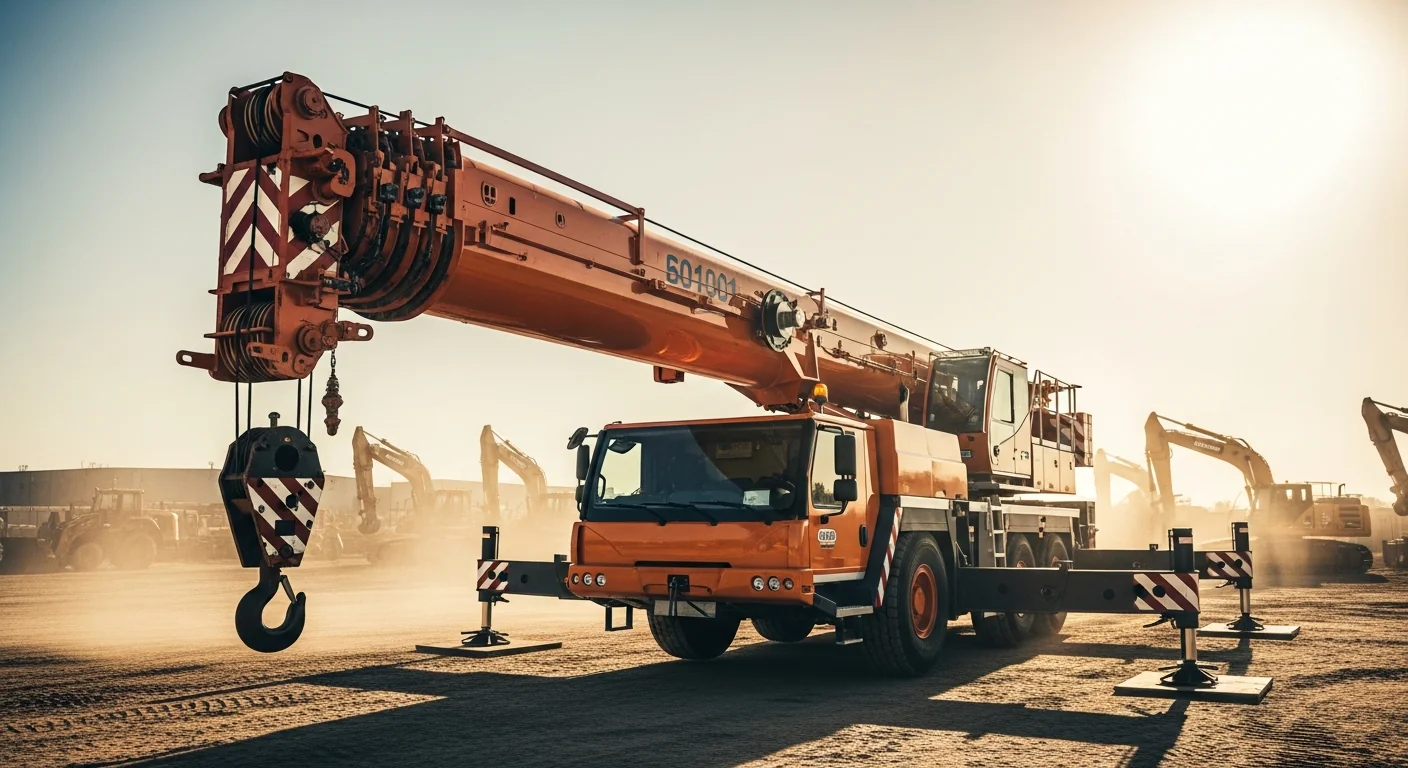
Most crane rental quotes show a daily rate—$285, $350, maybe $1,000. What they don't show is that mobilization, rigging, fuel, and operator fees will push your actual cost 40-60% higher. Here's the complete breakdown no competitor provides.
Based on current market data, here are specific daily rates by crane type and tonnage:
Small to Mid-Size Cranes:
- 22-ton rough terrain crane: $285/day
- 40-ton hydraulic truck crane: $265/day
- Carry deck cranes (8-25 ton): $200-$400/day
- Cherry picker/boom lifts: $150-$350/day
Large Capacity Cranes:
- 75-ton all-terrain crane: $350/day
- 100+ ton all-terrain: $800-$1,200/day
- Crawler cranes (50-300 ton): $600-$2,500/day
- Tower cranes: Up to $15,000/month
General range spans $200-$1,000/day, but last-minute bookings carry a 20-30% premium. During peak construction season (March-October), cranes over 25 tons require booking 2-4 weeks in advance.
Here's what rental companies don't advertise: weekly rates typically run 4-4.5× daily (not 7×), and monthly rates run 15-20× daily (not 30×). Understanding this structure can save thousands per project.
Example Cost Comparison:
- 10-day project with 40-ton crane: Daily rate = $2,650 total | Weekly + 3 days ≈ $1,985 total | Savings = ~$665
- 6-week project with 75-ton crane: Daily rate = $14,700 total | 1 month + 1 week ≈ $8,575 total | Savings = ~$6,125
Your daily rate is only 40-60% of your real cost. Budget these additional line items:
Mobilization/Demobilization: $2,000-$8,000 depending on distance and crane size. A 100-ton crane traveling 200 miles can cost $6,000+ just to arrive on site.
Certified Operator Costs: $400-$800/day if not included in rental. Under OSHA 29 CFR 1926.1400, all crane operators must hold valid NCCCO certification.
Fuel Surcharges: $200-$500/day for large cranes. Fuel costs vary by crane size, operating hours, and current diesel prices.
Rigging Equipment: $500-$3,000 for slings, hooks, and specialized lifting attachments.
Crane Mats: $500-$2,000/day for ground protection on soft terrain—required to prevent ground failure, the leading cause of crane tip-over incidents.
Assembly/Disassembly: Labor costs for larger cranes requiring on-site assembly.
Overtime Charges: $150-$250/hour beyond 8-hour days.
Weekend/Holiday Premiums: 1.5-2× base rates.
If you're spending $120,000+ annually on crane rentals, you may already be losing money without realizing it. Here's the mathematical comparison that exposes when ownership becomes the smarter financial choice.
A 100-ton all-terrain crane at $495,000 financed over 60 months at 6% APR equals approximately $9,580/month. Estimated rental for equivalent capacity runs around $35,000/month. Ownership breaks even at just 14 months of cumulative use.
Total Cost Comparison:
- Year 1 Ownership: $114,960 in payments + $495,000 purchase price
- Year 1 Rental: $35,000/month × 12 months = $420,000
- 3-Year Ownership: $344,880 in total payments
- 3-Year Rental: $1,260,000 in total rental costs
The break-even threshold sits around 120-130 days of annual utilization. Above this threshold, ownership wins mathematically. Below it, rental preserves capital flexibility.
Cranes retain 40-60% of their value at 5 years, meaning your "cost" of ownership is significantly lower than rental over time. If you're considering purchasing, learn more about how much a crane costs before committing.
An $850,000 crane generates $178,500 in Year 1 cash recovery through Section 179 deduction at a 21% corporate tax rate—a 21% immediate cash multiplier that exceeds typical SBA down payment requirements.
According to IRS Publication 946, the Section 179 deduction limit for 2026 is $2,560,000, allowing businesses to deduct the full purchase price of qualifying equipment immediately. Additionally, bonus depreciation for 2026 provides a 20% first-year deduction on qualifying equipment.
Critical timing: 2026 is the last year with any bonus depreciation under the Tax Cuts and Jobs Act. The rate remains at 100% in 2027 under OBBB, making 2026 the final opportunity to maximize first-year tax benefits.
Rental Tax Advantage: Crane rental payments are 100% deductible as operating expenses immediately—no depreciation tracking, no asset on balance sheet, preserves financial ratios for future lending.
When rental no longer makes financial sense, here are your financing pathways:
SBA Loan Programs:
- SBA 7(a) loans: Up to $5,000,000 for equipment purchases
- SBA 504 loans: Up to $5,500,000 for equipment and real estate
- SBA Microloans: Up to $50,000 for smaller attachments
Conventional Equipment Financing:
- A-tier credit (720+ FICO): 6.5%-9.5% APR
- B-tier credit (650-719 FICO): 9.5%-14% APR
- Startup/challenged credit: 12%-18% APR
- Typical down payment: 10-20%
- Approval timeline: 24-72 hours to 2 weeks
Banks and equipment lenders do finance used cranes, though rates may be 1-2% higher than new equipment financing. You can also find a quality crane for sale to pair with your financing plan.
An uncertified operator, missing signal person, or uninspected crane on soft ground—any one of these OSHA violations can trigger fines up to $165,514 per incident. Here's what compliance actually costs.
Under OSHA standard 29 CFR 1926.1400 (Cranes and Derricks in Construction), crane operations require:
Certified Crane Operator: NCCCO certification or equivalent, with recertification every 5 years. Many rental companies do NOT provide the operator—you must hire separately at $400-$800/day.
Signal Person: Required when operator's view is obstructed. Must be qualified or certified.
Assembly/Disassembly Director: Required for cranes requiring on-site assembly. Must be competent and designated in writing.
Daily Inspection: Required before each shift by qualified person.
Load Chart Compliance: Load charts must be present and followed for all lifts.
Ground Conditions Assessment: Required before crane setup to prevent tip-over incidents.### OSHA Violation Penalties (2026 Adjusted)
OSHA's updated penalty structure for 2026:
- Serious Violation: $1,190 - $16,550 per instance
- Willful Violation: $11,524 - $165,514 per instance
- Repeat Violation: $11,524 - $165,514 per instance
A single willful violation—such as using an uncertified operator or skipping required inspections—can cost more than your entire rental contract.
Rental Company Typically Provides:
- Maintained and inspected equipment
- Load charts and operator manuals
- Annual inspection records
- Equipment certifications
Renter Typically Must Provide:
- Certified operator (unless "operated rental")
- Signal person and riggers
- Lift plan engineering for complex lifts
- Crane mats and ground preparation
- Permits and insurance
- OSHA compliance oversight
Always clarify in writing who provides the operator, signal person, and rigging before signing. These three items alone can add $800-$1,500/day to your project cost.
Engineered lift plans are required for lifts above 75% of crane capacity, tandem lifts, or operations near power lines. Engineering costs range from $1,000-$10,000 depending on complexity, with a 5-10 business day timeline.
Ground bearing capacity must be verified before crane setup. Crane mats cost $500-$2,000/day but are essential on soft or uneven terrain. Ground failure remains the leading cause of crane tip-over incidents.
Choosing the wrong crane type costs money—either through over-specification (paying for capacity you don't need) or under-specification (project delays and additional mobilization costs).
Cherry Picker/Boom Lifts: Best for light-duty elevated work, maintenance, and inspections. No heavy lifting capability. $150-$350/day.
Carry Deck Cranes: Indoor/warehouse lifts in tight spaces. 8-25 ton capacity range. Four-wheel drive for industrial floors.
Rough Terrain Cranes: Single-engine design for unpaved job sites. 15-60 ton capacity. Cannot travel on public roads over 25 mph.
All-Terrain Cranes: Highway travel capability plus off-road performance. 30-600 ton capacity. Most versatile but highest cost.
Truck-Mounted Cranes: Road-mobile with quick setup time. 15-80 ton capacity. Good for utility work and light construction.
Crawler Cranes: Heavy lifts on soft ground with minimal ground preparation. 50-3,000 ton capacity. Slow setup but maximum stability.
Tower Cranes: Fixed position for high-rise construction. High capacity at height. Monthly rental basis.
Modern cranes include load monitoring and anti-sway systems as standard equipment on 80% of models. Large cranes (90+ tons) typically offer maximum lifting capacity over 100 tons, 56-meter boom length, and 77-meter lifting height.
Step 1: Determine maximum load weight → establishes minimum tonnage class
Step 2: Calculate required lift height and radius → determines boom length requirements
Step 3: Assess ground conditions → crawler vs. wheeled configuration
Step 4: Consider mobility needs → truck-mounted vs. all-terrain for road travel
Step 5: Evaluate workspace constraints → carry deck for confined spaces
Choosing a $600/day rough terrain crane instead of a $1,200/day all-terrain for suitable job sites saves $600/day—$3,000+ per week. Right-sizing your crane selection prevents both over-spending and project delays.
If you're consistently renting cranes and the math shows ownership makes sense, Ava can match you with lenders who specialize in crane financing to help you build equity instead of bleeding cash on rental fees.
When crane rental costs are bleeding your cash flow and building zero equity, financing puts you on the path to ownership—but only if you get the right rate from the right lender. Here's how EquipFlow's AI advisor Ava matches you with competing lenders who specialize in crane financing.
Ava analyzes your specific equipment requirements, credit profile, and utilization patterns to understand exactly which lenders will compete for your deal. She considers factors like crane type, capacity, age (if used), and your annual rental spending to determine if financing makes mathematical sense.
Based on your profile, Ava connects you with 3-4 lenders from our network who specialize in crane financing. When lenders compete for the same deal, rates typically drop 0.5-2 percentage points compared to going directly to a single lender.
See exactly how each lender's terms affect your monthly cash flow, total cost, and tax benefits. Compare not just rates (6.5%-18% depending on credit tier), but also down payment requirements, approval timelines, and equipment age restrictions.
You maintain complete control—no pressure, no obligation. Choose the offer that best fits your cash flow needs and business strategy. Most approvals happen within 24-48 hours for qualified borrowers.
When crane rental costs are bleeding your cash flow and building zero equity, financing puts you on the path to ownership—but only if you get the right rate from the right lender. Here's how EquipFlow's AI advisor Ava matches you with competing lenders who specialize in crane financing.
Ava analyzes your specific equipment requirements, credit profile, and utilization patterns to understand exactly which lenders will compete for your deal. She considers factors like crane type, capacity, age (if used), and your annual rental spending to determine if financing makes mathematical sense.
Based on your profile, Ava connects you with 3-4 lenders from our network who specialize in crane financing. When lenders compete for the same deal, rates typically drop 0.5-2 percentage points compared to going directly to a single lender.
See exactly how each lender's terms affect your monthly cash flow, total cost, and tax benefits. Compare not just rates (6.5%-18% depending on credit tier), but also down payment requirements, approval timelines, and equipment age restrictions.
You maintain complete control—no pressure, no obligation. Choose the offer that best fits your cash flow needs and business strategy. Most approvals happen within 24-48 hours for qualified borrowers.
When crane rental costs are bleeding your cash flow and building zero equity, financing puts you on the path to ownership—but only if you get the right rate from the right lender. Here's how EquipFlow's AI advisor Ava matches you with competing lenders who specialize in crane financing.
Ava analyzes your specific equipment requirements, credit profile, and utilization patterns to understand exactly which lenders will compete for your deal. She considers factors like crane type, capacity, age (if used), and your annual rental spending to determine if financing makes mathematical sense.
Based on your profile, Ava connects you with 3-4 lenders from our network who specialize in crane financing. When lenders compete for the same deal, rates typically drop 0.5-2 percentage points compared to going directly to a single lender.
See exactly how each lender's terms affect your monthly cash flow, total cost, and tax benefits. Compare not just rates (6.5%-18% depending on credit tier), but also down payment requirements, approval timelines, and equipment age restrictions.
You maintain complete control—no pressure, no obligation. Choose the offer that best fits your cash flow needs and business strategy. Most approvals happen within 24-48 hours for qualified borrowers.
When crane rental costs are draining your cash flow and building zero equity, smart financing puts you on the path to ownership—but only if you get the right rate from the right lender.
Lenders competing for the same deal typically drop rates 0.5-2 percentage points compared to going directly to a single bank. When you're financing a $500,000 crane, a 1.5% rate reduction saves you $7,500 annually—$37,500 over a 5-year loan term.
Ava matches you with 3-4 lenders from our network who actively compete for crane financing deals. This competitive pressure works in your favor, often resulting in better terms than you'd receive by approaching lenders individually.
Banks reject 67% of used equipment loans over 7 years old—but Ava finds lenders who specialize in older crane financing. She understands which lenders prefer specific crane manufacturers, capacity ranges, and credit profiles.
Instead of wasting weeks getting rejected by the wrong lenders, Ava pre-qualifies your deal with lenders who actually want your business. This targeted approach speeds up approval timelines and improves your chances of competitive terms.
Every day without the right equipment costs money. If you're currently paying $1,000/day in crane rental while waiting for financing approval, delays are expensive. Most contractors in our network receive multiple competing offers within 24-48 hours.
Ava's AI analysis immediately identifies which lenders can move fastest on your specific deal type, prioritizing speed without sacrificing rate competitiveness.
Compare multiple financing offers with zero commitment required. See exactly how different lenders' terms affect your monthly cash flow, total cost, and tax benefits before making any decisions. You maintain complete control throughout the process.
If financing doesn't make mathematical sense for your situation, you're under no obligation to proceed. Many contractors use EquipFlow simply to benchmark whether their current rental spending justifies equipment ownership.
When crane rental costs are draining your cash flow and building zero equity, smart financing puts you on the path to ownership—but only if you get the right rate from the right lender.
Lenders competing for the same deal typically drop rates 0.5-2 percentage points compared to going directly to a single bank. When you're financing a $500,000 crane, a 1.5% rate reduction saves you $7,500 annually—$37,500 over a 5-year loan term.
Ava matches you with 3-4 lenders from our network who actively compete for crane financing deals. This competitive pressure works in your favor, often resulting in better terms than you'd receive by approaching lenders individually.
Banks reject 67% of used equipment loans over 7 years old—but Ava finds lenders who specialize in older crane financing. She understands which lenders prefer specific crane manufacturers, capacity ranges, and credit profiles.
Instead of wasting weeks getting rejected by the wrong lenders, Ava pre-qualifies your deal with lenders who actually want your business. This targeted approach speeds up approval timelines and improves your chances of competitive terms.
Every day without the right equipment costs money. If you're currently paying $1,000/day in crane rental while waiting for financing approval, delays are expensive. Most contractors in our network receive multiple competing offers within 24-48 hours.
Ava's AI analysis immediately identifies which lenders can move fastest on your specific deal type, prioritizing speed without sacrificing rate competitiveness.
Compare multiple financing offers with zero commitment required. See exactly how different lenders' terms affect your monthly cash flow, total cost, and tax benefits before making any decisions. You maintain complete control throughout the process.
If financing doesn't make mathematical sense for your situation, you're under no obligation to proceed. Many contractors use EquipFlow simply to benchmark whether their current rental spending justifies equipment ownership.
When crane rental costs are draining your cash flow and building zero equity, smart financing puts you on the path to ownership—but only if you get the right rate from the right lender.
Lenders competing for the same deal typically drop rates 0.5-2 percentage points compared to going directly to a single bank. When you're financing a $500,000 crane, a 1.5% rate reduction saves you $7,500 annually—$37,500 over a 5-year loan term.
Ava matches you with 3-4 lenders from our network who actively compete for crane financing deals. This competitive pressure works in your favor, often resulting in better terms than you'd receive by approaching lenders individually.
Banks reject 67% of used equipment loans over 7 years old—but Ava finds lenders who specialize in older crane financing. She understands which lenders prefer specific crane manufacturers, capacity ranges, and credit profiles.
Instead of wasting weeks getting rejected by the wrong lenders, Ava pre-qualifies your deal with lenders who actually want your business. This targeted approach speeds up approval timelines and improves your chances of competitive terms.
Every day without the right equipment costs money. If you're currently paying $1,000/day in crane rental while waiting for financing approval, delays are expensive. Most contractors in our network receive multiple competing offers within 24-48 hours.
Ava's AI analysis immediately identifies which lenders can move fastest on your specific deal type, prioritizing speed without sacrificing rate competitiveness.
Compare multiple financing offers with zero commitment required. See exactly how different lenders' terms affect your monthly cash flow, total cost, and tax benefits before making any decisions. You maintain complete control throughout the process.
If financing doesn't make mathematical sense for your situation, you're under no obligation to proceed. Many contractors use EquipFlow simply to benchmark whether their current rental spending justifies equipment ownership.
When crane rental costs are draining your cash flow and building zero equity, smart financing puts you on the path to ownership—but only if you get the right rate from the right lender.
Lenders competing for the same deal typically drop rates 0.5-2 percentage points compared to going directly to a single bank. When you're financing a $500,000 crane, a 1.5% rate reduction saves you $7,500 annually—$37,500 over a 5-year loan term.
Ava matches you with 3-4 lenders from our network who actively compete for crane financing deals. This competitive pressure works in your favor, often resulting in better terms than you'd receive by approaching lenders individually.
Banks reject 67% of used equipment loans over 7 years old—but Ava finds lenders who specialize in older crane financing. She understands which lenders prefer specific crane manufacturers, capacity ranges, and credit profiles.
Instead of wasting weeks getting rejected by the wrong lenders, Ava pre-qualifies your deal with lenders who actually want your business. This targeted approach speeds up approval timelines and improves your chances of competitive terms.
Every day without the right equipment costs money. If you're currently paying $1,000/day in crane rental while waiting for financing approval, delays are expensive. Most contractors in our network receive multiple competing offers within 24-48 hours.
Ava's AI analysis immediately identifies which lenders can move fastest on your specific deal type, prioritizing speed without sacrificing rate competitiveness.
Compare multiple financing offers with zero commitment required. See exactly how different lenders' terms affect your monthly cash flow, total cost, and tax benefits before making any decisions. You maintain complete control throughout the process.
If financing doesn't make mathematical sense for your situation, you're under no obligation to proceed. Many contractors use EquipFlow simply to benchmark whether their current rental spending justifies equipment ownership.
.png)