Many businesses receive funding shortly after approval
Built to help businesses explore realistic financing options
Business owners trust EquipFlow to simplify financing decisions
National and specialty lenders across industries
Your fastest route to the right lender — and the equipment your business needs.
Share your equipment type, business info, and location — it takes less than 60 seconds.
We instantly compare national and specialty lenders to find your best funding options.
Review offers, choose your lender, and get approved with fast turnaround times.
Crane cost is the single most distorted number in heavy equipment finance—and most websites won't show you a real APR until after they've pulled your credit. Let me be direct: a new crane runs between $250,000 (35-ton boom truck) and $2,500,000+ (500-ton all-terrain Liebherr), and financing rates fall into three published tiers we'll show you below. A-tier borrowers (700+ FICO, 2+ years in business) typically see 6.5%-9.5% APR, subject to credit approval. B-tier lands at 9.5%-14% OAC. Startup-tier financing exists at 12%-18% for businesses under two years old, actual rates may vary based on credit profile.
Here's what most buyers miss. The 2026 Section 179 deduction caps out at $2,560,000—and 100% bonus depreciation is available on new AND used cranes placed in service before December 31, 2026. According to IRS Publication 946, that means a $250,000 Tadano-class mobile crane generates approximately $52,500 in Year-1 tax recovery at a 21% corporate rate. Your real cash outlay drops to $197,500. At a 32% bracket on a $248,058 crane, EquipFlow's analysis shows Section 179 recovers $79,379. At 35%, it's $86,820.
The math gets ugly fast for buyers who pay cash. Tying up $750,000 in equipment when working capital generates 15-20% ROI elsewhere is a $112,000-$150,000 annual opportunity cost. At 7% financing on the same crane, you're paying ~$52,500/year in interest. The smart operators don't ask 'can I afford to finance?' They ask 'can I afford NOT to?'
[CTA: Tell Ava about your crane needs and get matched with competing lenders in 24 hours. No credit pull for matching—compare your real options first.]
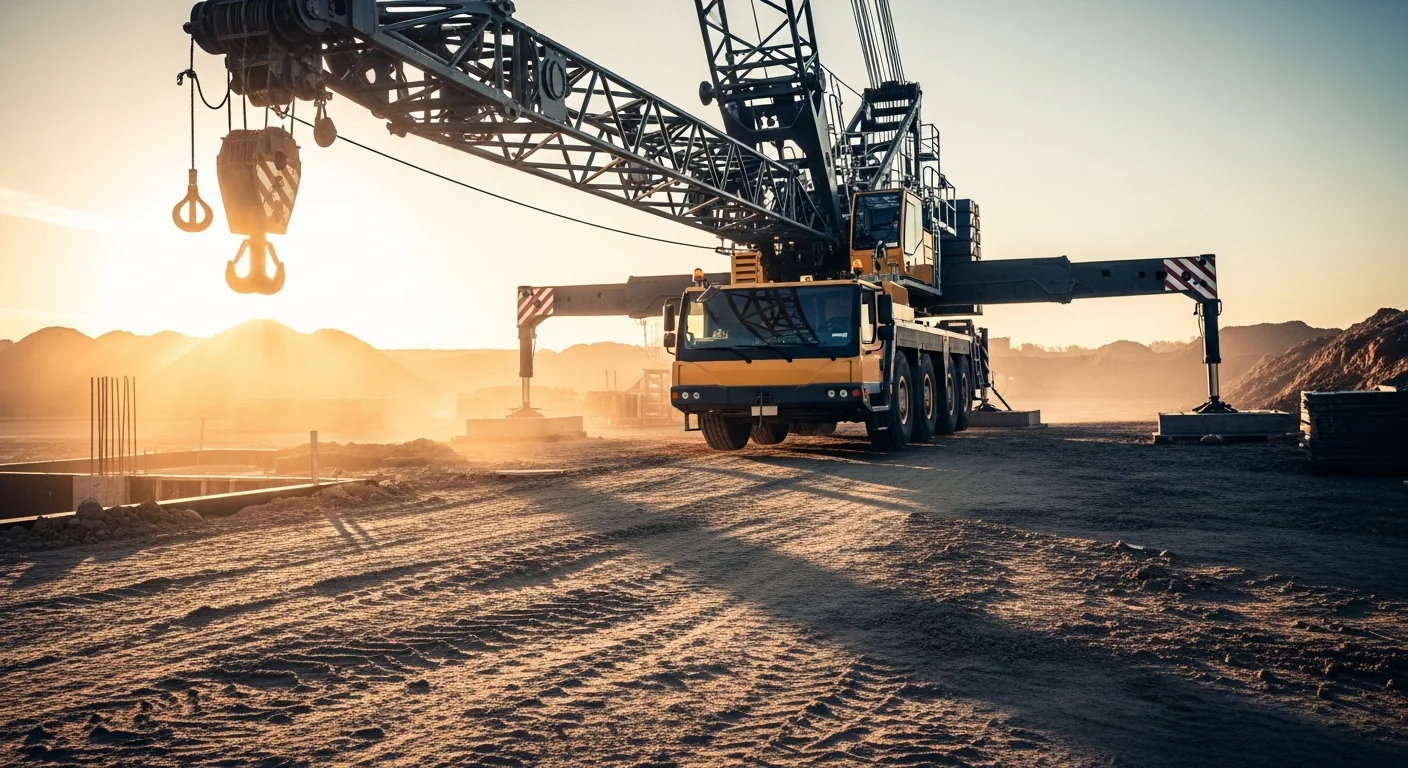
Let's start with real numbers, not vendor-speak. New crane pricing breaks down by tonnage class. A 35-ton rough-terrain crane (Terex T340-1XL class) starts around $250,000-$300,000. A 110-ton hydraulic boom (Grove TMS9000E class) lands between $700,000-$900,000. A 160-ton rough-terrain unit runs $1.2M-$1.6M. A 500-ton Liebherr LTM1400 all-terrain crane crosses $2.5M.
Rental benchmarks tell the other side of the story. According to Bigge Crane's published rates, a 35-ton rough-terrain rents bare for $7,000/month. A 160-ton bare runs $46,500/month. The Liebherr LTM1400 commands $1,350/hr straight time—that's roughly $216,000/month at 160 hours of utilization. A Terex T340-1XL operates at $315/hr. A Manitex 26101 26-ton at $285/hr.
Here's the tension: if you're running a 35-ton three weeks a month at $7,000/month bare rental, you're spending $84,000/year and building zero equity. The same crane financed at 8% over 60 months on $275,000 with 10% down? Roughly $5,020/month P&I, OAC. You're $2,000/month CHEAPER and you OWN the asset at month 60.
35-ton boom truck/RT: $250K-$300K. 60-ton class: $400K-$550K. 110-ton hydraulic: $700K-$900K. 160-ton RT: $1.2M-$1.6M. 300-ton AT: $1.8M-$2.2M. 500-ton AT (Liebherr LTM1400): $2.5M+. Used pricing typically runs 40-60% of new in years 3-7, with steeper discounts on cranes over 10 years old—where many lenders won't finance at all.
Bare rental excludes operator. Operated rental adds $85-$150/hr in labor depending on certification level. The OSHA-mandated NCCCO certification means operator labor isn't optional—it's a regulatory requirement.
[CTA: Calculate your finance-vs-rent breakeven point with our calculator—see how ownership builds equity while rental builds zero.]
Crane financing isn't one-size-fits-all. Lenders tier borrowers based on FICO, time in business, and annual revenue. Understanding where you land determines your rate tier and term structure.
A-tier borrowers (700+ FICO, 2+ years operating, $1M+ revenue) typically access 6.5%-9.5% APR on 60-84 month terms, subject to credit approval. Most require 10-15% down. B-tier borrowers (640-699 FICO, 1-2 years operating) land at 9.5%-14%, OAC, often with 15-20% down requirements. Startup-tier (under 1 year, 600-639 FICO) sees 12%-18%, actual rates may vary, with 20-25% down and personal guarantees.
Term length affects monthly payments but extends total interest paid. A $500,000 crane at 8% over 60 months runs $10,137/month P&I. The same rate over 84 months drops to $7,653/month but adds $42,652 in total interest. Run the monthly cash flow math against your revenue projections—longer terms preserve working capital but cost more long-term.
Down payment requirements vary by credit tier and equipment age. New cranes typically require 10-20% down. Used cranes (5-10 years) often demand 20-25%. Equipment over 10 years old becomes difficult to finance—many lenders won't touch it. If you're looking at older equipment, plan for larger down payments or shorter terms.
Section 179 and bonus depreciation turn crane purchases into tax strategies, not just equipment decisions. The 2026 Section 179 deduction caps at $2,560,000—meaning you can write off the full purchase price of most cranes in Year 1. Add 100% bonus depreciation (available through December 31, 2026) and the tax recovery becomes substantial.
According to IRS Publication 946, a $250,000 crane generates $52,500 in tax recovery at a 21% corporate rate. At 32%, that's $80,000. At 35%, it's $87,500. Your effective cash outlay drops significantly—turning a $250,000 crane into a $162,500-$197,500 net investment after tax recovery.
The bonus depreciation schedule changes after 2026. It drops to 80% in 2027, 60% in 2028, 40% in 2029, 20% in 2030, and zero in 2031. Timing matters. A $500,000 crane purchased in 2026 delivers $175,000 in tax recovery at 35%. The same crane purchased in 2028 delivers only $105,000. That's $70,000 in lost tax benefits for waiting.
Financing amplifies these benefits. Instead of tying up $500,000 in cash for a crane, finance it at 7% and keep your working capital deployed at 15-20% ROI elsewhere. The opportunity cost math favors financing when your capital generates higher returns than your borrowing cost.
[CTA: See what financing terms you qualify for—get competing offers in 24 hours with no obligation.]
The breakeven math on finance-vs-rental depends on utilization, but the equity-building argument starts immediately. Every rental payment builds zero ownership while financing builds asset value.
A 110-ton Grove TMS9000E class crane rents for approximately $415/hr straight time. At 160 hours/month utilization, that's $66,400/month going to the rental company. The same crane financed at $800,000 with 10% down at 7% over 60 months costs roughly $15,827/month P&I. You break even on monthly cash outlay at about 38 hours of utilization—less than 10 hours per week.
Beyond the breakeven point, financing becomes cash-flow-positive while building ownership. At 160 hours/month, financing saves $50,573/month versus rental. Over 60 months, that's $3.03 million in rental payments versus $949,620 in financing costs (including down payment). You save $2.08 million AND own a $800,000 asset.
Rental makes sense for occasional use or project-specific needs under 50% monthly utilization. But consistent users building zero equity through rental payments are essentially funding someone else's asset depreciation. Finance instead and own the cash flow.
[CTA: Get your personalized finance-vs-rental analysis—compare your real numbers with our calculator.]
Navigating crane financing requires understanding current federal programs and regulatory frameworks that impact both equipment acquisition and operational compliance. According to the SBA's current 2026 lending guidelines, the SBA 7(a) loan program maintains maximum loan amounts of $5 million for qualified equipment purchases, while the SBA 504 program offers long-term, fixed-rate financing for heavy equipment like cranes with borrower contributions as low as 10% of the project cost.
IRS Publication 946 specifies that crane equipment qualifies for Section 179 deduction benefits, with current 2026 limits allowing businesses to deduct up to $1,220,000 in qualifying equipment purchases, subject to phase-out thresholds. This immediate expensing provision can significantly reduce the effective cost of crane financing when properly structured with your tax advisor.
OSHA mandates that crane operations comply with stringent safety standards under 29 CFR 1926.1400 through 1926.1442, which govern crane and derrick operations in construction. These regulations require specific operator certification, equipment inspection protocols, and load capacity documentation that directly impact financing decisions. Lenders increasingly require OSHA compliance verification as part of their underwriting process, particularly for construction-focused crane purchases.
According to Federal Reserve economic data updated for 2026, commercial equipment loan rates have stabilized following recent monetary policy adjustments, with prime-based crane financing typically ranging from 7.5% to 12% depending on borrower creditworthiness and collateral strength. The Bureau of Labor Statistics reports that construction industry employment growth continues to drive crane demand, with heavy equipment utilization rates remaining above historical averages.
Compliance documentation plays a crucial role in securing favorable financing terms. Lenders require proof of operator training, maintenance protocols aligned with manufacturer specifications, and insurance coverage meeting both OSHA requirements and lender standards. Understanding these regulatory intersections helps borrowers structure crane financing packages that satisfy both operational needs and compliance obligations while maximizing available tax benefits and SBA program advantages.
We're not a lender. We don't underwrite anything. EquipFlow is a matching platform—Ava (our AI advisor) analyzes your situation and connects you with 3-4 lenders in our network who compete for your business. When lenders compete, rates typically drop 0.5-2 percentage points. On a $750,000 crane, that's $40,000-$80,000 in interest savings over a 60-month term.
Share the equipment (tonnage, new vs used, year), your business profile (years operating, monthly revenue, FICO range), and how you plan to use the crane. Ava uses this to determine which credit tier you fall into and which lenders are most likely to approve your deal at competitive terms.
Ava matches you with 3-4 lenders who specialize in your tonnage class and credit profile. Crane financing isn't generic—lenders who underwrite a 35-ton Manitex at $7,000/month rental equivalent are different from those structuring a $2.5M Liebherr deal. Matching matters.
Review real rate quotes side-by-side. See APR, term length, down payment, monthly P&I, FMV vs $1-buyout structure, and any doc fees. This is where lender competition pays off—you'll see exactly how each offer affects your monthly cash flow and total interest paid.
You pick the offer that fits. No pressure, no obligation, no penalty for walking away from all of them. Most deals close in 24-48 hours from acceptance to funded.
[CTA: Start your crane financing comparison—see what 3-4 lenders offer before anyone touches your credit report.]
We're not a lender. We don't underwrite anything. EquipFlow is a matching platform—Ava (our AI advisor) analyzes your situation and connects you with 3-4 lenders in our network who compete for your business. When lenders compete, rates typically drop 0.5-2 percentage points. On a $750,000 crane, that's $40,000-$80,000 in interest savings over a 60-month term.
Share the equipment (tonnage, new vs used, year), your business profile (years operating, monthly revenue, FICO range), and how you plan to use the crane. Ava uses this to determine which credit tier you fall into and which lenders are most likely to approve your deal at competitive terms.
Ava matches you with 3-4 lenders who specialize in your tonnage class and credit profile. Crane financing isn't generic—lenders who underwrite a 35-ton Manitex at $7,000/month rental equivalent are different from those structuring a $2.5M Liebherr deal. Matching matters.
Review real rate quotes side-by-side. See APR, term length, down payment, monthly P&I, FMV vs $1-buyout structure, and any doc fees. This is where lender competition pays off—you'll see exactly how each offer affects your monthly cash flow and total interest paid.
You pick the offer that fits. No pressure, no obligation, no penalty for walking away from all of them. Most deals close in 24-48 hours from acceptance to funded.
[CTA: Start your crane financing comparison—see what 3-4 lenders offer before anyone touches your credit report.]
We're not a lender. We don't underwrite anything. EquipFlow is a matching platform—Ava (our AI advisor) analyzes your situation and connects you with 3-4 lenders in our network who compete for your business. When lenders compete, rates typically drop 0.5-2 percentage points. On a $750,000 crane, that's $40,000-$80,000 in interest savings over a 60-month term.
Share the equipment (tonnage, new vs used, year), your business profile (years operating, monthly revenue, FICO range), and how you plan to use the crane. Ava uses this to determine which credit tier you fall into and which lenders are most likely to approve your deal at competitive terms.
Ava matches you with 3-4 lenders who specialize in your tonnage class and credit profile. Crane financing isn't generic—lenders who underwrite a 35-ton Manitex at $7,000/month rental equivalent are different from those structuring a $2.5M Liebherr deal. Matching matters.
Review real rate quotes side-by-side. See APR, term length, down payment, monthly P&I, FMV vs $1-buyout structure, and any doc fees. This is where lender competition pays off—you'll see exactly how each offer affects your monthly cash flow and total interest paid.
You pick the offer that fits. No pressure, no obligation, no penalty for walking away from all of them. Most deals close in 24-48 hours from acceptance to funded.
[CTA: Start your crane financing comparison—see what 3-4 lenders offer before anyone touches your credit report.]
When 3-4 lenders compete for your crane deal, rates typically drop 0.5-2 percentage points, subject to credit approval. On a $750,000 crane over 60 months, that's $30,000-$80,000 in interest savings. Single-lender shopping is leaving money on the table—period.
Crane financing isn't generic equipment lending. Lenders who underwrite a 35-ton boom truck are different from those structuring a $2.5M Liebherr deal. Ava matches you with lenders who specialize in your tonnage class, your credit tier, and your time-in-business profile. No wasted applications, no surprise declines after credit pulls.
Most contractors get 3+ competing offers within 24 hours of completing Ava's intake. Compare that to your bank's 2-3 week underwriting cycle. Every week you wait on equipment is $5K-$15K in lost revenue or rental fees that build zero equity.
Getting matched costs nothing. No commitment to accept any offer. Walk away from all 4 if the rates don't work. The only people who don't compare offers are the ones overpaying.
[CTA: Get your no-obligation rate comparison—soft credit pull only, see what you qualify for in under 24 hours.]
When 3-4 lenders compete for your crane deal, rates typically drop 0.5-2 percentage points, subject to credit approval. On a $750,000 crane over 60 months, that's $30,000-$80,000 in interest savings. Single-lender shopping is leaving money on the table—period.
Crane financing isn't generic equipment lending. Lenders who underwrite a 35-ton boom truck are different from those structuring a $2.5M Liebherr deal. Ava matches you with lenders who specialize in your tonnage class, your credit tier, and your time-in-business profile. No wasted applications, no surprise declines after credit pulls.
Most contractors get 3+ competing offers within 24 hours of completing Ava's intake. Compare that to your bank's 2-3 week underwriting cycle. Every week you wait on equipment is $5K-$15K in lost revenue or rental fees that build zero equity.
Getting matched costs nothing. No commitment to accept any offer. Walk away from all 4 if the rates don't work. The only people who don't compare offers are the ones overpaying.
[CTA: Get your no-obligation rate comparison—soft credit pull only, see what you qualify for in under 24 hours.]
When 3-4 lenders compete for your crane deal, rates typically drop 0.5-2 percentage points, subject to credit approval. On a $750,000 crane over 60 months, that's $30,000-$80,000 in interest savings. Single-lender shopping is leaving money on the table—period.
Crane financing isn't generic equipment lending. Lenders who underwrite a 35-ton boom truck are different from those structuring a $2.5M Liebherr deal. Ava matches you with lenders who specialize in your tonnage class, your credit tier, and your time-in-business profile. No wasted applications, no surprise declines after credit pulls.
Most contractors get 3+ competing offers within 24 hours of completing Ava's intake. Compare that to your bank's 2-3 week underwriting cycle. Every week you wait on equipment is $5K-$15K in lost revenue or rental fees that build zero equity.
Getting matched costs nothing. No commitment to accept any offer. Walk away from all 4 if the rates don't work. The only people who don't compare offers are the ones overpaying.
[CTA: Get your no-obligation rate comparison—soft credit pull only, see what you qualify for in under 24 hours.]
When 3-4 lenders compete for your crane deal, rates typically drop 0.5-2 percentage points, subject to credit approval. On a $750,000 crane over 60 months, that's $30,000-$80,000 in interest savings. Single-lender shopping is leaving money on the table—period.
Crane financing isn't generic equipment lending. Lenders who underwrite a 35-ton boom truck are different from those structuring a $2.5M Liebherr deal. Ava matches you with lenders who specialize in your tonnage class, your credit tier, and your time-in-business profile. No wasted applications, no surprise declines after credit pulls.
Most contractors get 3+ competing offers within 24 hours of completing Ava's intake. Compare that to your bank's 2-3 week underwriting cycle. Every week you wait on equipment is $5K-$15K in lost revenue or rental fees that build zero equity.
Getting matched costs nothing. No commitment to accept any offer. Walk away from all 4 if the rates don't work. The only people who don't compare offers are the ones overpaying.
[CTA: Get your no-obligation rate comparison—soft credit pull only, see what you qualify for in under 24 hours.]
.png)