Many businesses receive funding shortly after approval
Built to help businesses explore realistic financing options
Business owners trust EquipFlow to simplify financing decisions
National and specialty lenders across industries
Your fastest route to the right lender — and the equipment your business needs.
Share your equipment type, business info, and location — it takes less than 60 seconds.
We instantly compare national and specialty lenders to find your best funding options.
Review offers, choose your lender, and get approved with fast turnaround times.
Diesel generator for sale listings flood your inbox, but here's what the sellers won't tell you: if you're renting a 75kW unit at $2,300 per month, you've burned through $27,600 this year with zero equity to show for it. That same generator financed at 9.99% APR costs just $841 monthly—meaning you'd be halfway to ownership while renters are still writing checks.
The math gets even more compelling when you factor in Section 179 tax deductions. According to IRS Publication 946, businesses can deduct the full purchase price of qualifying diesel generators in year one, up to $2,560,000 for 2026. On a $33,500 generator, that's $8,375 to $11,725 in immediate tax savings depending on your bracket—essentially cutting your effective cost to $21,775.
What most buyers miss is that financing terms vary dramatically based on equipment age, brand, and your credit profile. A-tier borrowers with 700+ credit scores typically see 6-10% APR, while startup operations might face 12-18% rates. Used generators over 10 years old or with high engine hours often require 30-50% down payments, if lenders approve them at all. This guide breaks down the real numbers—pricing, financing rates, tax advantages, and the hidden costs that can add $8,000+ to your total project budget.
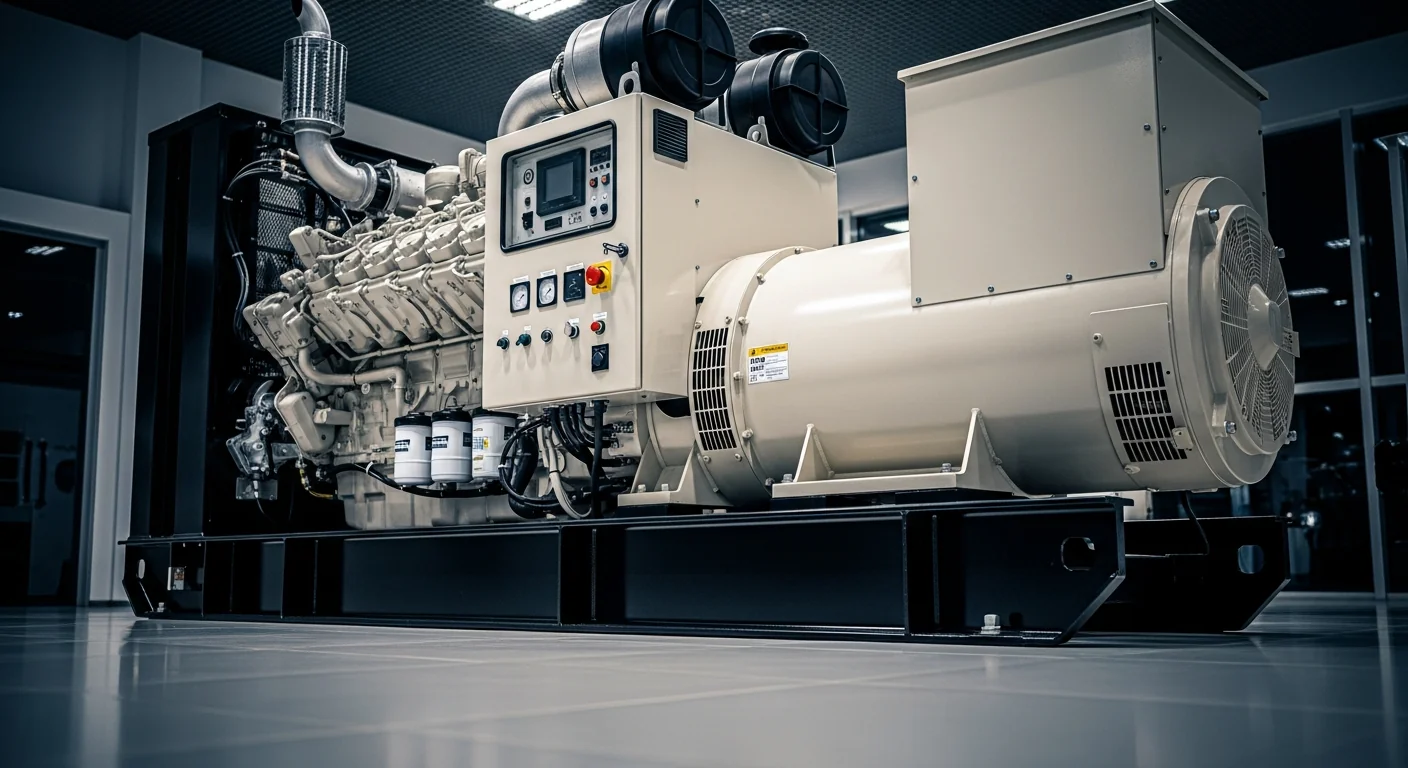
Pricing transparency separates serious buyers from tire-kickers. Diesel generators for sale range from $3,000 for portable 5-10kW units to $200,000+ for industrial 500kW+ systems. According to recent dealer data, a 30kW Kohler generator with dual automatic transfer switches runs approximately $41,000 fully installed.
Used diesel generator for sale pricing typically runs 30-50% below new equivalents, but financing gets tricky. Most lenders cap financed equipment at 10 years old or 5,000 engine hours. Beyond those limits, you're looking at 20-30% down payments minimum, assuming approval at all. Chinese-manufactured or off-brand units face even tougher lending standards—Caterpillar, Cummins, and John Deere equipment qualifies for captive financing programs that often beat bank rates.
The hidden costs nobody mentions can add $8,000-$15,000 to your project budget. OSHA compliance requirements alone—grounding systems, carbon monoxide detection, lockout/tagout procedures—can run $2,000-$8,000 depending on your facility. OSHA penalties for serious violations range from $1,190 to $16,550, with willful violations reaching $165,514. Installation and electrical work typically add $3,000-$10,000, while transfer switches for seamless power switching cost $2,000-$8,000.
Advertised rates and actual APR often differ by 2-4 percentage points once you factor in origination fees, documentation charges, and end-of-term costs. Here's what qualified borrowers actually pay:
A-Tier credit (700+ FICO score, 2+ years in business, strong financials): 6-10% APR with 10-15% down payment. These borrowers often qualify for SBA 7(a) loans up to $5,000,000 at even lower rates, though approval takes 30-60 days versus 24-48 hours for conventional equipment loans.
B-Tier credit (600-699 FICO, established business, adequate cash flow): 10-14% APR with 15-20% down payment. Most mainstream lenders target this segment, creating healthy competition that keeps rates reasonable.
Startup or challenged credit (under 600 FICO, less than 2 years operating, limited financials): 12-18% APR with 20-50% down payment. SBA Microloans up to $50,000 can provide an alternative path with lower down payment requirements.
Used equipment over 7 years old faces additional restrictions regardless of credit quality. Many lenders simply won't finance generators beyond 10 years or 5,000 hours, forcing buyers toward shorter-term loans or higher down payments.
Rental dependency is where contractors leak serious money. A 75kW diesel generator rents for approximately $2,300 per month from major providers. That same unit purchased for $39,500 and financed at 9.99% APR over 60 months costs $841 monthly—a $1,459 monthly difference.
The breakeven analysis gets compelling fast. At rental rates of $2,300 monthly, you hit purchase price equivalency in just 17 months. Factor in Section 179 tax savings—$13,825 at the 35% bracket on a $39,500 generator—and your effective financing cost drops to approximately $610 monthly, cutting breakeven to 12-15 months.
Industrial generator for sale opportunities often make even stronger financial sense. A 200kW unit renting for $1,000 daily ($4,333 monthly based on 22-day work months) versus ownership at $1,800-2,200 financed creates obvious value for any operation requiring power more than 6-8 months annually.
Renting makes sense only for short-term projects under 3 months, one-time events, or situations where you lack storage and maintenance capabilities. Beyond that, you're essentially financing someone else's equipment.
Section 179 deductions represent the single largest financial advantage of generator ownership that most buyers completely ignore. According to IRS Publication 946, the 2026 deduction limit is $2,560,000, allowing businesses to deduct the full purchase price of qualifying diesel generators in the year placed in service.
The tax savings are substantial and immediate:
- $23,900 generator: $5,975 savings at 25% bracket, $7,648 at 32% bracket, $8,365 at 35% bracket
- $33,500 generator: $8,375 savings at 25% bracket, $10,720 at 32% bracket, $11,725 at 35% bracket
- $56,899 generator: $14,225 at 25% bracket, $18,208 at 32% bracket, $19,915 at 35% bracket
For corporations, every dollar spent on qualifying diesel generators returns 21 cents in immediate tax savings at the 21% corporate rate. This liquidity multiplier means a $56,899 generator has an effective cost of just $44,950 after first-year tax recovery.
Bonus depreciation adds another layer of savings. For 2026, qualifying equipment receives an additional 20% first-year deduction on any remaining basis after Section 179. Note that this rate decreases annually—it was 40% in 2025 and remains at 100% in 2027 under OBBB, creating urgency for purchases.
The tax benefits apply whether you pay cash or finance, making the financing versus cash decision purely about opportunity cost and cash flow management.
Used portable diesel generator for sale listings often look like bargains until you hit financing roadblocks. Age and engine hours matter more than condition for most lenders. The typical restrictions:
Equipment under 5 years with fewer than 2,000 engine hours: Treated like new equipment with standard down payments (10-15%) and competitive rates.
Equipment 5-7 years old with 2,000-5,000 hours: Slightly higher rates (add 0.5-1%) and down payments (15-20%), but still broadly financeable.
Equipment over 7 years or 5,000+ hours: Many lenders exit this market entirely. Those that remain typically require 25-50% down and rates 2-4% above new equipment.
Brand significantly impacts financing availability. Caterpillar, Cummins, Kohler, and John Deere units benefit from manufacturer captive financing programs and stronger resale values. Chinese or off-brand equipment faces limited lender options and higher rates across all age categories.Documentation requirements scale with deal size. Under $75,000 typically requires only a simple application, recent bank statements, and driver's license with 24-48 hour approval. $75,000-$250,000 adds tax returns and financial statements with 3-7 day approval timelines. Over $250,000 requires comprehensive financial packages and 7-14 day underwriting.
OSHA workplace safety standards add significant post-purchase costs that buyers rarely budget properly. Key requirements include lockout/tagout procedures, proper grounding and bonding, carbon monoxide monitoring systems, adequate ventilation, and comprehensive safety signage and training documentation.
The financial stakes are serious. OSHA penalties range from $1,190-$16,550 for serious violations and up to $165,514 for willful or repeat violations. A single citation for improper grounding or inadequate CO detection can cost more than many buyers spend on the generator itself.
EPA emission compliance varies by application and location. New units must meet EPA Tier 4 Final standards in most applications, while existing units may need upgrades or permits depending on local air quality regulations. Healthcare facilities and data centers face additional UL listing requirements and IEEE standards for critical power systems.
Insurance requirements for financed generators typically add $500-$2,000 annually depending on unit value and application. Lenders require comprehensive coverage throughout the loan term, and premiums must be paid before funding disbursement.
The traditional equipment financing process forces you to shop lender by lender, often getting rejected because you applied to the wrong specialist. EquipFlow flips this model—instead of you hunting for lenders, competing lenders compete for your business.
Ava, our AI advisor, analyzes your specific equipment needs, business profile, and financing requirements. Whether you're targeting a used 50kW Caterpillar unit or a new 200kW Cummins system, Ava identifies which lenders in our network specialize in your equipment type and credit profile. This prevents the common mistake of applying to lenders who reject generators over 7 years old or don't understand diesel equipment depreciation curves.
Within 24 hours, Ava matches you with 3-4 lenders who actively compete for diesel generator deals. When lenders know they're competing, rates typically drop 0.5-2 percentage points compared to single-lender applications. This competition pressure is especially powerful for used equipment, where rate spreads between lenders can exceed 4%.
You'll receive detailed proposals showing APR, monthly payments, down payment requirements, and total cost over the life of each loan. This transparency lets you see exactly how a 48-month term at 8.5% compares to a 60-month term at 9.2%—both in monthly cash flow and total interest paid.
Once you select the best offer, that lender handles underwriting, documentation, and funding. You maintain control throughout the process with zero obligation to accept any offer. Most qualified applicants close within 7-14 business days from initial application to equipment delivery.
The traditional equipment financing process forces you to shop lender by lender, often getting rejected because you applied to the wrong specialist. EquipFlow flips this model—instead of you hunting for lenders, competing lenders compete for your business.
Ava, our AI advisor, analyzes your specific equipment needs, business profile, and financing requirements. Whether you're targeting a used 50kW Caterpillar unit or a new 200kW Cummins system, Ava identifies which lenders in our network specialize in your equipment type and credit profile. This prevents the common mistake of applying to lenders who reject generators over 7 years old or don't understand diesel equipment depreciation curves.
Within 24 hours, Ava matches you with 3-4 lenders who actively compete for diesel generator deals. When lenders know they're competing, rates typically drop 0.5-2 percentage points compared to single-lender applications. This competition pressure is especially powerful for used equipment, where rate spreads between lenders can exceed 4%.
You'll receive detailed proposals showing APR, monthly payments, down payment requirements, and total cost over the life of each loan. This transparency lets you see exactly how a 48-month term at 8.5% compares to a 60-month term at 9.2%—both in monthly cash flow and total interest paid.
Once you select the best offer, that lender handles underwriting, documentation, and funding. You maintain control throughout the process with zero obligation to accept any offer. Most qualified applicants close within 7-14 business days from initial application to equipment delivery.
The traditional equipment financing process forces you to shop lender by lender, often getting rejected because you applied to the wrong specialist. EquipFlow flips this model—instead of you hunting for lenders, competing lenders compete for your business.
Ava, our AI advisor, analyzes your specific equipment needs, business profile, and financing requirements. Whether you're targeting a used 50kW Caterpillar unit or a new 200kW Cummins system, Ava identifies which lenders in our network specialize in your equipment type and credit profile. This prevents the common mistake of applying to lenders who reject generators over 7 years old or don't understand diesel equipment depreciation curves.
Within 24 hours, Ava matches you with 3-4 lenders who actively compete for diesel generator deals. When lenders know they're competing, rates typically drop 0.5-2 percentage points compared to single-lender applications. This competition pressure is especially powerful for used equipment, where rate spreads between lenders can exceed 4%.
You'll receive detailed proposals showing APR, monthly payments, down payment requirements, and total cost over the life of each loan. This transparency lets you see exactly how a 48-month term at 8.5% compares to a 60-month term at 9.2%—both in monthly cash flow and total interest paid.
Once you select the best offer, that lender handles underwriting, documentation, and funding. You maintain control throughout the process with zero obligation to accept any offer. Most qualified applicants close within 7-14 business days from initial application to equipment delivery.
The traditional approach—calling banks individually or relying on dealer financing—leaves money on the table and limits your options. EquipFlow's lender competition model consistently delivers better outcomes for diesel generator buyers.
When 3-4 lenders compete for the same diesel generator deal, rates typically drop 0.5-2 percentage points compared to single-lender applications. This competition effect is particularly strong for used equipment financing, where rate spreads between lenders can exceed 4%. On a $50,000 generator, a 1.5% rate reduction saves approximately $4,200 over a 60-month term.
Most business owners don't realize that banks reject 67% of equipment loans for generators over 7 years old—but Ava does. She identifies lenders who specialize in diesel equipment, understand depreciation curves, and maintain active programs for your specific brand and vintage. This prevents wasted applications and improves approval odds significantly.
Every day without backup power represents risk to your operation. Equipment failures, storm seasons, and grid instability don't wait for lengthy approval processes. Ava's matching system delivers qualified lender responses within 24-48 hours for deals under $75,000, and 3-7 business days for larger transactions.
You're under zero obligation to accept any financing options for your diesel generator. Compare terms, rates, and structures from multiple lenders, then choose the option that best fits your cash flow and business objectives. This low-pressure approach lets you make informed decisions without sales pressure or rushed commitments.
The traditional approach—calling banks individually or relying on dealer financing—leaves money on the table and limits your options. EquipFlow's lender competition model consistently delivers better outcomes for diesel generator buyers.
When 3-4 lenders compete for the same diesel generator deal, rates typically drop 0.5-2 percentage points compared to single-lender applications. This competition effect is particularly strong for used equipment financing, where rate spreads between lenders can exceed 4%. On a $50,000 generator, a 1.5% rate reduction saves approximately $4,200 over a 60-month term.
Most business owners don't realize that banks reject 67% of equipment loans for generators over 7 years old—but Ava does. She identifies lenders who specialize in diesel equipment, understand depreciation curves, and maintain active programs for your specific brand and vintage. This prevents wasted applications and improves approval odds significantly.
Every day without backup power represents risk to your operation. Equipment failures, storm seasons, and grid instability don't wait for lengthy approval processes. Ava's matching system delivers qualified lender responses within 24-48 hours for deals under $75,000, and 3-7 business days for larger transactions.
You're under zero obligation to accept any financing options for your diesel generator. Compare terms, rates, and structures from multiple lenders, then choose the option that best fits your cash flow and business objectives. This low-pressure approach lets you make informed decisions without sales pressure or rushed commitments.
The traditional approach—calling banks individually or relying on dealer financing—leaves money on the table and limits your options. EquipFlow's lender competition model consistently delivers better outcomes for diesel generator buyers.
When 3-4 lenders compete for the same diesel generator deal, rates typically drop 0.5-2 percentage points compared to single-lender applications. This competition effect is particularly strong for used equipment financing, where rate spreads between lenders can exceed 4%. On a $50,000 generator, a 1.5% rate reduction saves approximately $4,200 over a 60-month term.
Most business owners don't realize that banks reject 67% of equipment loans for generators over 7 years old—but Ava does. She identifies lenders who specialize in diesel equipment, understand depreciation curves, and maintain active programs for your specific brand and vintage. This prevents wasted applications and improves approval odds significantly.
Every day without backup power represents risk to your operation. Equipment failures, storm seasons, and grid instability don't wait for lengthy approval processes. Ava's matching system delivers qualified lender responses within 24-48 hours for deals under $75,000, and 3-7 business days for larger transactions.
You're under zero obligation to accept any financing options for your diesel generator. Compare terms, rates, and structures from multiple lenders, then choose the option that best fits your cash flow and business objectives. This low-pressure approach lets you make informed decisions without sales pressure or rushed commitments.
The traditional approach—calling banks individually or relying on dealer financing—leaves money on the table and limits your options. EquipFlow's lender competition model consistently delivers better outcomes for diesel generator buyers.
When 3-4 lenders compete for the same diesel generator deal, rates typically drop 0.5-2 percentage points compared to single-lender applications. This competition effect is particularly strong for used equipment financing, where rate spreads between lenders can exceed 4%. On a $50,000 generator, a 1.5% rate reduction saves approximately $4,200 over a 60-month term.
Most business owners don't realize that banks reject 67% of equipment loans for generators over 7 years old—but Ava does. She identifies lenders who specialize in diesel equipment, understand depreciation curves, and maintain active programs for your specific brand and vintage. This prevents wasted applications and improves approval odds significantly.
Every day without backup power represents risk to your operation. Equipment failures, storm seasons, and grid instability don't wait for lengthy approval processes. Ava's matching system delivers qualified lender responses within 24-48 hours for deals under $75,000, and 3-7 business days for larger transactions.
You're under zero obligation to accept any financing options for your diesel generator. Compare terms, rates, and structures from multiple lenders, then choose the option that best fits your cash flow and business objectives. This low-pressure approach lets you make informed decisions without sales pressure or rushed commitments.
.png)