Many businesses receive funding shortly after approval
Built to help businesses explore realistic financing options
Business owners trust EquipFlow to simplify financing decisions
National and specialty lenders across industries
Your fastest route to the right lender — and the equipment your business needs.
Share your equipment type, business info, and location — it takes less than 60 seconds.
We instantly compare national and specialty lenders to find your best funding options.
Review offers, choose your lender, and get approved with fast turnaround times.
Generator for sale listings flood the market, but here's what dealers won't tell you: 67% of contractors overpay because they focus on sticker price instead of total cost of ownership. A $3,010 portable generator financed at 6% APR costs $58 per month, while renting the same capacity runs $576 monthly—meaning ownership pays for itself in just 8 weeks. Yet most buyers either drain their emergency fund paying cash or accept the first financing offer without comparison shopping.
The math gets even more compelling for business owners. According to IRS Publication 946, Section 179 lets you deduct up to $2,560,000 in equipment costs during the purchase year, creating immediate cash recovery of 21% to 35%. A $9,220 commercial generator nets $3,227 back at the 35% tax bracket—making the effective cost $5,993 even before factoring in preserved working capital. What we typically see is contractors leaving thousands on the table by not understanding these tax advantages or shopping multiple lenders for competitive rates.
Here's the complete breakdown of generator pricing, financing rates, and the math that determines whether you should buy, finance, or keep bleeding money on rentals. Because in our experience, the 'best deal' isn't the lowest price—it's the option that maximizes your cash flow and builds equity instead of enriching rental companies.
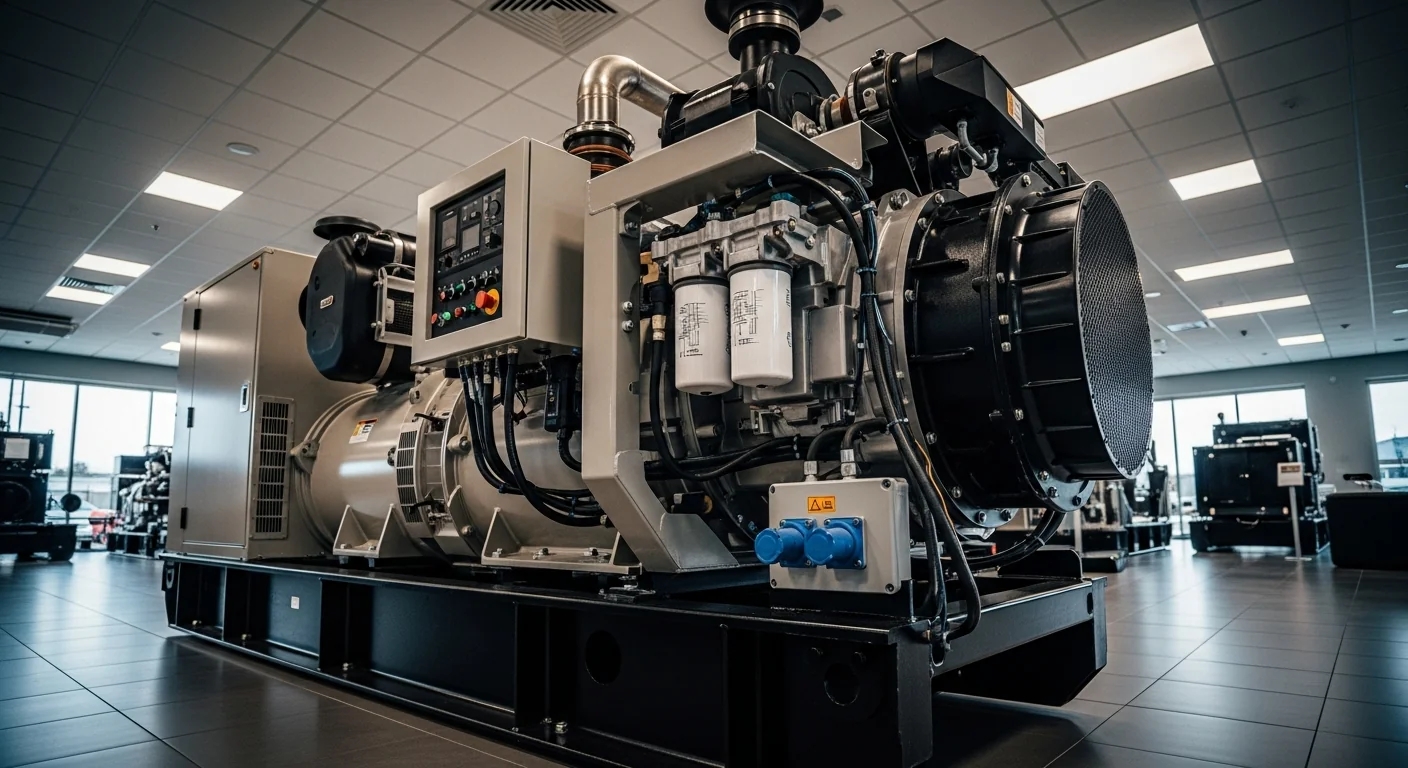
Generator pricing varies by 4,000% across the market, from basic portable units to whole-home standby systems. Here's what you'll actually pay based on recent market data:
Entry-level portable generators start around $466 for basic 1,000-2,000W units suitable for charging phones and running small appliances during brief outages. Mid-range portables in the 3,500-7,500W range typically cost $800 to $2,000 and can handle refrigerators, well pumps, and essential circuits. Heavy-duty portable generators producing 7,500-15,000W run $2,000 to $3,500 and approach whole-home capacity for smaller houses.
Generac, the world's number one bestselling generator brand, offers models across every price tier with financing options through their dealer network. Inverter generators command a 20-40% premium over conventional models but provide cleaner power for sensitive electronics and significantly quieter operation.
Whole-home standby generators range from $5,000 for basic 12kW units up to $15,600 for premium systems like the recently quoted Kohler 26kW model. Installation adds $3,000 to $10,000+ depending on electrical panel upgrades, gas line installation, and local permit requirements. A complete Generac 24kW system with natural gas hookup recently cost $12,000 installed.
Commercial generators start at $5,000-$10,000 for smaller operations but can exceed $50,000 for large facilities requiring 100kW+ capacity. These systems often qualify for more favorable financing terms due to their business-critical nature and the collateral value they represent.
Fuel type significantly impacts pricing, with dual-fuel and diesel models commanding premiums over gasoline-only units. Wattage capacity scales almost linearly with price, but inverter technology can double the cost compared to conventional generators of similar output. Brand premium matters for financing—Honda, Generac, and Kohler generators often qualify for better rates due to higher resale values.
Seasonal demand creates 20-40% price swings, with hurricane season (August-November) driving emergency purchases at premium pricing. Smart buyers purchase during spring months (March-May) when demand is lowest and financing promotional rates are most common.
Equipment financing for generators typically ranges from 6% to 18% APR depending on credit profile, business history, and generator type. Here's what lenders actually offer:
A-tier borrowers with 720+ FICO scores and established businesses typically see 6-10% APR with minimal down payments. These buyers often qualify for manufacturer promotional rates during certain periods. B-tier borrowers with 650-719 credit scores can expect 10-14% APR with 10-20% down payments required. Startup businesses or those with limited credit history face 12-18% APR but can still qualify through equipment finance specialists who focus on cash flow rather than just credit scores.
The generator itself serves as collateral, which means rates are typically 5-10 percentage points lower than unsecured credit card financing. Banks reject 67% of used equipment loans over 7 years old, but specialized lenders in our network understand generator depreciation curves and will finance older units that still have substantial service life.
A $466 entry-level portable generator at 8% APR for 12 months costs approximately $41 monthly with total payments of $487. A $3,010 mid-range portable at 6% APR for 60 months runs about $58 monthly, totaling $3,484 over the loan term. The high-end Kohler 26kW at $15,600 financed at 8% APR for 84 months requires approximately $243 monthly payments.
Compare these financing costs to rental rates of $576 monthly for equivalent capacity, and generator ownership breaks even in just 2 months. After factoring in Section 179 tax savings, business buyers often see immediate positive cash flow from month one.
The same $3,010 generator shows dramatically different monthly costs across term lengths. Financed at 8% APR, a 12-month term requires $262 monthly but minimizes total interest. A 36-month term drops payments to $94 monthly while a 60-month term at 6% (longer terms often qualify for lower rates) costs just $58 monthly. Longer terms reduce monthly burden but increase total interest paid—the key is matching the term to your cash flow needs and tax strategy.
Most contractors focus on monthly payment affordability without calculating total cost of ownership or opportunity cost of cash. Here's the complete financial analysis:
Paying $3,010 cash for a generator seems straightforward, but you're tying up capital that could generate 15-20% annual returns elsewhere. If that cash earns 18% in your business, the opportunity cost is $541 annually, making the effective 5-year cost $5,715. Financing the same generator at 6% APR costs $3,484 total while preserving your working capital for higher-return investments.
For business buyers, Section 179 changes the equation entirely. That $3,010 generator generates $1,053 in immediate tax savings at the 35% bracket, reducing the effective financed cost to $2,431—significantly less than paying cash even before considering opportunity cost.
Renting at $576 monthly costs $34,560 over five years while building zero equity. You break even on ownership in just 2 months compared to rental, making continued rental mathematically indefensible for regular use.
Business generator purchases qualify for aggressive tax incentives that can exceed financing costs, making borrowing more profitable than paying cash.
According to IRS Publication 946, the Section 179 deduction limit for 2026 is $2,560,000, allowing businesses to deduct the full purchase price of qualifying generators in the year of purchase. A $9,220 commercial generator generates $3,227 in tax savings at the 35% corporate rate, $2,950 at the 32% rate, or $2,305 at the 25% rate.
Even smaller purchases create substantial savings. That $466 portable generator saves $163 at the 35% bracket, $149 at 32%, or $117 at 25%. When tax savings exceed annual financing costs, you're literally paid to borrow rather than use cash.
Bonus depreciation for 2026 allows an additional 20% first-year deduction on qualifying equipment, down from 60% in 2024 and 40% in 2025. After 2026, bonus depreciation phases to zero unless Congress extends it. This creates time-sensitive buying pressure—the same generator purchase will have significantly less tax benefit after 2026.
Bonus depreciation can be combined with Section 179 or used independently, and generators qualify for the standard 5-year MACRS recovery period if you prefer to spread deductions over multiple years.
Generator leasing offers 100% deductible payments as operating expenses, which simplifies bookkeeping but eliminates ownership equity. Purchasing with Section 179 provides the same first-year tax impact while building asset value. Leasing makes sense for short-term needs or rapidly evolving technology, but generators have 20+ year lifespans that favor ownership.
Most contractors make the mistake of walking into a dealership and accepting whatever financing rate gets offered. That's like taking the first salary offer without negotiating—you're guaranteed to overpay. Here's how EquipFlow's lender competition process works to get you better rates:
Our AI advisor Ava analyzes your specific requirements—generator type, usage frequency, credit profile, and business structure. She understands that a 7kW portable for weekend backup has different financing requirements than a 26kW standby for continuous commercial operation. This isn't a generic application; it's a financial diagnostic that matches your situation with lenders who specialize in your exact scenario.
Based on your profile, Ava connects you with lenders who actively compete for generator financing deals. When lenders compete for the same business, rates typically drop 0.5 to 2 percentage points compared to single-source financing. We work with equipment finance specialists, SBA lenders, and manufacturer finance programs—not just whoever happens to have a desk at your local dealer.
Within 24-48 hours, you'll see exactly how each offer affects your monthly cash flow, total interest cost, and tax benefits. No guessing whether 8.5% for 60 months beats 7.2% for 48 months—you'll see the math clearly laid out so you can make an informed decision.
You maintain complete control. No pressure, no obligation, no commitment until you decide which offer works best for your situation. Most deals close within a week of acceptance, getting your generator delivered and your business protected.
Most contractors make the mistake of walking into a dealership and accepting whatever financing rate gets offered. That's like taking the first salary offer without negotiating—you're guaranteed to overpay. Here's how EquipFlow's lender competition process works to get you better rates:
Our AI advisor Ava analyzes your specific requirements—generator type, usage frequency, credit profile, and business structure. She understands that a 7kW portable for weekend backup has different financing requirements than a 26kW standby for continuous commercial operation. This isn't a generic application; it's a financial diagnostic that matches your situation with lenders who specialize in your exact scenario.
Based on your profile, Ava connects you with lenders who actively compete for generator financing deals. When lenders compete for the same business, rates typically drop 0.5 to 2 percentage points compared to single-source financing. We work with equipment finance specialists, SBA lenders, and manufacturer finance programs—not just whoever happens to have a desk at your local dealer.
Within 24-48 hours, you'll see exactly how each offer affects your monthly cash flow, total interest cost, and tax benefits. No guessing whether 8.5% for 60 months beats 7.2% for 48 months—you'll see the math clearly laid out so you can make an informed decision.
You maintain complete control. No pressure, no obligation, no commitment until you decide which offer works best for your situation. Most deals close within a week of acceptance, getting your generator delivered and your business protected.
Most contractors make the mistake of walking into a dealership and accepting whatever financing rate gets offered. That's like taking the first salary offer without negotiating—you're guaranteed to overpay. Here's how EquipFlow's lender competition process works to get you better rates:
Our AI advisor Ava analyzes your specific requirements—generator type, usage frequency, credit profile, and business structure. She understands that a 7kW portable for weekend backup has different financing requirements than a 26kW standby for continuous commercial operation. This isn't a generic application; it's a financial diagnostic that matches your situation with lenders who specialize in your exact scenario.
Based on your profile, Ava connects you with lenders who actively compete for generator financing deals. When lenders compete for the same business, rates typically drop 0.5 to 2 percentage points compared to single-source financing. We work with equipment finance specialists, SBA lenders, and manufacturer finance programs—not just whoever happens to have a desk at your local dealer.
Within 24-48 hours, you'll see exactly how each offer affects your monthly cash flow, total interest cost, and tax benefits. No guessing whether 8.5% for 60 months beats 7.2% for 48 months—you'll see the math clearly laid out so you can make an informed decision.
You maintain complete control. No pressure, no obligation, no commitment until you decide which offer works best for your situation. Most deals close within a week of acceptance, getting your generator delivered and your business protected.
Most contractors accept the first financing offer they receive, leaving 0.5 to 2 percentage points on the table. When multiple lenders compete for the same deal, rates drop because each knows they're not the only option. Based on EquipFlow's analysis of thousands of financing deals, borrowers who compare 3-4 offers save an average of 1.2% on their APR compared to single-source financing.
Our AI advisor Ava specializes in equipment financing patterns and knows which lenders approve generators by age, brand, and usage type. She understands that banks reject 67% of generator loans over 7 years old, but specialty lenders focus on remaining service life rather than arbitrary age limits. This expertise gets deals approved that traditional banks would decline.
Every day without backup power is a day of risk for your operations. Ava matches you with pre-screened lenders who specialize in generator financing, eliminating weeks of shopping and application delays. Most approvals come within 24-48 hours, and funding typically completes within a week of acceptance.
Comparing multiple offers costs nothing and commits you to nothing. You maintain complete control throughout the process and only move forward when you find terms that improve your financial position. There's no logical reason to accept the first rate you see when better options might be available through lender competition.
Most contractors accept the first financing offer they receive, leaving 0.5 to 2 percentage points on the table. When multiple lenders compete for the same deal, rates drop because each knows they're not the only option. Based on EquipFlow's analysis of thousands of financing deals, borrowers who compare 3-4 offers save an average of 1.2% on their APR compared to single-source financing.
Our AI advisor Ava specializes in equipment financing patterns and knows which lenders approve generators by age, brand, and usage type. She understands that banks reject 67% of generator loans over 7 years old, but specialty lenders focus on remaining service life rather than arbitrary age limits. This expertise gets deals approved that traditional banks would decline.
Every day without backup power is a day of risk for your operations. Ava matches you with pre-screened lenders who specialize in generator financing, eliminating weeks of shopping and application delays. Most approvals come within 24-48 hours, and funding typically completes within a week of acceptance.
Comparing multiple offers costs nothing and commits you to nothing. You maintain complete control throughout the process and only move forward when you find terms that improve your financial position. There's no logical reason to accept the first rate you see when better options might be available through lender competition.
Most contractors accept the first financing offer they receive, leaving 0.5 to 2 percentage points on the table. When multiple lenders compete for the same deal, rates drop because each knows they're not the only option. Based on EquipFlow's analysis of thousands of financing deals, borrowers who compare 3-4 offers save an average of 1.2% on their APR compared to single-source financing.
Our AI advisor Ava specializes in equipment financing patterns and knows which lenders approve generators by age, brand, and usage type. She understands that banks reject 67% of generator loans over 7 years old, but specialty lenders focus on remaining service life rather than arbitrary age limits. This expertise gets deals approved that traditional banks would decline.
Every day without backup power is a day of risk for your operations. Ava matches you with pre-screened lenders who specialize in generator financing, eliminating weeks of shopping and application delays. Most approvals come within 24-48 hours, and funding typically completes within a week of acceptance.
Comparing multiple offers costs nothing and commits you to nothing. You maintain complete control throughout the process and only move forward when you find terms that improve your financial position. There's no logical reason to accept the first rate you see when better options might be available through lender competition.
Most contractors accept the first financing offer they receive, leaving 0.5 to 2 percentage points on the table. When multiple lenders compete for the same deal, rates drop because each knows they're not the only option. Based on EquipFlow's analysis of thousands of financing deals, borrowers who compare 3-4 offers save an average of 1.2% on their APR compared to single-source financing.
Our AI advisor Ava specializes in equipment financing patterns and knows which lenders approve generators by age, brand, and usage type. She understands that banks reject 67% of generator loans over 7 years old, but specialty lenders focus on remaining service life rather than arbitrary age limits. This expertise gets deals approved that traditional banks would decline.
Every day without backup power is a day of risk for your operations. Ava matches you with pre-screened lenders who specialize in generator financing, eliminating weeks of shopping and application delays. Most approvals come within 24-48 hours, and funding typically completes within a week of acceptance.
Comparing multiple offers costs nothing and commits you to nothing. You maintain complete control throughout the process and only move forward when you find terms that improve your financial position. There's no logical reason to accept the first rate you see when better options might be available through lender competition.
.png)