
Many businesses receive funding shortly after approval
Built to help businesses explore realistic financing options
Business owners trust EquipFlow to simplify financing decisions
National and specialty lenders across industries
Your fastest route to the right lender — and the equipment your business needs.
Share your equipment type, business info, and location — it takes less than 60 seconds.
We instantly compare national and specialty lenders to find your best funding options.
Review offers, choose your lender, and get approved with fast turnaround times.
A skid steer guide covers everything from choosing the right machine size (rated operating capacities range from 728 to 4,200 lbs) to understanding how to finance, operate, and maintain these versatile loaders for maximum return on investment. Whether you're a first-time buyer, a seasoned contractor evaluating buy vs. rent, or a startup navigating challenging credit, this guide maps every decision—from the $20,000 small-frame units to $80,000+ large-frame machines—with current 2026 financing rates, tax strategies, safety requirements, and brand-by-brand depreciation data you won't find anywhere else.
Here's what most contractors don't realize: your bank won't touch a seven-year-old skid steer—and the average used unit on the market right now is exactly 7.5 years old. That means the most common equipment purchase contractors make is the one traditional lenders are least willing to finance. But here's the math that changes everything: at $967/month financed versus $4,500-$5,400/month rented, ownership breaks even in under 12 months. Factor in Section 179 tax deductions that can put $10,500+ back in your pocket in Year 1 alone, and suddenly that "high" interest rate becomes irrelevant.
The mistake 90% of buyers make is shopping for equipment first and financing second. Smart operators understand that financing strategy determines which machines they can afford, which lenders will approve them, and how much they'll actually pay after taxes. This guide gives you that roadmap—with real numbers, not sales pitches.
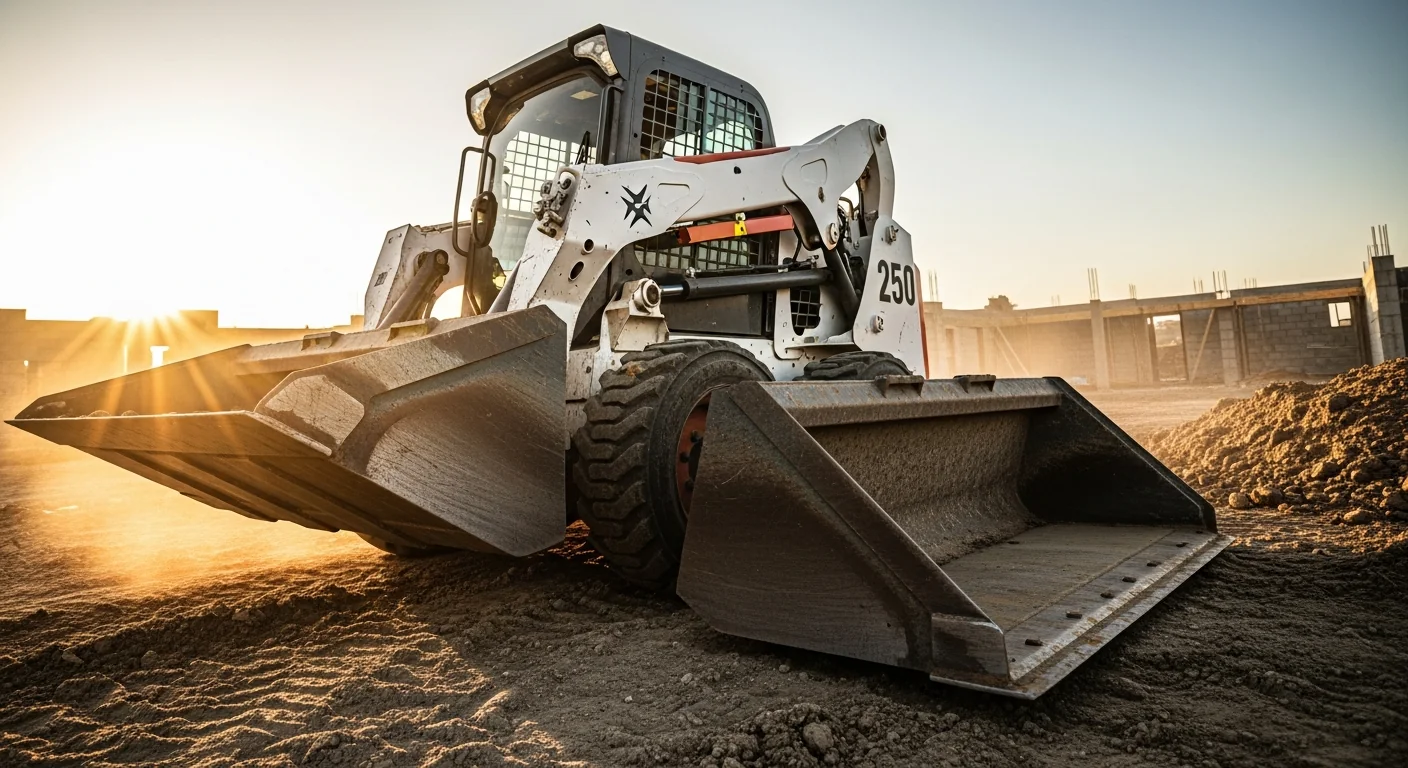
Skid steer loaders earned their name from their steering mechanism—skidding the wheels on one side while the other side drives forward, creating a zero-radius turn. Bobcat invented the concept over 60 years ago, and today these compact powerhouses handle everything from demolition and grading to snow removal and material handling.
The numbers tell the story: over 100,000 contractors currently operate skid steers, making them the most versatile piece of compact construction equipment in North America. But here's what's changed—compact track loaders (CTLs) now represent 80% of the combined skid steer/CTL market, up from minority share just a decade ago. The rubber tracks provide better flotation on soft ground and distribute weight more evenly, but wheeled units still dominate on hard surfaces where speed and maneuverability matter more than ground pressure.
Skid steers range from ultra-compact units like the Kato AS12 (728 lbs rated operating capacity) to monsters like the GEHL V420 (4,200 lbs ROC). Operating weights span 2,892 to 11,665 pounds, with engine power from 21 hp to 120 hp. Width varies from 35.5 inches for tight-access work to 84 inches for maximum stability.
Most popular capacity is 2,700 lbs ROC—the sweet spot for general construction and landscaping work. But understanding these size classes is critical because your financing strategy changes dramatically at each tier. Small-frame units under $35,000 can qualify for SBA Microloans up to $50,000 through nonprofit intermediary lenders. Mid-frame machines hit the sweet spot for traditional equipment loans. Large-frame units may benefit from SBA 7(a) loans up to $5,000,000 or SBA 504 loans up to $5,500,000 for major fleet purchases.
Here's the math most dealers won't show you upfront. That $50,000 mid-frame skid steer doesn't actually cost $50,000 when you factor in Section 179 tax deductions and financing structure.
According to IRS Publication 946, businesses can deduct the full purchase price of qualifying skid steers in the year placed in service, up to the 2026 limit of $2,560,000. For a $50,000 machine at the 21% corporate tax rate, you're looking at $10,500 in immediate Year 1 tax savings. Your net cash outlay drops to $39,500—a 21% liquidity multiplier that reduces your effective purchase price.
But the tax story gets even better. The One Big Beautiful Bill Act (OBBBA), signed July 4, 2025, restored 100% bonus depreciation for property acquired and placed in service after January 19, 2025. This reversed the Tax Cuts and Jobs Act phase-down that would have dropped the rate to 20% in 2026. For businesses in higher tax brackets, the savings are substantial: $4,560 at 25% bracket, $5,837 at 32% bracket, $6,384 at 35% bracket on an $18,241 skid steer.
Not all skid steers hold value equally. Bobcat leads retention at 65-72% after three years, dropping to 40-48% at seven years. Caterpillar follows closely at 63-70% three-year retention. Budget brands? They're down to 48-55% after just three years and 35-42% at five years.
This matters for financing because the average used skid steer sold is 7.5 years old—right at the point where most banks stop lending. High-flow hydraulics add $5,000-$8,000 in resale value, while an enclosed cab adds $4,000-$8,000. These features aren't just comfort upgrades—they're equity protection.
The rental vs. ownership debate ends with simple math. A mid-size skid steer financed at $50,000 over 60 months at 6% APR costs approximately $967/month. Rental rates? $4,500-$5,400 monthly for the same capacity machine.
Ownership breaks even at 11-12 months. Every month after that saves you $2,800-$4,000 versus renting. Factor in annual maintenance costs of $2,000-$5,000 plus insurance of $1,200-$3,000, and you're still cash-flow positive by month 18-24. But here's the kicker—Section 179 deductions can provide $10,500-$17,500 in first-year tax savings at higher brackets, accelerating the payback to under 8 months.
Renting only makes financial sense if you're using the machine less than 500 hours per year or need it for a single short-duration project under three months. Beyond that, you're building zero equity while hemorrhaging cash flow.
Here's what lenders actually charge in 2026, broken down by credit tier and time in business:
A-Tier Borrowers (700+ credit score, 2+ years in business): 6.5-9.5% APR with 0-10% down payment required. These borrowers can access captive finance programs from Bobcat Financial, Cat Financial, and John Deere Financial, often with promotional rates.
B-Tier Borrowers (620-699 credit, 1-2 years in business): 9.5-14% APR with 10-15% down payment. Most traditional equipment lenders operate in this space, but you'll pay 1-3 percentage points more for used equipment.
Startup/Challenged Credit (under 620 credit, less than 1 year in business): 12-18% APR with 15-25% down payment minimum. Subprime equipment lenders specialize in this market, but the cost escalates quickly.
Most banks cap equipment age at 7-10 years, but the average used skid steer on the market is exactly 7.5 years old. This creates a financing gap that specialized lenders fill—at a premium. Expect to pay 1-3 percentage points more for used versus new, and 20%+ down payment regardless of credit tier.
The alternative path? SBA Microloans up to $50,000 through nonprofit intermediary lenders have more flexible qualification criteria for smaller machines. For larger purchases, SBA 7(a) loans offer up to $5,000,000 with competitive rates and longer terms. You can also explore skid steer financing options tailored to your credit profile and business needs.
Under OSHA standard 29 CFR 1926.602, operators must receive training on material handling equipment. Training is required, but certification isn't—though many lenders and insurance companies prefer documented training programs. OSHA penalties for non-compliance run up to $16,550 for serious violations and $165,514 for willful or repeat violations.Compliance affects your financing in two ways: lenders may require proof of operator training as a loan condition, and insurance premiums decrease with documented training programs. Non-compliance violations create lien risk on financed equipment, so smart operators build training costs into their equipment budgets.
Three trends are reshaping the skid steer market. First, size polarization—growth at both ends with 100+ hp/4,000+ lbs ROC large machines and ultra-compact low-profile units for tight spaces. The 75-hp class remains America's most popular, but extremes are gaining share.
Second, electrification is real but niche. Electric compact loaders hold over 50% market share in Europe but less than 5% in North America. Firstgreen's Elise series (700/900/1200 models) offers swappable batteries and zero emissions, but higher upfront costs limit adoption to specific applications.
Third, technology integration is accelerating. Bobcat's Jobsite Companion AI voice command system debuted at CES 2026 with obstacle and people detection. John Deere's Surround View provides 270-degree stitched camera views, while 8-inch touchscreens are becoming standard across manufacturers. These features add to purchase price but also boost resale value and operator productivity.
Getting stuck with one bank's "take it or leave it" offer is exactly why contractors overpay for equipment financing. When lenders compete for your deal, rates typically drop 0.5-2 percentage points. Here's how we make that happen:
Our AI advisor needs to know three things: the skid steer you're targeting (new vs. used, size class, approximate price), your business profile (time in business, revenue range, credit tier), and your preferred deal structure (loan vs. lease, down payment preference). This takes 3-4 minutes and helps Ava identify which lenders actually finance your specific situation. No credit check at this stage—just matching.
Ava doesn't just throw your application at random banks. She knows which lenders finance used equipment over 7 years old, which ones work with startups, and which captive finance companies (Bobcat Financial, Cat Financial) offer the most aggressive new equipment rates. When lenders know they're competing, they lead with their best terms.
Within 24-48 hours, you'll see exactly how each offer affects your cash flow, tax situation, and total cost of ownership. No guessing whether 8% over 60 months beats 6.5% over 48 months—you'll see the math. We also factor in manufacturer incentives like Kubota's current 0% APR programs on select models.
You control the process. No pressure, no obligation to accept any offer. Once you choose, the lender handles documentation and funding directly. Most deals close within 5-7 business days of acceptance.
Getting stuck with one bank's "take it or leave it" offer is exactly why contractors overpay for equipment financing. When lenders compete for your deal, rates typically drop 0.5-2 percentage points. Here's how we make that happen:
Our AI advisor needs to know three things: the skid steer you're targeting (new vs. used, size class, approximate price), your business profile (time in business, revenue range, credit tier), and your preferred deal structure (loan vs. lease, down payment preference). This takes 3-4 minutes and helps Ava identify which lenders actually finance your specific situation. No credit check at this stage—just matching.
Ava doesn't just throw your application at random banks. She knows which lenders finance used equipment over 7 years old, which ones work with startups, and which captive finance companies (Bobcat Financial, Cat Financial) offer the most aggressive new equipment rates. When lenders know they're competing, they lead with their best terms.
Within 24-48 hours, you'll see exactly how each offer affects your cash flow, tax situation, and total cost of ownership. No guessing whether 8% over 60 months beats 6.5% over 48 months—you'll see the math. We also factor in manufacturer incentives like Kubota's current 0% APR programs on select models.
You control the process. No pressure, no obligation to accept any offer. Once you choose, the lender handles documentation and funding directly. Most deals close within 5-7 business days of acceptance.
Getting stuck with one bank's "take it or leave it" offer is exactly why contractors overpay for equipment financing. When lenders compete for your deal, rates typically drop 0.5-2 percentage points. Here's how we make that happen:
Our AI advisor needs to know three things: the skid steer you're targeting (new vs. used, size class, approximate price), your business profile (time in business, revenue range, credit tier), and your preferred deal structure (loan vs. lease, down payment preference). This takes 3-4 minutes and helps Ava identify which lenders actually finance your specific situation. No credit check at this stage—just matching.
Ava doesn't just throw your application at random banks. She knows which lenders finance used equipment over 7 years old, which ones work with startups, and which captive finance companies (Bobcat Financial, Cat Financial) offer the most aggressive new equipment rates. When lenders know they're competing, they lead with their best terms.
Within 24-48 hours, you'll see exactly how each offer affects your cash flow, tax situation, and total cost of ownership. No guessing whether 8% over 60 months beats 6.5% over 48 months—you'll see the math. We also factor in manufacturer incentives like Kubota's current 0% APR programs on select models.
You control the process. No pressure, no obligation to accept any offer. Once you choose, the lender handles documentation and funding directly. Most deals close within 5-7 business days of acceptance.
Getting stuck with your bank's first offer is the most expensive mistake contractors make. When lenders compete for your business, you win—period.
Lenders competing for the same deal typically drop rates 0.5-2 percentage points versus their standard published rates. That's $1,800-$7,200 in savings on a $50,000 loan over five years. We connect you with 3-4 specialized lenders who know they're competing, so they lead with their best terms from day one.
Our AI advisor specializes in equipment financing patterns. She knows that banks reject 67% of used equipment loans over 7 years old, but she also knows which independent lenders and captive finance companies will approve those deals. Ava matches your specific situation—equipment age, credit profile, down payment capacity—with lenders who actually want your business.
Every day without equipment costs money. Whether you're missing project deadlines or paying rental fees, speed matters. Ava can match you with competing lenders within 24 hours, with initial approval decisions in 24-48 hours. Most deals close within 5-7 business days of acceptance—fast enough to capture time-sensitive opportunities.
You control the entire process. Compare multiple offers, negotiate terms, or walk away—entirely your choice. No obligation to accept any financing offer means you can explore your options without commitment. We only succeed when you find financing that actually works for your business.
Getting stuck with your bank's first offer is the most expensive mistake contractors make. When lenders compete for your business, you win—period.
Lenders competing for the same deal typically drop rates 0.5-2 percentage points versus their standard published rates. That's $1,800-$7,200 in savings on a $50,000 loan over five years. We connect you with 3-4 specialized lenders who know they're competing, so they lead with their best terms from day one.
Our AI advisor specializes in equipment financing patterns. She knows that banks reject 67% of used equipment loans over 7 years old, but she also knows which independent lenders and captive finance companies will approve those deals. Ava matches your specific situation—equipment age, credit profile, down payment capacity—with lenders who actually want your business.
Every day without equipment costs money. Whether you're missing project deadlines or paying rental fees, speed matters. Ava can match you with competing lenders within 24 hours, with initial approval decisions in 24-48 hours. Most deals close within 5-7 business days of acceptance—fast enough to capture time-sensitive opportunities.
You control the entire process. Compare multiple offers, negotiate terms, or walk away—entirely your choice. No obligation to accept any financing offer means you can explore your options without commitment. We only succeed when you find financing that actually works for your business.
Getting stuck with your bank's first offer is the most expensive mistake contractors make. When lenders compete for your business, you win—period.
Lenders competing for the same deal typically drop rates 0.5-2 percentage points versus their standard published rates. That's $1,800-$7,200 in savings on a $50,000 loan over five years. We connect you with 3-4 specialized lenders who know they're competing, so they lead with their best terms from day one.
Our AI advisor specializes in equipment financing patterns. She knows that banks reject 67% of used equipment loans over 7 years old, but she also knows which independent lenders and captive finance companies will approve those deals. Ava matches your specific situation—equipment age, credit profile, down payment capacity—with lenders who actually want your business.
Every day without equipment costs money. Whether you're missing project deadlines or paying rental fees, speed matters. Ava can match you with competing lenders within 24 hours, with initial approval decisions in 24-48 hours. Most deals close within 5-7 business days of acceptance—fast enough to capture time-sensitive opportunities.
You control the entire process. Compare multiple offers, negotiate terms, or walk away—entirely your choice. No obligation to accept any financing offer means you can explore your options without commitment. We only succeed when you find financing that actually works for your business.
Getting stuck with your bank's first offer is the most expensive mistake contractors make. When lenders compete for your business, you win—period.
Lenders competing for the same deal typically drop rates 0.5-2 percentage points versus their standard published rates. That's $1,800-$7,200 in savings on a $50,000 loan over five years. We connect you with 3-4 specialized lenders who know they're competing, so they lead with their best terms from day one.
Our AI advisor specializes in equipment financing patterns. She knows that banks reject 67% of used equipment loans over 7 years old, but she also knows which independent lenders and captive finance companies will approve those deals. Ava matches your specific situation—equipment age, credit profile, down payment capacity—with lenders who actually want your business.
Every day without equipment costs money. Whether you're missing project deadlines or paying rental fees, speed matters. Ava can match you with competing lenders within 24 hours, with initial approval decisions in 24-48 hours. Most deals close within 5-7 business days of acceptance—fast enough to capture time-sensitive opportunities.
You control the entire process. Compare multiple offers, negotiate terms, or walk away—entirely your choice. No obligation to accept any financing offer means you can explore your options without commitment. We only succeed when you find financing that actually works for your business.
.png)


